
Edgar Degas had exhibited at the Salon …
Years: 1866 - 1866
Edgar Degas had exhibited at the Salon for the first time in 1865, when the jury accepted his painting Scene of War in the Middle Ages, which attracted little attention.
The painting is arguably his most curious composition, in which nine female nudes are shot, or are being shot at, by fifteenth-century mounted archers who ride stirrupless, with the horses’ harnesses barely sketched in.
Degas was born in Paris, France, the oldest of five children of Célestine Musson De Gas, a Creole from New Orleans, and Augustin De Gas, a banker.
The family was moderately wealthy.
Degas' mother had died when he was thirteen, after which his father and grandfather were the main influences on his early life.
At age eleven, Degas (in adulthood he will abandon the more pretentious spelling of the family name) had begun his schooling with enrollment in the Lycée Louis-le-Grand, graduating in 1853 with a baccalauréat in literature.
Degas had begun to paint early in life.
By the age of eighteen, he had turned a room in his home into an artist's studio, and in 1853 he had registered as a copyist in the Louvre.
His father, however, had expected him to go to law school.
Degas had duly enrolled at the Faculty of Law of the University of Paris in November 1853, but made little effort at his studies.
In 1855, Degas had met Jean Auguste Dominique Ingres, whom he revered, and whose advice he will never forget: "Draw lines, young man, and still more lines, both from life and from memory, and you will become a good artist." (Werner, Alfred (1969) Degas Pastels. New York: Watson-Guptill. p. 14)
In April of that same year, Degas had received admission to the École des Beaux-Arts, where he studied drawing with Louis Lamothe, under whose guidance he had flourished, following the style of Ingres.
In July 1856, Degas had traveled to Italy, where he remains for the next three years.
In 1858, while staying with his aunt's family in Naples, he had made the first studies for his early masterpiece, The Bellelli Family.
He also drew and painted numerous copies after Michelangelo, Raphael, Titian, and other artists of the Renaissance but, contrary to conventional practice, he usually selected from an altarpiece a detail that had caught his attention—a secondary figure, or a head which he treated as a portrait.
Upon his return to France in 1859, Degas had moved into a Paris studio large enough to permit him to begin painting The Bellelli Family—an imposing canvas he intensed for exhibition in the Salon, although it will remain unfinished until 1867.
He also began work on several history paintings: Alexander and Bucephalus and The Daughter of Jephthah in 1859–60; Sémiramis Building Babylon in 1860; and Young Spartans around 1860.
In 1861, Degas had visited his childhood friend Paul Valpinçon in Normandy, and had made the earliest of his many studies of horses.
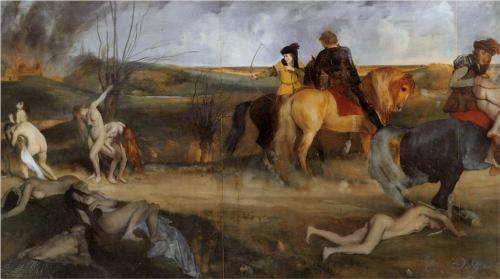
Edgar Degas: Scene of War in the Middle Ages (1865) oil on canvas, 85 x 147 cm; Musée d'Orsay, Paris, France
Locations
People
Groups
Topics
Subjects
Regions
Subregions
Related Events
Showing 10 events out of 13367 total
Years: 1866 - 1866
Edgar Degas: Scene of War in the Middle Ages (1865) oil on canvas, 85 x 147 cm; Musée d'Orsay, Paris, France
Locations
People
Groups
Topics
Subjects
Regions
Subregions