
Edward receives the formal submissions, all in …
Years: 920 - 920
Edward receives the formal submissions, all in the year 920, of Raegnald, the Irish-Norse king of York; Ealdred, ruler of English Northumbria; the Welsh king of Strathclyde; and (possibly) Constantine II of Scotland.
Locations
People
- Andronikos III Palaiologos
- Constantine of Scotland
- Ealdred of Northumbria
- Edward the Elder
- Ottir
- Ragnall ua Ímair
Groups
- Britons (historical)
- Saxons
- Irish people
- Anglo-Saxons
- Wessex, English Kingdom of
- Britain, Medieval
- Vikings
- Ireland, medieval
- Scottish people
- Alba (Scotland), Scots Kingdom of
- Strathclyde, British Kingdom of
- York, Scandinavian (Norse)
Topics
Commodoties
Subjects
Regions
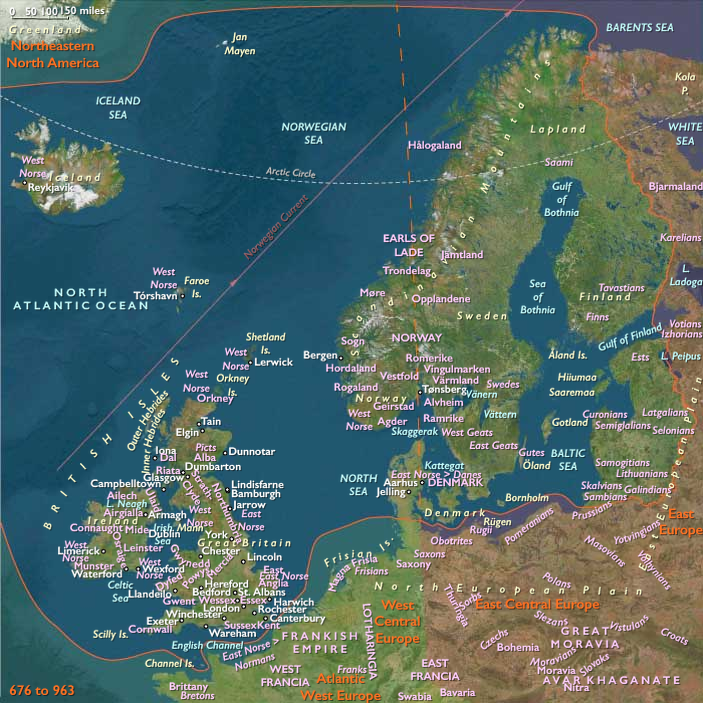
Subregions
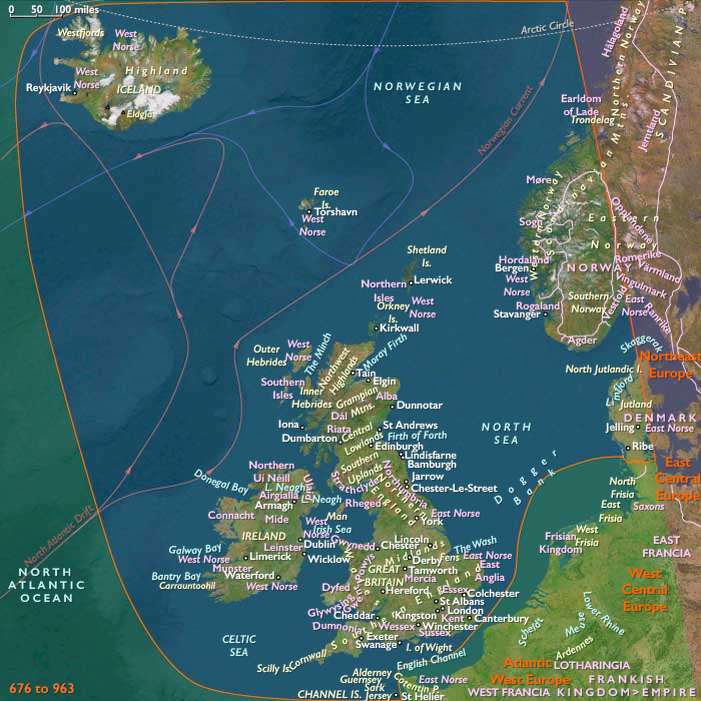
Related Events
Filter results
Showing 10 events out of 13 total
The Revival of the Ducal Title in Aquitaine (890s–927)
During the late 9th and early 10th centuries, the once-unified Duchy of Aquitaine, which had been fragmented following the decline of Carolingian power, is revived as a political entity by Count William the Pious of Auvergne.
William the Pious and the Reestablishment of the Duchy of Aquitaine (890s)
- William the Pious (d. 918), Count of Auvergne, is the first to assume the title of Duke of Aquitaine, effectively recreating the duchy in the 890s.
- His control over large parts of central and southern Francia, including Auvergne, Limousin, and Poitou, gives him the power base needed to assert dominance over Aquitaine.
- Though still nominally under the West Frankish king, William governs independently, a sign of the weakening of royal authority.
- His most enduring legacy is the founding of Cluny Abbey in 910, a landmark moment in medieval monastic reform.
The Transfer of the Ducal Title to the Counts of Poitiers (927)
- After William’s death in 918, his successor, William II (the Younger), Duke of Aquitaine, continues his rule but dies in 927 without a direct heir.
- With William II’s death, the title passes to the Count of Poitiers, who now inherits the Duchy of Aquitaine, further consolidating power under the House of Poitiers.
Significance of the Ducal Transition
-
The House of Poitiers Gains Dominance
- The transfer of the ducal title to the Poitevin counts establishes their long-term rule over Aquitaine, lasting for centuries.
-
Aquitaine as a Semi-Independent Duchy
- Under Poitevin leadership, Aquitaine continues to function as a de facto independent entity, though still technically part of West Francia.
-
The Weakening of Royal Power in Southern France
- The revival of the duchy outside royal control demonstrates the continued decentralization of West Francia, as local rulers gain autonomy at the expense of the monarchy.
Conclusion: The Foundations of Poitevin Rule in Aquitaine
The title of Duke of Aquitaine, first assumed by William the Pious, passes to the Poitevin counts in 927, marking the formal beginning of their long rule over the region. This transition reinforces Aquitaine’s autonomy, setting the stage for its later power struggles with the Capetian monarchy, culminating in its pivotal role in medieval France and England.
Atlantic West Europe (928–939): Dynastic Realignments and Rising Regional Powers
From 928 to 939, Atlantic West Europe experienced significant dynastic shifts, deepened fragmentation of royal authority, and the consolidation of regional principalities, particularly in Normandy, Aquitaine, Burgundy, Anjou, and Flanders. Political instability persisted, but economic recovery and cultural growth were increasingly evident.
Political and Military Developments
-
West Francia: Continued Fragmentation
- King Rudolph of Burgundy (r. 923–936) struggled to assert royal authority, facing powerful regional magnates. Upon his death, Louis IV ("d'Outremer"), son of the exiled Charles the Simple, returned from England to claim the throne (936), attempting to restore Carolingian legitimacy amidst growing noble independence.
-
Normandy: Establishment of Ducal Authority
- William Longsword (r. 927–942), son of Rollo, succeeded in consolidating Normandy’s internal governance, securing stronger territorial control and building diplomatic relationships with neighboring Frankish lords, notably marrying into Breton nobility.
-
Aquitaine: Strengthened Ducal Autonomy
- Ebalus Manzer (r. 927–935) and William III ("Towhead") (r. 935–963) maintained internal cohesion in Aquitaine, preserving regional autonomy and promoting stability through patronage of religious institutions and strategic alliances.
-
Flanders and Anjou: Territorial Consolidation
- Arnulf I of Flanders (r. 918–965) further strengthened his control, fortifying key cities such as Ghent and Bruges, enhancing their economic and strategic positions in the region.
- Fulk I ("the Red") of Anjou (r. 898–942) continued aggressive expansion along the Loire Valley, establishing a foundation for future Angevin prominence.
-
Burgundian Realignments
- Rudolph II, King of Upper Burgundy, extended his influence into northern Italy (931), briefly combining the crowns of Upper Burgundy and Italy. Upon his death (937), regional power dynamics shifted as his son Conrad succeeded him, focusing more inwardly on Burgundian affairs.
Economic and Social Developments
-
Urban and Commercial Growth
- Economic activity expanded significantly, notably in Flanders (Bruges, Ghent) and Normandy (Rouen), where strengthened political stability and maritime trade enhanced commercial vitality.
- Agricultural expansion continued across central France and Aquitaine, supporting population growth and early urbanization.
-
Integration and Cultural Fusion
- In Normandy, Norse settlers integrated further, blending culturally with local Franks, enhancing economic productivity and social cohesion.
Religious and Cultural Developments
-
Expansion of Cluniac Reform
- The Cluniac monastic reform continued to spread rapidly, influencing religious life across Aquitaine, Burgundy, and the Loire Valley, advocating spiritual renewal and ecclesiastical autonomy from secular control.
-
Monastic Scholarship and Education
- Monastic centers, notably Tours, Cluny, and Auxerre, expanded their educational role, preserving classical knowledge and fostering early scholastic developments.
Legacy and Significance
By 939, Atlantic West Europe had witnessed:
- Continued erosion of centralized Carolingian authority, increasingly replaced by independent regional principalities in Normandy, Flanders, Aquitaine, Burgundy, and Anjou.
- Solidified regional identities and political structures, setting the stage for later medieval geopolitical configurations.
- Strengthened economic recovery and trade expansion, particularly in maritime and agricultural economies.
- Growing cultural dynamism driven by monastic reform and intellectual revival, laying essential foundations for the cultural renaissance of the High Middle Ages.
These developments collectively reinforced the regional principalities that characterized Atlantic West Europe’s trajectory into the mid and late medieval periods.
The Struggle for Aquitaine: Ebalus, King Rudolph, and the Power Shift in the South (927–932)
After the death of Duke Acfred of Aquitaine in 927, his chosen heir, Ebalus (or Ebles Manzer), an illegitimate son of Ranulf II of Aquitaine, assumes control over the Duchy of Aquitaine, the Counties of Berry, Auvergne, and Velay. However, his hold on power is soon challenged by King Rudolph of West Francia, who seeks to curb Ebalus’ influence in the south.
Ebalus Becomes Duke of Aquitaine (928)
- Acfred of Aquitaine dies in 927, leaving his titles to Ebalus, whom William the Pious had protected.
- In 928, Ebalus formally assumes power, taking control of:
- Duchy of Aquitaine
- County of Auvergne
- County of Berry
- County of Velay
King Rudolph’s Efforts to Diminish Ebalus’ Power (929–932)
1. Loss of Berry (929)
- In 929, King Rudolph of Burgundy, seeing Ebalus as too powerful, begins to limit his authority by removing Berry from his control.
- This move signals the king’s intent to weaken the Ramnulfid dynasty (the ruling family of Poitou and Aquitaine) and assert royal influence in the south.
2. Transfer of Aquitaine and Auvergne to Raymond Pons of Toulouse (932)
- In 932, Rudolph strips Ebalus of his ducal title and grants it instead to Raymond Pons, Count of Toulouse.
- Raymond Pons travels north, accompanied by:
- His brother Ermengol of Rouergue.
- Sancho IV, Duke of Gascony.
- They perform homage to King Rudolph, solidifying their royal allegiance and shifting the balance of power against Ebalus.
3. La Marche Becomes an Independent County
- To further weaken Ebalus, Rudolph creates the County of La Marche, removing it from Ebalus' vassal, the Lord of Charroux, and making it an independent entity.
Unexpected Outcome: Strengthening the Ramnulfid Dynasty
- Despite these land transfers, Rudolph’s strategy does not yield the expected results.
- Rather than eliminating Ebalus, Rudolph soon finds himself cooperating with him in fighting against Viking incursions.
- This military alliance reinforces the Ramnulfid position, ensuring that Ebalus remains a significant force in Aquitaine.
- The struggle for supremacy between the Ramnulfids and the House of Rouergue (Raymond Pons’ family) continues for decades, reflecting the fragmented political landscape of southern France.
Conclusion: The Fragile Balance of Power in Aquitaine
The events of 929–932 demonstrate the continued decline of royal authority in West Francia, as King Rudolph fails to impose lasting control over the south. Though he transfers titles away from Ebalus, the reality of feudal power ensures that the Ramnulfid dynasty remains a dominant force, highlighting the limits of royal influence in an increasingly decentralized kingdom.
William III of Aquitaine: A Struggle for Recognition and Power (935–962)
William III of Aquitaine, son of Ebalus Manzer and Emilienne, was born in Poitiers and inherited his father’s claim to the Duchy of Aquitaine in 935. However, despite his effective rule over the region, his ducal title was not formally recognized by the royal chancery until 962, just a year before his death.
William’s Claim to Aquitaine (935)
- Upon the death of Ebalus Manzer in 935, William asserts control over Aquitaine, though West Frankish royal authority remains weak in the south.
- However, his rule is not immediately recognized by the royal chancery, likely due to ongoing power struggles between the monarchy and feudal lords.
Conflict with Hugh the Great (936)
- Following the death of King Rudolph in 936, the new king, Louis IV (d'Outremer), begins asserting royal authority over feudal lords.
- Under pressure from Hugh the Great, one of the most powerful nobles in West Francia, Louis compels William to forfeit some lands to Hugh.
- Though William yields without open conflict, this act sours relations between him and Hugh, leading to continued tension.
William’s Long Struggle for Ducal Recognition
- Despite ruling as Duke of Aquitaine in practice, William’s ducal title is not officially recognized by the monarchy until 962, almost three decades later.
- This reflects the fragmentation of West Francia, where regional rulers exercised real power but lacked immediate royal validation.
Consequences of William’s Rule
-
Aquitaine Remains Semi-Independent
- Even without immediate royal recognition, William’s rule ensures that Aquitaine remains autonomous from the central monarchy.
-
Tensions with the Robertians
- His deteriorating relations with Hugh the Great and his successors underscore the struggle between regional lords and the West Frankish monarchy.
-
Feudal Decentralization Continues
- William’s delayed ducal recognition shows the declining influence of the Carolingian kings, as nobles increasingly govern independently of royal authority.
Conclusion: A Duke in All But Name
William III of Aquitaine’s claim to power in 935 and his belated recognition in 962 illustrate the political reality of feudal France, where noble power outweighed royal legitimacy. His struggles against Hugh the Great and the monarchy exemplify the shift toward regional autonomy, setting the stage for Aquitaine’s continued prominence in medieval France.
Atlantic West Europe (940–951): Consolidation of Regional Powers and Cultural Revival
From 940 to 951, Atlantic West Europe experienced continued fragmentation of centralized royal authority accompanied by the consolidation of powerful regional principalities, notably in Normandy, Aquitaine, Flanders, Burgundy, and Anjou. Political rivalries deepened, while economic growth and monastic reform fostered a significant cultural revival.
Political and Military Developments
-
West Francia: Royal Authority in Decline
- Louis IV ("d'Outremer") (r. 936–954) faced persistent challenges from powerful nobles, notably Hugh the Great, Duke of the Franks, significantly limiting royal control. Louis engaged in continual struggles to reassert his authority with mixed success.
-
Normandy: Stability and Integration
- Under Richard I ("the Fearless") (r. 942–996), Normandy stabilized politically, blending Norse traditions with Frankish culture. Richard strengthened ties with local nobility, secured internal cohesion, and expanded Normandy's economic and military influence.
-
Aquitaine: Ducal Autonomy Strengthened
- William III ("Towhead") (r. 935–963) solidified ducal control, fostering regional stability through strategic alliances with local lords and ecclesiastical patronage, ensuring Aquitaine's enduring independence from royal oversight.
-
Flanders and Anjou: Expanded Influence
- Arnulf I of Flanders (r. 918–965) continued fortifying key Flemish cities like Ghent and Bruges, enhancing their economic vitality and strategic position.
- Fulk II ("the Good") of Anjou (r. 942–960) reinforced Angevin territorial control through warfare, diplomacy, and strategic marriages, significantly expanding his domain along the Loire.
-
Burgundy: Dynastic Stabilization
- Conrad I ("the Peaceful"), king of Burgundy (r. 937–993), secured internal stability through diplomatic alliances, notably strengthened by marital ties and strategic political arrangements, laying the foundations for regional prosperity.
Economic and Social Developments
-
Maritime and Commercial Expansion
- Trade flourished significantly in Flanders and Normandy, bolstered by strategic coastal ports like Bruges, Ghent, and Rouen, which became centers for North Sea and Atlantic commerce.
-
Agricultural and Urban Growth
- Increased agricultural productivity continued throughout central France, Aquitaine, and Burgundy, supporting population growth and urbanization. Towns emerged as vibrant centers of local trade and artisanal production.
Religious and Cultural Developments
-
Cluniac Reform and Ecclesiastical Influence
- The Cluniac reform movement expanded widely, influencing monastic life and church organization throughout Burgundy, Aquitaine, and the Loire Valley. This reform emphasized monastic purity, independence from secular authority, and spiritual renewal.
-
Cultural and Intellectual Renaissance
- Major monastic schools in Tours, Auxerre, and Cluny flourished, promoting the study of classical texts and early scholastic thought, significantly shaping medieval intellectual and cultural life.
Legacy and Significance
By 951, Atlantic West Europe had witnessed:
- Firm establishment and increased autonomy of regional principalities such as Normandy, Aquitaine, Flanders, Anjou, and Burgundy at the expense of weakened Carolingian royal power.
- Economic growth driven by maritime trade and agricultural expansion, fostering urbanization and regional prosperity.
- A cultural and intellectual renaissance, largely influenced by monastic reform movements, enhancing the region's scholarly reputation and laying the groundwork for future intellectual developments.
These political realignments, economic expansions, and cultural advancements defined Atlantic West Europe’s trajectory into the High Middle Ages.
Atlantic West Europe (952–963): Regional Dominance and the Emergence of Capetian Power
From 952 to 963, Atlantic West Europe continued to evolve politically, economically, and culturally. Regional rulers solidified their domains amid weakening royal authority, paving the way for the rise of the Capetian dynasty, while economic growth and monastic reforms further enriched the cultural landscape.
Political and Military Developments
-
West Francia: Prelude to Capetian Ascendancy
- The reign of Lothair (r. 954–986) began amid ongoing fragmentation, challenged by powerful nobles such as Hugh the Great, Duke of the Franks, who extended his influence in the north, setting the stage for Capetian rule.
- Upon Hugh the Great’s death in 956, his son, Hugh Capet, inherited significant territorial and political influence, foreshadowing the shift toward a new royal dynasty.
-
Normandy: Consolidation of Ducal Power
- Richard I ("the Fearless") (r. 942–996) further secured Normandy’s independence and territorial integrity. He strengthened alliances through marriage and diplomacy, ensuring stability and economic prosperity.
-
Aquitaine: Stability under William Towhead
- Duke William III ("Towhead") (r. 935–963) maintained firm control of Aquitaine, fostering internal peace, promoting cultural patronage, and resisting external interference from royal authorities, solidifying Aquitaine’s autonomy.
-
Flanders and Anjou: Continued Expansion
- Arnulf I of Flanders (r. 918–965) bolstered his realm's economic power through trade, fortifying key urban centers such as Bruges and Ghent, further establishing Flanders as a vibrant commercial hub.
- Fulk II ("the Good") of Anjou (r. 942–960) effectively expanded his territory along the Loire Valley, strengthening Angevin political dominance and laying the foundation for future growth under his descendants.
-
Burgundy: Stable Kingship under Conrad
- Conrad I ("the Peaceful"), king of Burgundy (r. 937–993), maintained peace and prosperity in Upper Burgundy (Kingdom of Arles), emphasizing diplomatic and familial alliances, providing stable leadership throughout the region.
Economic and Social Developments
-
Maritime and Commercial Growth
- Trade flourished, especially in Normandy and Flanders, with Rouen, Bruges, and Ghent thriving as important centers for regional commerce, facilitating extensive trade networks across Northern and Western Europe.
-
Agricultural Productivity and Urban Expansion
- Improvements in agriculture led to surplus production and population growth, supporting urbanization across central France, Aquitaine, Burgundy, and the Low Countries. This growth stimulated local markets and artisanal industries.
Religious and Cultural Developments
-
Cluniac and Monastic Reform Movements
- The Cluniac reforms gained widespread adoption, significantly influencing monastic life and spiritual renewal in Aquitaine, Burgundy, and the Loire Valley. Monasteries served as vital centers for intellectual revival, manuscript production, and religious education.
-
Early Scholasticism and Cultural Revival
- Monastic schools in Tours, Cluny, and Auxerre emerged as critical educational and intellectual hubs, preserving classical learning, encouraging scholarly debate, and cultivating the roots of early scholastic thought.
Legacy and Significance
By 963, Atlantic West Europe had experienced key transformations:
- Regional powers such as Normandy, Aquitaine, Anjou, Flanders, and Burgundy had solidified political autonomy amid declining Carolingian authority, establishing lasting patterns of territorial governance.
- Economic growth, driven by thriving commerce and agricultural expansion, facilitated significant urban and demographic developments.
- Monastic reforms and intellectual revival laid cultural and spiritual foundations for medieval European society, influencing subsequent generations.
These trends significantly shaped the region, setting the stage for the impending rise of the Capetian dynasty and the vibrant cultural and economic era that followed.
Lothair and Hugh the Great’s Failed Siege of Poitiers (955) and the Rout of William III of Aquitaine
By 955, King Lothair of West Francia, still a young ruler, seeks to assert his authority over his magnates. One of his greatest concerns is William III of Aquitaine, whose power in the south threatens royal influence. To curb William’s strength, Lothair joins forces with Hugh the Great, Duke of the Franks, and together they lay siege to Poitiers in August 955.
The Siege of Poitiers (955)
- Poitiers, the heart of William III’s power, is a well-defended stronghold.
- Lothair and Hugh launch a siege, but the city’s defenders hold out successfully, refusing to surrender.
- The siege does not achieve the desired outcome, as Poitiers remains firmly in Aquitanian hands.
The Battle and William III’s Defeat
- After the failed siege, William III gathers his forces and offers battle against Lothair and Hugh.
- In open combat, William’s forces are routed, suffering a decisive defeat.
- This setback weakens his position in Aquitaine, but he still retains control over much of his domain, as Poitiers remains unconquered.
Consequences of the 955 Campaign
-
Royal Authority Remains Weak in Aquitaine
- Despite winning the battle, Lothair and Hugh fail to subdue Poitiers, meaning William III continues to rule Aquitaine independently.
-
Hugh the Great’s Continued Dominance
- Hugh, already the most powerful noble in France, further strengthens his influence by helping to lead the campaign against William.
- His role in the battle underscores his power as the true enforcer of royal authority in the kingdom.
-
Lothair’s Struggle for Control
- Though he participates in the victory, Lothair remains reliant on Hugh, highlighting his limited authority as king.
- His inability to secure Aquitaine further proves the monarchy’s weakness in the feudalized realm of West Francia.
Conclusion: A Partial Victory, but No Lasting Gains
While Lothair and Hugh defeat William III in battle, their failure to capture Poitiers means that Aquitaine remains outside direct royal control. This event highlights the continued fragmentation of West Francia, as the great magnates continue to operate with near-total independence, leaving Lothair as a nominal king with little direct authority.
The Rise of Hugh Capet and the Fragmented Kingdom of the Franks (941–956)
Born in 941, Hugh Capet was the son of Hugh the Great, Duke of the Franks, and Hedwige of Saxony, daughter of Henry the Fowler, King of East Francia. His paternal family, the Robertians, were powerful landowners in the Île-de-France, and his lineage was deeply tied to both the Carolingians and the Ottonian rulers of the Holy Roman Empire.
Hugh Capet’s Royal and Noble Connections
- Grandson of King Robert I of West Francia.
- Great-great-great-great-grandson of Charlemagne, descended from Pepin of Italy through his grandmother Beatrice of Vermandois.
- Grandnephew of King Odo of West Francia.
- Related to the Ottonian emperors, being first cousin to Otto II of Germany.
- Son of Hugh the Great, the most powerful noble in West Francia, though he never took the crown.
Hugh the Great’s Role in the Return of Louis IV (936)
- When King Rudolph (Raoul) of Burgundy died in 936, Hugh the Great orchestrated the return of Louis IV ("d’Outremer"), son of the deposed Charles the Simple, from exile in England.
- Motives remain unclear, but possible reasons include:
- Preventing Rudolph’s brother, Hugh the Black, from claiming the throne.
- Blocking Herbert II of Vermandois or Richard the Fearless, Duke of Normandy, from taking power.
- Though he restored the Carolingian dynasty, Hugh the Great ensured his own dominance, keeping Louis IV as a weak, dependent king.
Hugh Capet Inherits Power (956)
- Hugh the Great dies in 956, leaving his vast estates to his young son, Hugh Capet.
- At the time, Hugh Capet is still a minor, so his mother, Hedwige of Saxony, acts as his guardian.
- Despite his father’s immense influence, Hugh immediately faces challenges from ambitious neighbors.
Loss of Land to Former Vassals
- Theobald I of Blois, a former vassal of Hugh the Great, seizes Chartres and Châteaudun, weakening Hugh’s control in the Loire Valley.
- Fulk II of Anjou, another former client of Hugh the Great, carves out a principality at Hugh’s expense, gaining control over key territories along the Breton border.
The Fragmentation of West Francia
Hugh Capet grows up in a much-reduced West Frankish kingdom, which looks nothing like modern France:
- The king is known as Rex Francorum ("King of the Franks"), not "King of France," a title that will only emerge under Philip II Augustus (1180–1223).
- West Francia is a weak and fragmented realm, with the king controlling only a small portion of the former Carolingian Empire.
- The Holy Roman Empire, ruled by Hugh’s first cousin Otto II and later Otto III, dominates the eastern Frankish lands.
- South of the Loire, the king’s influence is nearly nonexistent, as local rulers act independently.
- Normandy and Burgundy are virtually autonomous, with Hugh’s brothers Otto and Henry ruling Burgundy from 956.
- Brittany is entirely independent, resisting West Frankish authority.
Conclusion: The Future King of a Feudal Kingdom
As Hugh Capet comes of age, he inherits a divided and decentralized realm, where noble power surpasses royal authority. His eventual rise to the throne in 987 will mark the end of Carolingian rule and the beginning of the Capetian dynasty, setting the foundation for the Kingdom of France. However, for now, he remains a young duke in a fractured kingdom, struggling to reclaim lost lands and secure his position.
Bruno the Great: Archbishop, Duke, and Regent of West Francia (956)
Bruno the Great, the younger brother of Otto I of Germany, was not only Archbishop of Cologne (since 953) but also Duke of Lotharingia, making him one of the most powerful figures in 10th-century Europe. His dual authority as both a spiritual and secular ruler earned him the title of "Archduke," as recorded by his biographer Ruotger.
Following the deaths of King Louis IV of West Francia in 954 and Hugh the Great, Duke of the Franks, in 956, Bruno steps in as regent of West Francia, acting on behalf of his nephews:
- Lothair (b. 941), now King of West Francia, the son of Louis IV and Gerberga of Saxony (Bruno’s sister).
- Hugh Capet (b. 941), Duke of the Franks, son of Hugh the Great and Hedwige of Saxony (also Bruno’s sister).
Bruno’s Role as Regent of West Francia (956–965)
-
Maintaining Stability in West Francia
- With Lothair still a minor, Bruno serves as his regent, guiding the young Carolingian king through a period of political instability.
- He also ensures that Hugh Capet, the heir to Hugh the Great, remains a powerful noble but does not threaten the monarchy.
-
Strengthening Ottonian Influence in France
- As maternal uncle to both Lothair and Hugh Capet, Bruno’s regency extends Ottonian influence into West Francia.
- This helps Otto I’s empire maintain a balance of power over its western neighbor, preventing West Francia from falling into complete chaos.
-
Defending Lotharingia and West Francia
- As Duke of Lotharingia, Bruno ensures the stability of this contested region, preventing further West Frankish interference.
- His control over Lotharingia and West Francia places him in a unique position of influence across both realms.
Conclusion: The Most Powerful Man After Otto I
Bruno the Great’s position as both archbishop and duke made him the most powerful man after Otto I in the Holy Roman Empire and beyond. His role as regent of West Francia ensured that Ottonian control extended into France, stabilizing the Carolingian monarchy under King Lothair and managing the rising power of Hugh Capet, setting the stage for the eventual Capetian takeover of France in 987.
The Division of Lotharingia: The End of a Unified Duchy (959)
By 959, Bruno the Great, the Duke of Lotharingia and Archbishop of Cologne, makes a critical administrative decision that permanently ends the unity of Lotharingia. As one of the last dukes of the whole region, Bruno appoints two local nobles, Frederick and Godfrey, as margraves, effectively splitting the duchy into Upper and Lower Lotharingia.
Background: Lotharingia’s Shifting Allegiances
- Originally part of Middle Francia, Lotharingia had long been contested between East and West Francia since the Treaty of Meerssen (870) and the Treaty of Ribemont (880).
- It had shifted from East Francia (Germany) to West Francia (France) and back again, remaining a hotly disputed territory.
- Under Bruno’s rule, Lotharingia was stabilized as part of the Holy Roman Empire, but its vast size and strategic importance made it difficult to govern as a single duchy.
The Division of Lotharingia (959)
To ensure more effective rule, Bruno appoints:
- Frederick I as Margrave of Upper Lotharingia, later recognized as Duke of Upper Lorraine.
- Godfrey I as Margrave of Lower Lotharingia, later known as Duke of Lower Lorraine.
This administrative division is meant to improve governance and military defense but ultimately results in:
- The permanent split of Lotharingia into two distinct duchies.
- A further weakening of centralized control, as regional lords gain more autonomy.
- Continued fragmentation, making Lotharingia a battleground for German, French, and local noble interestsin the following centuries.
Legacy: The Last Duke of a United Lotharingia
- Bruno is one of the last rulers to control all of Lotharingia as a single entity.
- His decision in 959 shapes the future of the region, ensuring that Upper and Lower Lorraine evolve as separate feudal entities.
- This fragmentation reinforces feudal decentralization, marking another step toward the eventual dissolution of the Carolingian world and the rise of independent regional powers.
With Bruno’s death in 965, the once-mighty Lotharingia is permanently divided, reflecting the broader breakdown of centralized authority in medieval Europe.
Years: 920 - 920
Locations
People
- Andronikos III Palaiologos
- Constantine of Scotland
- Ealdred of Northumbria
- Edward the Elder
- Ottir
- Ragnall ua Ímair
Groups
- Britons (historical)
- Saxons
- Irish people
- Anglo-Saxons
- Wessex, English Kingdom of
- Britain, Medieval
- Vikings
- Ireland, medieval
- Scottish people
- Alba (Scotland), Scots Kingdom of
- Strathclyde, British Kingdom of
- York, Scandinavian (Norse)
Topics
Commodoties
Subjects
Regions
Subregions