
Engineers in Lothal accorded high priority to …
Years: 2061BCE - 1918BCE
Engineers in Lothal accorded high priority to the creation of a dockyard and a warehouse to serve the purposes of naval trade.
While the consensus view among archaeologists identifies this structure as a "dockyard," it has also been suggested that owing to small dimensions, this basin may have been an irrigation tank and canal.
The dock was built on the eastern flank of the town, and is regarded by archaeologists as an engineering feat of the highest order.
It was located away from the main current of the river to avoid silting, but provided access to ships in high tide as well.
The warehouse was built close to the acropolis on a 3.5 meter-high (10.5 ft) podium of mud bricks.
The rulers could thus supervise the activity on the dock and warehouse simultaneously.
A mud-brick wharf, two hundred and twenty meters (seven hundred and twenty feet) long, built on the western arm of the dock, with a ramp leading to the warehouse, facilitates the movement of cargo.
The superstructure of an important public building opposite to the warehouse has completely disappeared.
Throughout their time, the city had to brace itself through multiple floods and storms.
Dock and city peripheral walls were maintained efficiently.
The town's zealous rebuilding ensured the growth and prosperity of the trade.
However, with rising prosperity, Lothal's people failed to upkeep their walls and dock facilities, possibly because of overconfidence in their systems.
A flood of moderate intensity in 2050 BCE exposed some serious weaknesses in the structure, but the problems were not addressed properly.
The uniform organization of the town and its institutions give evidence that the Harappans were a highly disciplined people.
Commerce and administrative duties were performed according to standards laid out.
Municipal administration was strict—the width of most streets remained the same over a long time, and no encroached structures were built.
Householders possessed a sump, or collection chamber to deposit solid waste in order to prevent the clogging of city drains.
Drains, manholes, and cesspools kept the city clean and deposited the waste in the river, which was washed out during high tide.
A new provincial style of Harappan art and painting was pioneered.
The new approaches included realistic portrayals of animals in their natural surroundings.
Metalware, gold and jewelry and tastefully decorated ornaments attest to the culture and prosperity of the people of Lothal.
Most of their equipment: metal tools, weights, measures, seals, earthenware and ornaments were of the uniform standard and quality found across the Indus civilization.
Lothal was a major trade center, importing en masse raw materials like copper, chert, and semiprecious stones from Mohenjo-daro and Harappa, and mass distributing to inner villages and towns.
It also produced large quantities of bronze celts, fishhooks, chisels, spears, and ornaments.
Lothal exported its beads, gemstones, ivory, and shells.
The stone blade industry catered to domestic needs— fine chert was imported from the Sukkur valley or from Bijapur in modern Karnataka.
Bhagatrav supplied semiprecious stones while chank shell came from Dholavira and Bet Dwarka.
An intensive trade network, which stretches across the frontiers to Egypt, Bahrain, and Sumer, gives the inhabitants great prosperity.
One evidence of trade in Lothal is the discovery of typical Persian Gulf seals, a circular button seal.
Locations
Topics
Commodoties
Subjects
- Origins
- Commerce
- Symbols
- Watercraft
- Engineering
- Environment
- Decorative arts
- Anthropology
- Archaeology
Regions
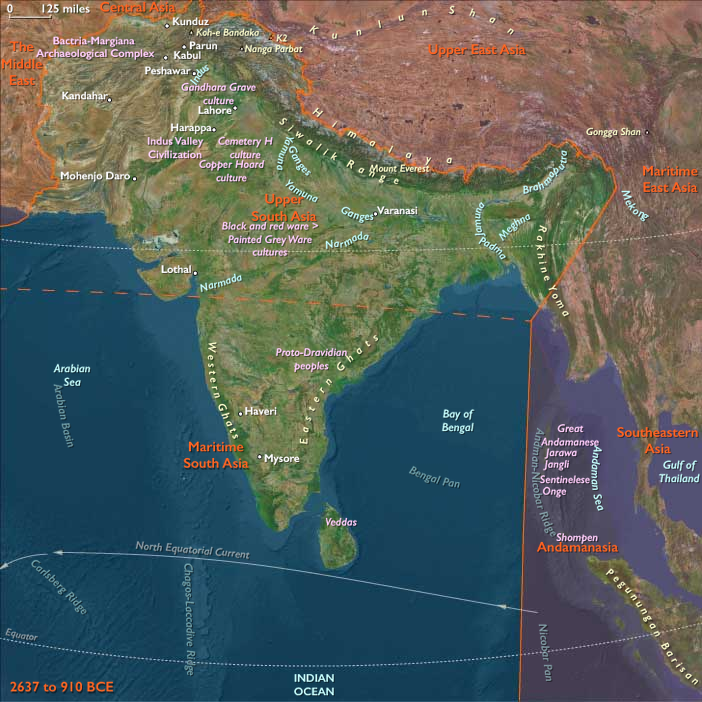
Subregions
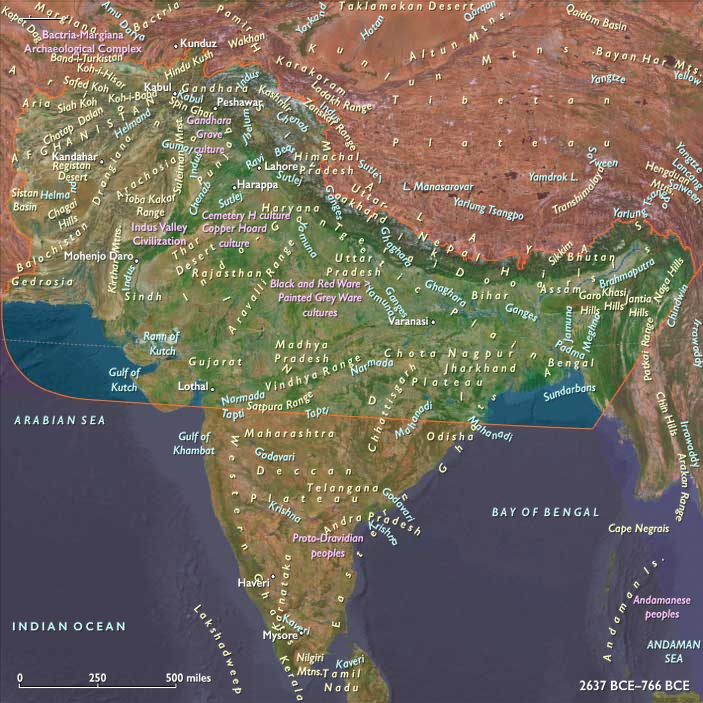
Years: 2061BCE - 1918BCE
Locations
Topics
Commodoties
Subjects
- Origins
- Commerce
- Symbols
- Watercraft
- Engineering
- Environment
- Decorative arts
- Anthropology
- Archaeology
Regions
Subregions