The Advent of Printed Music and Vernacular …
Years: 1504 - 1515
The Advent of Printed Music and Vernacular Hymnology (1511 onward)
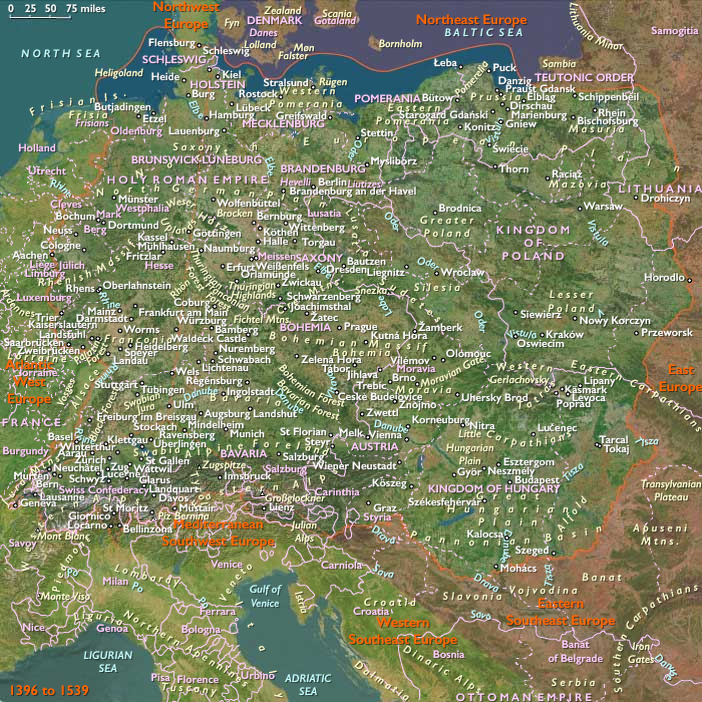
Beginning around 1511, the invention of the printing press revolutionized the dissemination of music across Atlantic West Europe, profoundly altering musical culture and religious practices. First appearing in Germany, printed music rapidly spread, democratizing access to compositions previously confined to monasteries, royal courts, and wealthy patrons.
This technological advancement quickly facilitated the rise of vernacular hymnology—the composition and dissemination of hymns in local languages rather than traditional Latin—deeply influencing devotional practices in Germany, France, and England. Hymns, now accessible to wider segments of society, became central to religious worship, education, and community identity, reinforcing the broader European trend toward vernacular literature and religious expression.
Cultural and Technological Significance:
The introduction of printed music significantly lowered barriers to musical literacy, encouraging widespread participation in devotional singing and enabling composers and poets to reach broader audiences. Hymnals and songbooks, printed in local languages, became powerful vehicles for religious instruction, personal devotion, and communal solidarity, playing a critical role in the development and spread of the Protestant Reformation.
Consequences and Legacy:
The intersection of music printing and vernacular hymnology accelerated the transformation of European religious and cultural life. Printed hymnals not only reshaped worship practices but also became instruments of cultural cohesion, identity formation, and reformist ideology. This innovation significantly influenced the course of European religious history, empowering lay participation in worship and laying critical foundations for the Reformation's religious and social transformations.
Related Events
Filter results
Showing 10 events out of 25 total
East Central Europe (1684–1827 CE): From Vienna’s Salvation to the Age of Revolutions
Geography & Environmental Context
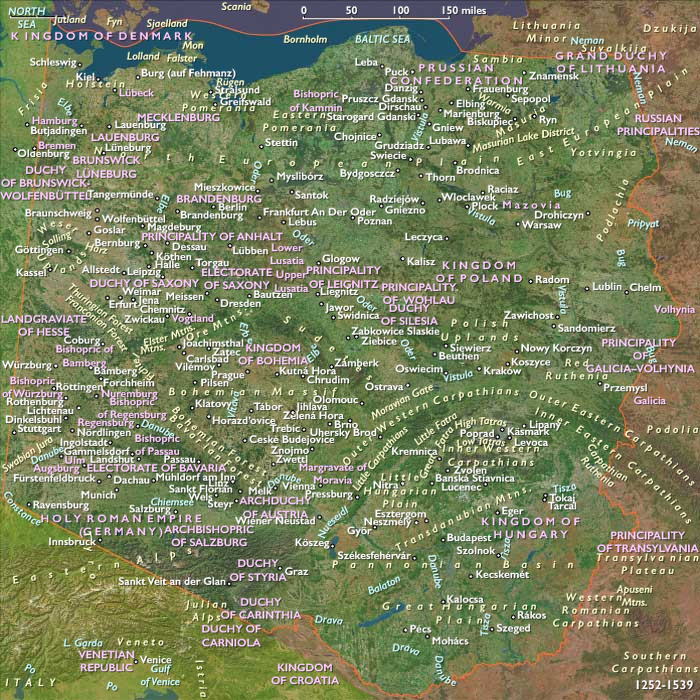
East Central Europe includes the greater part of Germany east of 10°E (Brandenburg, Saxony, Thuringia, Franconia, eastern Bavaria, Silesia), together with Bohemia and Moravia, the Austrian heartlands (Vienna, Lower and Upper Austria, Carinthia, Styria), and parts of the upper Danube basin. Anchors include the Elbe and Oder valleys, the Ore and Sudeten Mountains, the Danube corridor through Vienna, and the Vienna Woods and Alpine forelands. These landscapes connected the Holy Roman Empire’s patchwork of German states with the Habsburg monarchy’s Danubian dominion.
Climate & Environmental Shifts
The end of the Little Ice Age produced climatic instability—harsh winters (notably 1708–09, “the Great Frost”) and drought years interspersed with good harvests. Floods along the Elbe, Oder, and Danube repeatedly damaged fields and towns. The spread of the potato and clover improved food security and fodder supplies, mitigating famine after mid-century. By the early 19th century, agrarian innovation was widespread.
Subsistence & Settlement
-
Agriculture: Rye, oats, and wheat remained staples, with potatoes gradually adopted across Saxony, Bohemia, and Austria. Vineyards revived in Franconia and along the Danube. Sheep grazing supported a wool trade in Silesia and Saxony.
-
Urban centers:
-
Vienna expanded as the Habsburg capital and cultural hub.
-
Prague rebuilt after Thirty Years’ War devastation.
-
Berlin emerged as Brandenburg-Prussia’s capital.
-
Leipzig’s trade fairs tied Central Europe into global commerce.
-
-
Industrial proto-centers: Saxon textiles, Silesian mining, and Austrian ironworks foreshadowed later industrial revolutions.
Technology & Material Culture
-
Transport: The Elbe and Danube carried bulk goods; improved roads supported armies and post coaches. Canals were planned but rarely realized.
-
Industry: Mining of silver, salt, and iron; Saxon porcelain (Meissen, from 1710) became a prestige export.
-
Everyday life: Timber-framed villages and baroque towns persisted; after 1750, rococo and neoclassical styles marked elite culture. New consumer goods—coffee, sugar, porcelain, printed cottons—spread among urban middle classes.
Movement & Interaction Corridors
-
Danube corridor: Vienna to Budapest and Belgrade, supplying grain and military convoys.
-
Elbe corridor: Leipzig and Dresden to Hamburg.
-
Military marches: Repeated campaigns of Habsburg, Prussian, and Saxon armies moved through Silesia, Bohemia, and Austria.
-
Intellectual networks: Universities (Halle, Jena, Vienna, Prague) circulated Enlightenment and Romantic thought.
Cultural & Symbolic Expressions
-
Baroque Catholicism: Habsburg Austria rebuilt monasteries and churches in monumental style, asserting Catholic power.
-
Protestant learning: Saxony and Brandenburg cultivated Pietism and rationalist theology; universities fostered Enlightenment scholarship.
-
Music and arts: Vienna became a musical capital—Haydn, Mozart, and Beethoven transformed European culture. German literature blossomed in Leipzig, Weimar, and Berlin (Goethe, Schiller).
-
National awakenings: Early stirrings of Czech, Slovak, and German romantic nationalism emerged, emphasizing folk traditions and vernacular culture.
Environmental Adaptation & Resilience
-
Potato adoption: Widespread cultivation reduced famine vulnerability after the 1770s.
-
Agricultural reforms: Enclosure, crop rotation, and estate rationalization under enlightened absolutists.
-
Disaster response: Parish granaries and charitable institutions distributed food in bad years.
-
Forest regulation: Habsburg and Prussian forestry codes sought sustainable timber supply.
Political & Military Shocks
-
Ottoman wars: The failed Ottoman siege of Vienna (1683) was followed by Habsburg advances into Hungary and the Balkans.
-
War of the Spanish Succession (1701–1714): Austria gained territories in Italy and the Low Countries.
-
Pragmatic Sanction (1713): Secured Maria Theresa’s succession, contested in the War of the Austrian Succession (1740–1748).
-
Silesian Wars (1740–1763): Frederick the Great seized Silesia, establishing Prussia as Austria’s rival.
-
Seven Years’ War (1756–1763): A global war with East Central Europe as a major theater; Prussia survived against Austria, Russia, and France.
-
Napoleonic Wars (1792–1815): Vienna repeatedly occupied; the Holy Roman Empire dissolved (1806); Austria fought at Austerlitz (1805), Wagram (1809), Leipzig (1813).
-
Congress of Vienna (1815): Austria regained centrality in German affairs, while Prussia expanded in the Rhineland.
-
1820s unrest: Student protests and secret societies (Carlsbad Decrees, 1819) signaled the era of rising nationalism and liberalism.
Transition
From 1684 to 1827, East Central Europe was reshaped by warfare, dynastic rivalry, and cultural efflorescence. The Habsburgs defended Vienna, expanded southward, and patronized Catholic Baroque and Enlightenment reform. Prussia emerged as a disciplined military state, rivaling Austria for dominance in the German lands. Saxony and Bohemia rebuilt as cultural and economic hubs, while peasants adopted potatoes and clover to stabilize food supplies. By 1827, the subregion was firmly part of a Europe redefined by the Napoleonic Wars and the Vienna settlement—its dynasties resilient, but new currents of nationalism and revolution already stirring.

Several new German universities are founded, some soon considered among Europe's best.
An increasingly literate public makes possible a jump in the number of journals and newspapers.
At the end of the seventeenth century, most books printed in Germany were in Latin; by the end of the next century, all but five percent are in German.
The eighteenth century also sees a refinement of the German language and a flowering of German literature with the appearance of such figures as Gotthold Lessing, Johann Wolfgang von Goethe, and Friedrich Schiller.
German music also reaches great heights with the Bach family, George Frederick Handel, Joseph Haydn, and Wolfgang Amadeus Mozart.
In 1755, he wrote his Versuch einer gründlichen Violinschule, a comprehensive treatise on violin playing.
This work is published in 1756 (the year of Wolfgang's birth).
Today, the work is consulted by musicians interested in eighteenth century-performance practice.
This work will make a reputation in Europe for Leopold, and his name will begin to appear in music dictionaries and other works of musical pedagogy.
Leopold was born in Augsburg, son of Johann Georg Mozart (1679–1736), a bookbinder, and his second wife Anna Maria Sulzer (1696–1766).
From an early age he sang as a choirboy, and attended a local Jesuit school, the St. Salvator Gymnasium, where he studied logic, science, theology, graduating magna cum laude in 1735.
He then moved on to a more advanced school, the St. Salvator Lyceum.
While a student in Augsburg, he appeared in student theatrical productions as an actor and singer, and became a skilled violinist and organist.
He also developed an interest, which he has retained, in microscopes and telescopes.
Although his parents had planned a career for Leopold as a Catholic priest, this apparently was not Leopold's own wish.
He withdrew from the St. Salvator Lyceum after less than a year and, following a year's delay, moved to Salzburg to resume his education, enrolling in November 1737 at the Benedictine University (now University of Salzburg) to study philosophy and jurisprudence.
At this time Salzburg is the capital of an independent state within the Holy Roman Empire (the Prince-Archbishopric of Salzburg), now part of Austria.
Except for periods of travel, Leopold will spend the rest of his life here.
Leopold received the degree of Bachelor of Philosophy in 1738 but in September 1739 was expelled from the university for poor attendance.
In 1740, he began his career as a professional musician, becoming violinist and valet to one of the university's canons, Johann Baptist, Count of Thurn-Valsassina and Taxis.
This was also the year of his first musical publication, the six Trio Sonatas, Opus 1.
These were titled Sonate sei da chiesa e da camera; Leopold did the work of copper engraving himself.
He continued to compose, producing a series of German Passion cantatas.
In 1747 he married Anna Maria Pertl, who has borne him seven children, although only two of them will survive past infancy: Maria Anna Walburga Ignatia (called "Nannerl") and Wolfgang Amadeus Mozart.
In 1743 Leopold Mozart had been appointed to a position (fourth violinist) in the musical establishment of Count Leopold Anton von Firmian, the ruling Prince-Archbishop of Salzburg.
His duties included composition and the teaching of violin (later, piano) to the choirboys of the Salzburg cathedral.
At the start of the tour the children had been aged eleven and seven respectively.
Their extraordinary skills had been demonstrated during a visit to Vienna in 1762, when they had played before the Empress Maria Theresa at the Imperial Court.
Sensing the social and pecuniary opportunities that might accrue from a prolonged trip embracing the capitals and main cultural centers of Europe, Leopold had obtained an extended leave of absence from his post as deputy Kapellmeister to the Prince-Archbishop of Salzburg.
Throughout the subsequent tour, the children's Wunderkind status was confirmed as their precocious performances consistently amazed and gratified their audiences.
The first stage of the tour's itinerary took the family, via Munich and Frankfurt, to Brussels and then on to Paris where they stayed for five months.
They then departed for London, where during a stay of more than a year Wolfgang made the acquaintance of some of the leading musicians of the day, heard much music, and composed his first symphonies.
The family then moved on to the Netherlands, where the schedule of performances was interrupted by the illnesses of both children, although Wolfgang continued to compose prolifically.
The homeward phase incorporated a second stop in Paris and a trip through Switzerland, before the family's return to Salzburg in November 1766.
The material rewards of the tour, though reportedly substantial, have not transformed the family's lifestyle, and Leopold continues in the Prince-Archbishop's service.
However, the journey has enabled the children to experience to the full the cosmopolitan musical world, and has given them an outstanding education.
In Wolfgang's case this will continue through further journeys in the following six years, prior to his appointment by the Prince-Archbishop as a court musician.
Franz Mesmer is said to have arranged a performance in his garden of a twelve-year-old Wolfgang Amadeus Mozart's Bastien und Bastienne (K50), a one-act opera, when court intrigue prevents the performance of La Finta Semplice (K51) for which Mozart has composed five hundred pages of music; however, Mozart's biographer Nissen has stated that there is no proof that this performance actually took place.
Mesmer marries a wealthy widow in January 1768 and establishes himself as a physician in the Austrian capital Vienna; living on a splendid estate, he becomes a patron of the arts.
Mozart later will immortalize his former patron by including a comedic reference to Mesmer in his opera Così fan tutte.
Leopold Mozart and his young son Wolfgang Amadeus had departed for Italy after one year in Salzburg, leaving Wolfgang's mother and sister at home.
This journey occurs from December 1769 to March 1771, and like earlier journeys has the purpose of displaying the now-teenaged Mozart's abilities as a performer and as a rapidly maturing composer.
Mozart had met G.B. Martini in Bologna and been accepted as a member of the famous Accademia Filarmonica.
He had heard Gregorio Allegri's Miserere once in performance in the Sistine Chapel and had then written it out in its entirety from memory, only returning to correct minor errors; thus producing the first illegal copy of this closely guarded property of the Vatican.
Mozart had written the opera Mitridate Rè di Ponto, performed with success in Milan in 1770.
This had led to further opera commissions, and Wolfgang and Leopold had returned twice from Salzburg to Milan (August–December 1771, October 1772–March 1773) for the composition and premieres of Ascanio in Alba (1771) and Lucio Silla (1772).
Leopold had hoped these visits would result in a professional appointment for his son in Italy, but these hopes are never fulfilled.
Wolfgang, towards the end of the final Italian journey, writes the first of his works that is still widely performed today, the solo cantata Exsultate, jubilate, K. 165.
Mozart's celebrated serenade for orchestra in D major, K. 250 (248b), popularly known as the Haffner Serenade, had been commissioned by Mozart's friend and contemporary Sigmund Haffner the Younger to be used in the course of the festivities before the wedding of his sister Marie Elisabeth Haffner and her intended, Franz Xaver Spaeth.
It is first performed in Salzburg on the eve of the wedding, July 21, 1776.
After finally returning with his father from Italy on March 13, 1773, Mozart had found employment as a court musician by the ruler of Salzburg, Prince-Archbishop Hieronymus Colloredo.
The composer has a great number of friends and admirers in Salzburg and has had the opportunity to work in many genres, including symphonies, sonatas, string quartets, masses, serenades, and a few minor operas.
Between April and December 1775, Mozart had developed an enthusiasm for violin concertos, producing a series of five (the only ones he will ever write), which had steadily increased in their musical sophistication.
The last three—K. 216, K. 218, K. 219—are now staples of the repertoire.
In 1776, he had turned his efforts to piano concertos, culminating in the E-flat concerto K. 271 of early 1777, considered by critics to be a breakthrough work.
Despite these artistic successes, Mozart has grown increasingly discontented with Salzburg and had redoubled his efforts to find a position elsewhere.
One reason is his low salary, one hundred and fifty florins a year; Mozart longs to compose operas, and Salzburg provides only rare occasions for these.
The situation had worsened in 1775 when the court theater was closed, especially since the other theater in Salzburg is largely reserved for visiting troupes.
Two long expeditions in search of work had interrupted this long Salzburg stay.
Mozart and his father had visited Vienna from July 14 to September 26, 1773, and Munich from December 6, 1774 to March 1775.
Neither visit had been successful, though the Munich journey resulted in a popular success with the premiere of Mozart's opera La finta giardiniera.
East Central Europe (1780–1791 CE): Joseph II’s Radical Reforms, Prussian Ascendancy, and Growing Polish Vulnerability
Between 1780 and 1791 CE, East Central Europe—comprising modern-day Poland, Czechia, Slovakia, Hungary, and those regions of eastern Germany and Austria east of 10°E and north of the defined boundary—experienced significant internal reforms, intensified geopolitical rivalries, and increasing vulnerability of the Polish–Lithuanian Commonwealth. Dominated by the ambitious reforms of Joseph II of Austria, the era saw heightened tensions between the Habsburg Monarchy and Prussia, and growing threats from an increasingly assertive Russia. These developments set the stage for dramatic political and territorial upheavals.
Political and Military Developments
Joseph II’s Radical Reforms in Austria (1780–1790)
-
Following the death of Maria Theresa in 1780, her son Joseph II (r. 1780–1790) accelerated extensive Enlightenment reforms in the Habsburg domains, aiming at radical modernization:
-
Abolition of serfdom (1781), dramatically reshaping rural social structures.
-
Centralization of administrative and judicial systems to reduce noble power.
-
Imposition of German as the official administrative language (1784), sparking resistance among non-German populations in Hungary, Czechia, Slovakia, and Galicia.
-
-
Although driven by Enlightenment ideals, Joseph’s reforms provoked widespread backlash, particularly among Hungarian nobles, Slovak and Czech intellectuals, and Polish elites in Galicia, ultimately leading to significant unrest and political instability.
Continued Polish Vulnerability and Constitutional Efforts
-
The Polish–Lithuanian Commonwealth, significantly weakened after the First Partition (1772), sought internal reforms to stave off further decline:
-
The Great Sejm (1788–1792) convened, aiming for sweeping constitutional reform to strengthen central authority and reduce foreign interference.
-
On May 3, 1791, Poland adopted the progressive Constitution of May 3, Europe's first modern codified national constitution, introducing significant political reforms, centralizing governance, and attempting to restore Polish sovereignty.
-
Prussian Ascendancy under Frederick II and Frederick William II
-
Frederick the Great (r. 1740–1786) consolidated Prussian territorial gains, enhancing the kingdom’s economic strength, administrative efficiency, and military power.
-
His successor, Frederick William II (1786–1797), pursued a cautious but assertive foreign policy, positioning Prussia as a critical rival to Austria and actively monitoring developments in Poland, setting the stage for future intervention.
Economic and Technological Developments
Economic Growth and Agricultural Modernization
-
Agricultural reforms, notably Joseph II’s abolition of serfdom in Austria and improved farming methods, significantly increased agricultural productivity and rural prosperity across the region, despite causing considerable social disruption.
-
Prussia continued agricultural and economic advancements, particularly in West Prussia, benefiting from fertile lands, Baltic trade, and efficient administrative practices.
Industrial and Commercial Advances
-
Industrial and commercial activities expanded notably in urban centers such as Vienna, Prague, Budapest, Leipzig, and Wrocław (Breslau), enhancing trade networks connecting East Central Europe to broader European markets.
Cultural and Artistic Developments
Intellectual Vibrancy and Enlightenment Influence
-
Joseph II’s reforms and patronage significantly influenced intellectual and cultural life, with Vienna and Prague emerging as prominent centers of Enlightenment thought, artistic innovation, and educational reform.
-
Key Enlightenment thinkers and cultural figures, including composers Wolfgang Amadeus Mozart and Joseph Haydn, flourished during this period, significantly enriching regional cultural heritage.
National Awakening in Hungary, Czechia, and Poland
-
Rising national consciousness emerged strongly in response to Joseph II’s centralizing reforms:
-
Hungarian nobles, Czech intellectuals, and Polish elites increasingly articulated distinctive national identities, advocating linguistic and cultural autonomy.
-
Literary and cultural movements strengthened national identities, laying the foundations for future national struggles and cultural revivals.
-
Settlement and Urban Development
Accelerated Urban Expansion
-
Major cities such as Vienna, Prague, Budapest, Leipzig, and Warsaw expanded significantly in size, infrastructure, and population, becoming vibrant centers of trade, culture, and intellectual discourse.
-
New administrative and civic structures supported urban growth, reflecting intensified central governance and cultural patronage.
Social and Religious Developments
Transformation of Social Structures
-
Joseph II’s abolition of serfdom profoundly altered social hierarchies, empowering peasants economically yet sparking significant noble resistance and societal tensions throughout Austria, Bohemia, Moravia, Hungary, and Galicia.
Religious Reform and Toleration
-
Joseph II continued to advocate religious tolerance and reform:
-
Edicts such as the Patent of Toleration (1781) significantly relaxed religious restrictions, allowing greater religious freedom for Protestants, Jews, and Orthodox Christians, though encountering opposition from conservative Catholic clergy.
-
Long-Term Consequences and Historical Significance
The period 1780–1791 CE was pivotal for East Central Europe. Joseph II’s ambitious but controversial reforms radically reshaped social, economic, and political landscapes within the Austrian domains, stimulating both modernization and nationalist backlash. Poland’s groundbreaking Constitution of May 3 represented a last attempt to reclaim sovereignty, though it intensified regional geopolitical tensions. Prussia continued to consolidate power, setting the stage for intensified rivalry with Austria and further partitions of Poland. Collectively, these transformations profoundly influenced the region’s historical trajectory, laying foundations for subsequent national movements, revolutionary upheavals, and geopolitical realignments into the nineteenth century.
The German libretto is by Christoph Friedrich Bretzner with adaptations by Gottlieb Stephanie.
The plot concerns the attempt of the hero Belmonte, assisted by his servant Pedrillo, to rescue his beloved Konstanze from the seraglio of Pasha Selim.
The company that first sponsored the opera was the Nationalsingspiel ("national Singspiel"), a pet project (1778–1783) of the Austrian emperor Joseph II.
The Emperor had set up the company to perform works in the German language (as opposed to the Italian opera style widely popular in Vienna).
This project will ultimately be given up as a failure, but along the way it produces a number of successes, mostly a series of translated works.
Mozart's opera emerges as its outstanding original success.
Conceived, written, and composed to celebrate the newly recovered health of Nancy Storace, the Vienna-based, Anglo-Italian soprano destined to become the first Susanna of Figaro, and to welcome her back to the stage after a temporary loss of her singing voice owing to a nervous breakdown, the short work is compelling evidence of what may indeed have been an amicable and cooperative relationship between Salieri and Mozart, formerly thought to have been enemies.