Ferdinand of Habsburg was born in Alcalá …
Years: 1522 - 1522
Ferdinand of Habsburg was born in Alcalá de Henares, Spain, the second son of the Trastamara Princess Joanna ("Joanna the Mad"), and Habsburg Archduke Philip the Handsome, who was heir to Maximilian I, Holy Roman Emperor.
Ferdinand shares his customs, culture, and even his birthday with his maternal grandfather Ferdinand II of Aragon.
He was born, raised, and educated in Spain, and had not learned German when he was young.
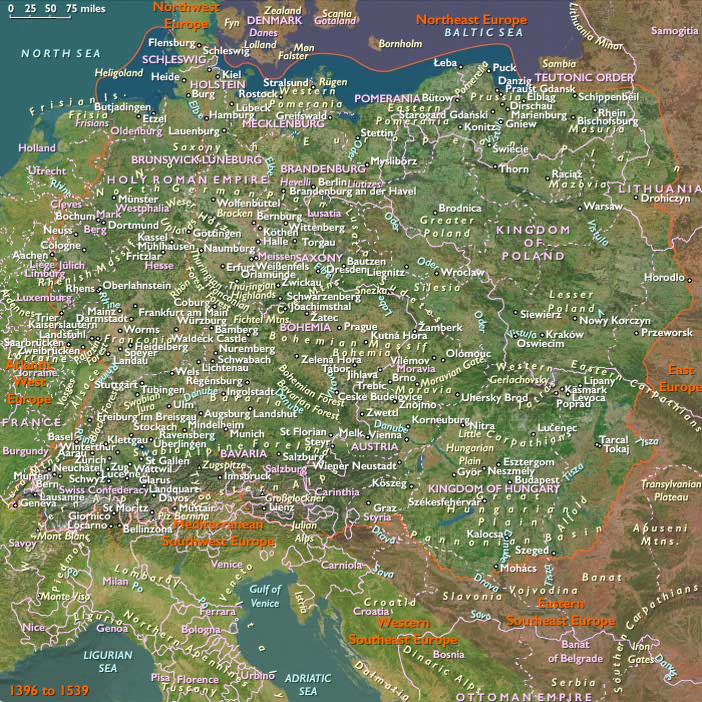
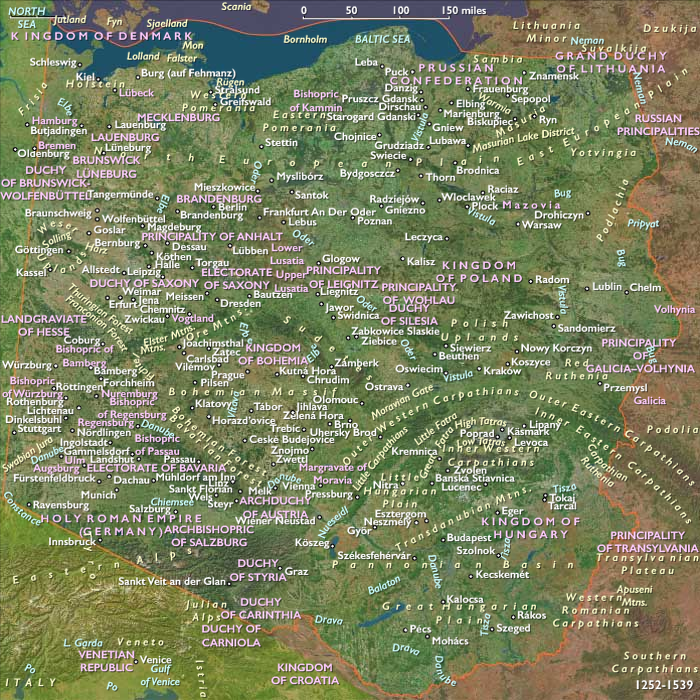
On the death of his grandfather Maximilian I and the accession of his nineteen-year-old brother, Charles V, to title of Holy Roman Emperor in 1519, Ferdinand had been entrusted with the government of the Austrian hereditary lands, roughly modern-day Austria and Slovenia.
He is Archduke of Austria from 1521.
Locations
People
Groups
Subjects
Regions
Subregions
Related Events
Filter results
Showing 10 events out of 38619 total
The Teutonic Knights’ Grand Master, Albert of Brandenburg, whose refusal to acknowledge the submission of to Poland had sparked a devastating war in eastern Prussia, had been granted a four-year truce early in 1521.
The dispute had been referred to Emperor Charles V and other princes, but as no settlement had been reached, Albert has continued his efforts to obtain help in view of a renewal of the war.
For this purpose he visits the Diet of Nuremberg in 1522, where he makes the acquaintance of the Reformer Andreas Osiander, by whose influence Albert is won over to Protestantism.
Grand Master Albert now journeys to Wittenberg, where he is advised by Martin Luther to abandon the rules of his Order, to marry, and to convert Prussia into a hereditary duchy for himself.
This proposal, which is understandably appealing to Albert, had already been discussed by some of his relatives; but it is necessary to proceed cautiously, and he assures Pope Adrian VI that he is anxious to reform the Order and punish the knights who had adopted Lutheran doctrines.
Luther for his part does not stop at the suggestion, but in order to facilitate the change makes special efforts to spread his teaching among the Prussians, while Albert's brother, Margrave George of Brandenburg-Ansbach, lays the scheme before their uncle, Sigismund of Poland.
Queen Mary’s coronation had been followed by brilliant festivities, the royal marriage blessed on January 13, 1522 in Buda.
Mary's anointment and coronation as queen of Bohemia takes place on June 1, 1522.
Mary and Louis fell in love when they are reunited in Buda, and both pursue a life of riotous pleasure, soon disqualifying the teenage king from affairs of state.
Hans Krell, who had started his career as court painter of George of Brandenburg in Ansbach, in 1522 enters into the service of King Louis II of Hungary in Prague and Buda, where he is employed as court portraitist.
Hungary, its fortresses in the southeast under attack by the Ottoman Turkish forces of Sultan Süleyman, has formed an anti-Turkish alliance with Safavid-ruled Persia and the Habsburg-ruled Holy Roman Empire.
French monarch Francis, despite his mixed feelings about an alliance with Islamic “infidels,” supports the Ottoman Empire due to his enmity toward Habsburg emperor Charles V. The magnates, suddenly alive to the Turkish danger, vote to reestablish a standing army, but nothing is done to raise it, since each rival faction tries to put the burden of its upkeep on the others.
Appeals for help from abroad meet with little response.
Meanwhile, the early appearance of Protestantism is further worsening internal relations in the country.
The first reformatory writings had begun the work of winning George of Brandenburg over to the evangelical cause.
Martin Luther's powerful testimony of faith at the Diet of Worms in 1521 has made an indelible impression upon his mind, and the vigorous sermons of evangelical preachers in the pulpits of St. Lawrence and St. Sebald in Nuremberg, during the diet there in 1522, have deepened the impression.
Of the three competing states—Sitawaka, Raigama, and Bhuvanekabahu VII's kingdom of Kotte—that had emerged following the Spoiling of Vijayabahu in 1521, Sitawaka, under the dynamic leadership of Mayadunne, poses the greatest threat to the autonomy of the other states.
In 1522, the Kandyans secure Portuguese protection against Sitawaka.
There are Portuguese settlements in and around Mylapore, the oldest residential district of Madras.
The Luz Church, built in 1516, was the first church built in Madras by the Portuguese.
Later, in 1522, the São Tomé basilica church is built in Mylapore by the Portuguese, after they destroyed the original Kapaleeswarar Temple, a temple of Shiva located on the site.
The Basilica is built over the supposed tomb of St Thomas, one of the twelve disciples of Jesus, who is said to have arrived from Judea to Southern India—Tamilakam—in the present day Indian state of Kerala in CE 52 and preached between 52 and 72, when he was martyred on St. Thomas Mount.
The first successful settlement of São Tomé, an uninhabited island before the arrival of the Portuguese sometime around 1470, had been established in 1493 by Álvaro Caminha, who had received the land as a grant from the crown.
Príncipe had been settled in 1500 under a similar arrangement.
Attracting settlers has proved difficult, however, and most of the earliest inhabitants were "undesirables" sent from Portugal, mostly Jews.
In time these settlers had found the volcanic soil of the region suitable for agriculture, especially the growing of sugar.
São Tomé is right on the equator and wet enough to grow sugar in wild abundance.
Its proximity to the African Kingdom of Kongo provides an eventual source of slave labor to work the sugar plantations.
The cultivation of sugar is a labor-intensive process and the Portuguese begin to import large numbers of enslaved people from the mainland.
São Tomé and Príncipe are taken over and administered by the Portuguese crown in 1522.
The Knights Hospitaller, by now also referred to as the Knights of Rhodes, have been the scourge of Muslim shipping on the eastern Mediterranean for more than two centuries.
The Knights have been forced to become a more militarized order, fighting especially with the Barbary pirates.
They had withstood two invasions in the fifteenth century, one by the Sultan of Egypt in 1444 and another by the Ottoman Sultan Mehmed II in 1480 who, after capturing Constantinople and defeating the Byzantine Empire in 1453, had made the Knights a priority target.
In 1494 they created a stronghold on the peninsula of Halicarnassus (presently Bodrum), using pieces of the partially destroyed Mausoleum, one of the Seven Wonders of the Ancient World, to strengthen their rampart, the Petronium.
An entirely new sort of force arrives in 1522: four hundred ships under the command of Ottoman Sultan Suleiman the Magnificent, who is concentrating his efforts on military campaigns, deliver one hundred thousand men to the island (two hundred thousand in other sources).
Against this force the Knights, under Grand Master Philippe Villiers de L'Isle-Adam, have about seven thousand men-at-arms and their fortifications.
The siege lasts six months, at the end of which the surviving defeated Hospitallers are allowed to withdraw to Sicily.
The first public controversy regarding Zwingli's preaching breaks out during the season of Lent in 1522.
On the first fasting Sunday, March 9, Zwingli and about a dozen other participants consciously transgress the fasting rule by cutting and distributing two smoked sausages (the Wurstessen in Christoph Froschauer's workshop).
Zwingli defends his act in a sermon that was published on April 16, under the title Von Erkiesen und Freiheit der Speisen (Regarding the Choice and Freedom of Foods).
He notes that no general valid rule on food can be derived from the Bible and that to transgress such a rule is not a sin.
The event, which comes to be referred to as the Affair of the Sausages, is considered to be the start of the Reformation in Switzerland.
Even before the publication of this treatise, the diocese of Constance reacts by sending a delegation to Zurich.
The city council condemns the fasting violation, but assumes responsibility over ecclesiastical matters and requests the religious authorities clarify the issue.
The bishop responds on May 24 by admonishing the Grossmünster and city council and repeating the traditional position.
Following this event, Zwingli and other humanist friends petition the bishop on July 2 to abolish the requirement of celibacy on the clergy.
Two weeks later the petition is reprinted for the public in German as Eine freundliche Bitte und Ermahnung an die Eidgenossen (A Friendly Petition and Admonition to the Confederates).
The issue is not just an abstract problem for Zwingli, as he had secretly married a widow, Anna Reinhard, earlier in the year.
Their cohabitation is well-known and their public wedding will take place on April 2, 1524, three months before the birth of their first child.
They will eventually have four children: Regula, William, Huldrych, and Anna.
As the petition is addressed to the secular authorities, the bishop responds at the same level by notifying the Zurich government to maintain the ecclesiastical order.
Other Swiss clergymen join in Zwingli's cause, which encourages him to make his first major statement of faith, Apologeticus Archeteles (The First and Last Word).
He defends himself against charges of inciting unrest and heresy, denying the ecclesiastical hierarchy any right to judge on matters of church order because of its corrupted state.
The events of 1522 bring no clarification on the issues.
Not only does the unrest between Zurich and the bishop continue, tensions are growing among Zurich's Confederation partners in the Swiss Diet.
On December 22, the Diet recommends that its members prohibit the new teachings, a strong indictment directed at Zurich.
The city council feels obliged to take the initiative and find its own solution.

The work of Piero di Cosimo, a Florentine whose later paintings reflect the influence of Leonardo da Vinci, among others, remains distinguished by a uniquely personal imaginative vision and love of visual incident.
The Myth of Prometheus, a series of five panels painted by Piero, shows Prometheus standing before a life-size statue.
His undated “Fight between the Lapiths and the Centaurs” displays an energetic urgency reminiscent of Luca Signorelli.
He dies in his late fifties.
Vasari gives Piero's date of death as 1521, and this date is still repeated by many sources.
However, contemporary documents reveal that he died of plague on April 12, 1522.
Italian poet and dramatist Luigi Alamanni, a friend of Niccolo Machiavelli, is involved in an unsuccessful conspiracy against Cardinal Giulio de Medici in 1522.
Alamanni flees Florence for France, where he becomes court poet to King Francis.
The reign of the Medici Pope Leo X is notable primarily for the excommunication of Martin Luther early in his final year.
In the conclave after the death of Leo X, Leo's cousin, Cardinal Giulio de' Medici, is the leading figure.
With Spanish and French cardinals in a deadlock, the absent Dutch churchman Adrian Florensz Dedal, a former teacher of theology at the University of Louvain, is proposed as a compromise and on January 9, 1522 he is elected by an almost unanimous vote.
Charles V is delighted upon hearing that his tutor had been elected to the papacy but soon realizes that Adrian VI is determined to reign impartially.
Francis I of France, who feared that Adrian would become a tool of the Emperor, and had uttered threats of a schism, eventually relents and sends an embassy to present his homage.
Fears of a Spanish Avignon based on the strength of his relationship with the Emperor as his former tutor and regent prove baseless, and Adrian leaves for Italy at the earliest opportunity, making his solemn entry into Rome on August 29.
He is crowned in St. Peter's Basilica on August 31, 1522, at the age of sixty-three, and immediately enters upon the path of the reformer.
His plan is to attack notorious abuses one by one; however, in his attempt to improve the system of indulgences he is hampered by his cardinals.
He finds reduction of the number of matrimonial dispensations to be impossible, as the income had been farmed out for years in advance by Pope Leo X.
In his reaction to the early stages of the Lutheran revolt, Adrian VI does not completely understand the gravity of the situation.
At the Diet of Nuremberg, which opens in December 1522, he is represented by Francesco Chiericati, whose private instructions contain the frank admission that the disorder of the Church is perhaps the fault of the Roman Curia itself, and that it should be reformed.
However, the former professor and Inquisitor General is strongly opposed to any change in doctrine and demands that Luther be punished for teaching heresy.