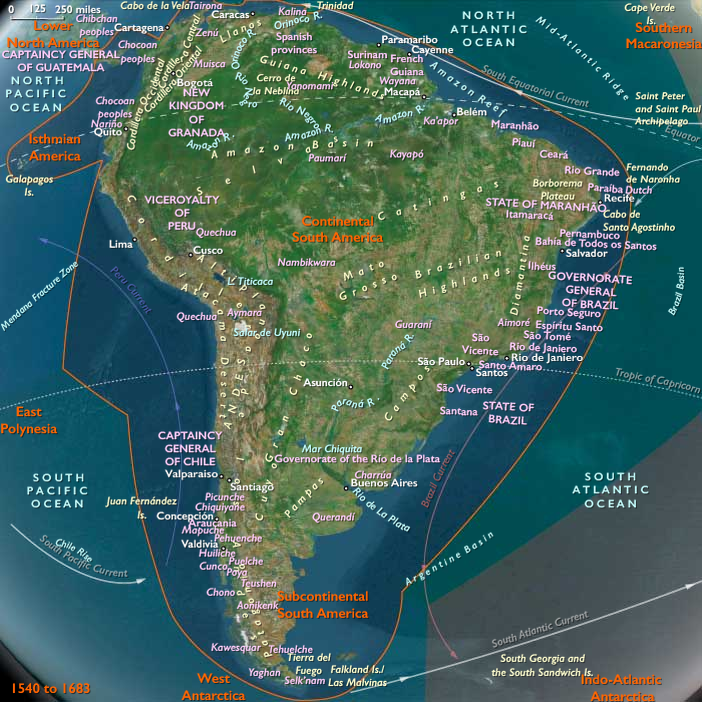
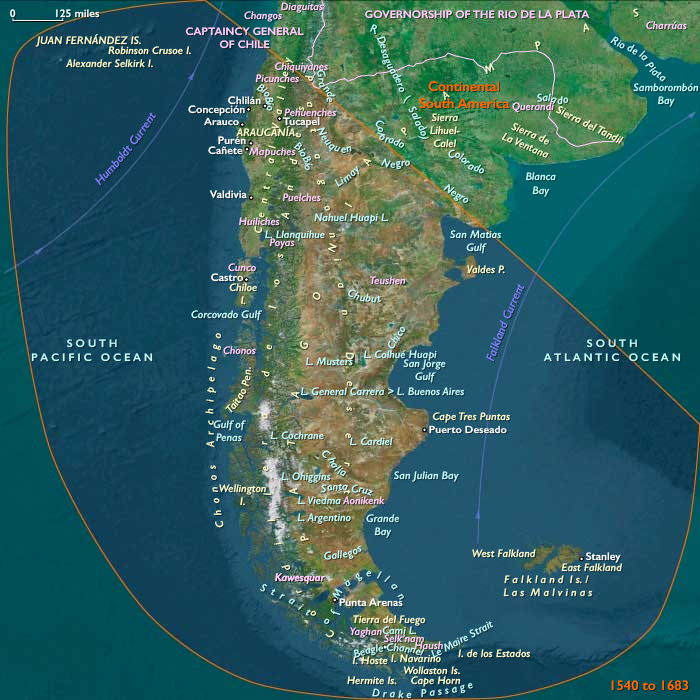
...Fernández also discovers the small Pacific islands …
Years: 1574 - 1574
November
...Fernández also discovers the small Pacific islands of San Félix and ...
Locations
People
Groups
Topics
- Colonization of the Americas, Spanish
- Exploration of Oceania, European
- Exploration of Australia, European
Commodoties
Subjects
Regions
Subregions
Related Events
Filter results
Showing 10 events out of 303 total
Vincenzo Scamozzi, an Italian architect and theoretical writer much influenced by his compatriot Andrea Palladio, designs the Palladianesque Villa of Leonardo Verlato, at Villaverla in 1574. (It will not be completed until 1615, the year before Scamozzi’s death at sixty-eight.)
Selim II had sent his support through a messenger, who had endeavored to put the Dutch in contact with the rebellious Moriscos of Spain and the pirates of Algiers.
Selim also sends a great fleet to attack Tunis in the autumn of 1574, thus succeeding in reducing Spanish pressure on the Dutch.
In the Battle of La Goleta, Selim II musters a fleet of between two hundred and fifty and three hundred warships, with about seventy-five thousand men.
The Ottoman fleet is commanded by Sinan Pasha and Alūj Ali.
The Ottoman fleet combined, with troops sent by the governors of Algiers, Tripoli and Tunis, makes for a total force of about one hundred thousand.
The army attacks Tunis and La Goleta.
The presidio of La Goleta, defended by seven thousand men, falls on August 24. The last Christian troops in a small fort opposite Tunis surrender on September 3.
John of Austria attempts to relieve the siege with a fleet of galleys from Naples and Sicily but failed due to storms.
The Spanish crown, being heavily involved in the Netherlands and short of funds, is unable to offer significant help.
Sinan Pasha, an Italian Muslim, leads the Ottoman capture of Tunis.
Cervantes participates in these events as a soldier, and is among the troops of Don Juan of Austria that try to rescue the city.
He will claim that the Ottomans led twenty-two assaults against the fort of Tunis, losing twenty-five thousand men, while only three hundred Christians survived.
Abd al-Malik, the future Moroccan King, participates in the conquest on the side of the Ottomans.
Gabrio Serbelloni is the commander of the fort of Tunis.
The general of La Goleta, Don Pedro Portocarerro, is taken as a captive to Constantinople, but dies on the way.
The captured soldiers are employed as slaves on galleys.
The capture of Tunis gives the territories of the Hafsid dynasty to the Ottoman Empire.
The battle marks the final establishment of Ottoman rule in Tunis, putting an end to the Hafsid dynasty and the Spanish presence in Tunis.
The year 1575 sees the posthumous publication of Estraordinario libro, the eighth and final volume of Italian architect, painter, and theorist Sebastiano Serlio’s immensely influential Tutte l'opere d'architettura, et prospetiva ("Complete Works on Architecture and Perspective.” L’Architettura, as it is called, is the first architectural handbook to emphasize the practical rather than the theoretical aspects of architecture, and the first to catalog the five orders.
The eighth volume contains fifty fanciful designs for doorways.
A third church in Herzegovina, the Serbian Orthodox, has also competed for Christian adherents.
Christianity is thus structurally weaker in Bosnia than in almost any other part of the Balkans.
The motives that incline Bosnians to adopt Islam are economic: the prosperous cities of Sarajevo and Mostar are mainly Muslim, and it is not possible to lead a full civic life there without converting to Islam.
Other motives include the privileged legal status enjoyed by Muslims and, possibly, a desire to avoid the harac, though Muslims are subject, unlike Christians, both to the alms tax and to the duties of general military service. (Modern historians have largely disproven the traditional belief that Bosnian noblemen converted en masse to Islam in order to keep their estates).
Another way in which Bosnia differs from other parts of the Ottoman Balkans is that for most of last century Bosnia has been a frontier province, facing two of the empire's most important enemies, Austria-Hungary and Venice.
To fill up depopulated areas of northern and western Bosnia, the Ottomans have encouraged the migration of large numbers of hardy settlers with military skills from Serbia and Herzegovina.
Many of these settlers are Vlachs, members of a pre-Slav Balkan population that has acquired a Latinate language and specialized in stockbreeding, horse raising, long-distance trade, and fighting.
Most are members of the Serbian Orthodox church.
Before the Ottoman conquest, that church had had very few members in the Bosnian lands outside Herzegovina and the eastern strip of the Drina valley; there is no definite evidence of any Orthodox church buildings in central, northern, or western Bosnia before 1463.
Several Orthodox monasteries have been built during the sixteenth century, however, in those parts of Bosnia, apparently to serve the newly settled Orthodox population there.
Mediterranean Southwest Europe (1576–1587 CE): Cultural Flourishing and Trans-Mediterranean Exchanges
The era 1576–1587 CE in Mediterranean Southwest Europe marks a vibrant cultural flourishing, with significant advancements and exchanges across Italy, the Iberian Peninsula, and the strategic island of Malta. This period is highlighted by the dynamic expansion of the commedia dell'arte, the introduction of coffee to European society, and continued infrastructural and cultural growth in Malta under the Knights Hospitaller.
Commedia dell'Arte and Theatrical Innovation
This era sees major Italian commedia dell'arte companies flourish, notably the Gelosi (the "Jealous"), Confidenti (the "Confident"), Uniti (the "United"), Desiosi (the "Desired"), Accesi (the "Inspired"), and Fideli (the "Faithful"). The Compagnia dei Gelosi, formed around 1568 under the leadership of scenario writer Flaminio Scala, gains immense popularity throughout Italy and beyond. Renowned for improvisational performances, quick wit, and social commentary, these troupes significantly influence European theatre. Another leading troupe, the Compagnia degli Uniti, emerges prominently under the guidance of Drusiano Martinelli and his wife, Angelica. Their performances are celebrated for their sophisticated wit and cultural refinement, and notable actor Silvio Fiorillo gains recognition for his innovative portrayals of stock characters like the boastful Capitano Mattamoros and the quirky Pulcinella.
Introduction of Coffee to Europe
Coffee arrives in Europe for the first time during this era through the vibrant trade connections between Venice and the Ottoman Empire. Initially imported from North Africa, Egypt, and the Levant, coffee becomes a luxury beverage for Venice's elite. Venetian merchants capitalize on its exotic appeal, charging premium prices and helping to popularize the beverage across Europe, laying the foundations for the continent’s enduring coffee culture.
Continued Developments in Malta
Under the stewardship of the Knights Hospitaller, Malta continues its transformation into a fortified bastion and cultural hub. The newly established capital city, Valletta, completed in 1571, solidifies its reputation as Superbissima("Most Proud"). Valletta's formidable fortifications, designed initially by Francesco Laparelli and completed by Girolamo Cassar, secure the island against persistent Mediterranean threats. Concurrently, the island's Sacra Infermeria advances as a leading European medical facility, housing prominent schools of anatomy, surgery, and pharmacy. Malta becomes renowned not only for its defensive might but also as a center of Renaissance art and culture, particularly with the completion of the ornate Conventual Church of St. John in 1577, which soon houses masterpieces by artists such as Caravaggio.
Iberian Cultural Dynamics and Artistic Trends
In Iberia, cultural activities unfold amidst continuing strictures imposed by the Spanish Inquisition and the Counter-Reformation. Nevertheless, this era sees sustained literary and artistic output, carefully navigating the balance between orthodoxy and creative expression. The visual arts, especially influenced by the enduring Mannerist style, continue to flourish, reflecting the complex socio-political environment under the reign of King Philip II of Spain.
Integration of Mediterranean Islands
Spanish administrative and cultural practices deepen their roots across Mediterranean islands such as Sicily, Sardinia, and the Balearic Islands. These territories increasingly reflect Castilian norms, consolidating Spain's political and cultural hegemony in the region.
Legacy of the Era
The period 1576–1587 CE epitomizes a rich cultural and intellectual dynamism. From the transformative impact of the commedia dell'arte and the introduction of coffee into European life, to the fortified and culturally enriched landscape of Malta, these years represent a critical intersection of artistic, social, and political developments that significantly influence subsequent European cultural history.

Coffee is first imported to Italy from the Ottoman Empire.
The vibrant trade between Venice and the Muslims in North Africa, Egypt, and the East brings a large variety of African goods, including coffee, to this leading European port.
Venetian merchants introduce coffee-drinking to the wealthy in Venice, charging them heavily for the beverage.
In this way, coffee is introduced to Europe.
Aldus Manutius the Younger is fated to be the last member of the Italian family of Manuzio to be active in the famous Aldine Press established by his grandfather Aldus Manutius the Elder.
Aldus the Younger had written a work on Latin spelling, Orthographiae ratio, when only fourteen years old.
While in Venice superintending the Aldine Press after his father, Paulus Manutius, had moved to Rome, he had published his Epitome orthographiae in 1575 and the following year publishes his commentary on Horace's Ars poetica.
About the same time, he is appointed professor of literature at the chancery in Venice.
Selim's son had ascended the throne as Murad III at his father's death in December 1574, Selim’s brilliant grand vizier Mehmed Pasa Sokollu had lost much of his power.
During what becomes known as the “Sultanate of the Women” from 1570 to 1578, Murad has come under the influence of the women in his harem and of his courtiers, and ignored the advice of Sokollu, who favors peace, in 1578 opposing Ottoman entry into war with Venice and with Persia.
Externally, Murad continues the military offensive of his predecessors.
The rising principality of Moscow has conquered the last Mongol states in Central Asia and reached the Caspian Sea, thus posing a threat to the Ottoman positions north of the Black Sea and in the Caucasus.
Giovanni Battista Moroni, a Venetian-born pupil of the local painter Moretto da Brescia, who strongly influenced Moroni's manner in painting religious compositions, is one of the few Italian artists to have made portraiture their chief specialty.
His portraits are mostly of the petty aristocracy and bourgeoisie of Bergamo.
The Tailor (circa 1571; National Gallery, London) is one of his best-known works.
Moroni emphasizes a sitter's dignity and nobility by means of natural, unforced poses and masterful compositions.
Despite their impassive facial expressions, many of his portraits impart a sense of gentle melancholy that is reinforced by predominantly gray tonalities and by a restrained treatment of the textures of cloth and draperies.
Moroni's simple yet subtle style of portraiture is clearly influenced by that of Titian, who himself has commended Moroni's work.
Among Moroni's other more notable portraits are the Portrait of a Young Man (Brera Picture Gallery, Milan) and the Portrait of a Gentleman (1563; Uffizi Gallery, Florence).
Moroni dies in Bergamo on February 5, 1578, in his early fifties.
Andrea Palladio, nearing the end of his life in 1579, designs a central-plan church as a chapel at Maser.
It is a shallow Greek cross covered by a circular dome.
Internally, the complex decoration of all surfaces relates it in style more closely to Palladio's late palace designs than to his churches.
He follows this with a similar unexecuted project, San Nicola di Tolentino in Venice.
These demonstrate Palladio's ideal church plan and follow his reconstruction of the Pantheon in the Quattro libri and paralleling designs by Giacomo da Vignola (1507–73), the leading architect in Rome after Michelangelo.
Years: 1574 - 1574
November
Locations
People
Groups
Topics
- Colonization of the Americas, Spanish
- Exploration of Oceania, European
- Exploration of Australia, European