
Fleury has been present at all interviews …
Years: 1725 - 1725
Fleury has been present at all interviews between Louis XV and his titular first minister, and on Bourbon's attempt to break through this rule, Fleury retires from court.
The king takes no part in the decisions of Bourbon’s government, which is secretly under the influence of a group of speculators and wheeler-dealers such as Étienne Berthelot de Pléneuf and banker J. Pâris-Duverney.
Berthelot’s daughter, Jeanne Agnès, had at the age of fifteen been married to Louis, marquis de Prie, and had gone with him to the court of Savoy at Turin, where he was ambassador.
Twenty-one when she returned to France, she had soon become Bourbon’s declared mistress.
During his ministry, she has in several respects been the real ruler of France.
The king is quite frail, and several alerts have led to concern for his life.
Bourbon is concerned for Louis’s health, less from concern for the monarch or the future of the dynasty and more from a desire to prevent the late regent’s House of Orléans, which Bourbon sees as an enemy camp, from ascending the throne should the king die.
As the Spanish infanta is far too young to produce an heir, Bourbon, hostile also to Spain, sends the infanta home and sets about choosing a European princess old enough to produce an heir.
Eventually, the choice falls on twenty-one-year-old Marie Leszczyńska, daughter of Poland’s deposed King Stanislaus, who is currently residing at Wissembourg in Alsace.
A poor princess who had followed her father's misfortunes, she is nonetheless said to be virtuous, and quite charming.
She is also from a royal family that had never interbred with the French royals, and it is hoped that she will infuse it with vigorous blood.
Her father’s relatively low status will also ensure that the marriage will not cause diplomatic embarrassment to France by having to choose one royal court over another.
The marriage is celebrated in September 1725 and Louis immediately falls in love with Marie, who is seven years his senior.
This union is Madame de Prie’s most notable triumph but most of Europe considers the marriage of its most powerful king with such a low-ranking princess to be improper and lacking in grandeur.
Stanislaus moves to Chateau Chambord, in the Loire valley.
Locations
People
Groups
Subjects
Regions
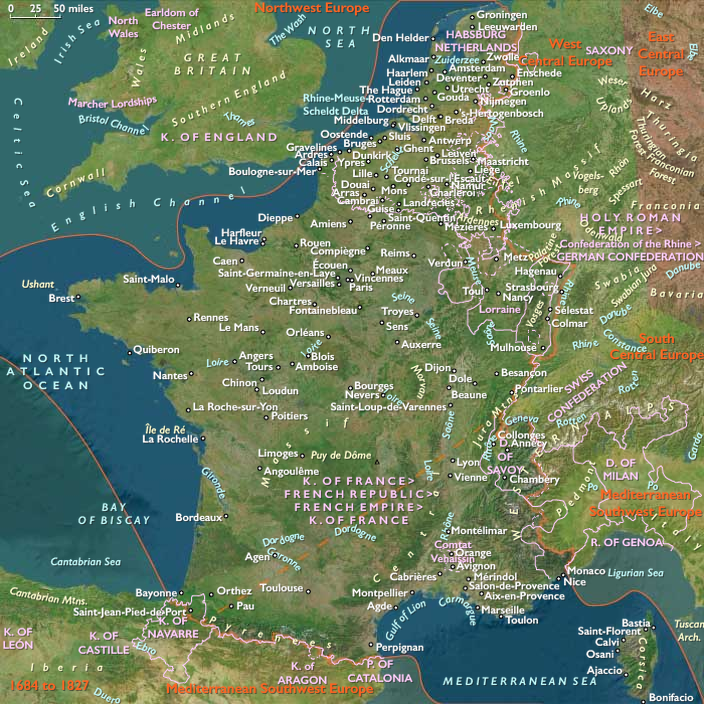
Subregions
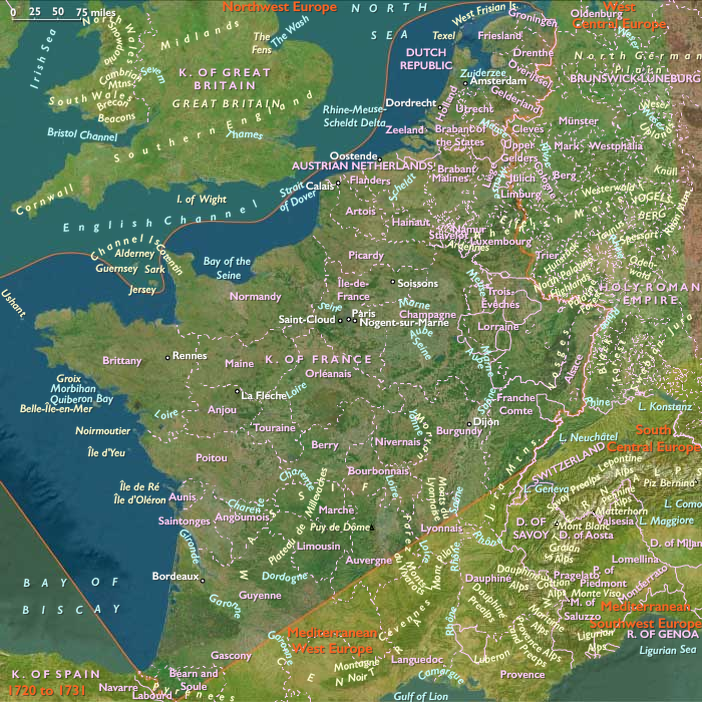
Years: 1725 - 1725
Locations
People
Groups
Subjects
Regions
Subregions