
Some persons in Yathrib, who had satirized …
Years: 625 - 625
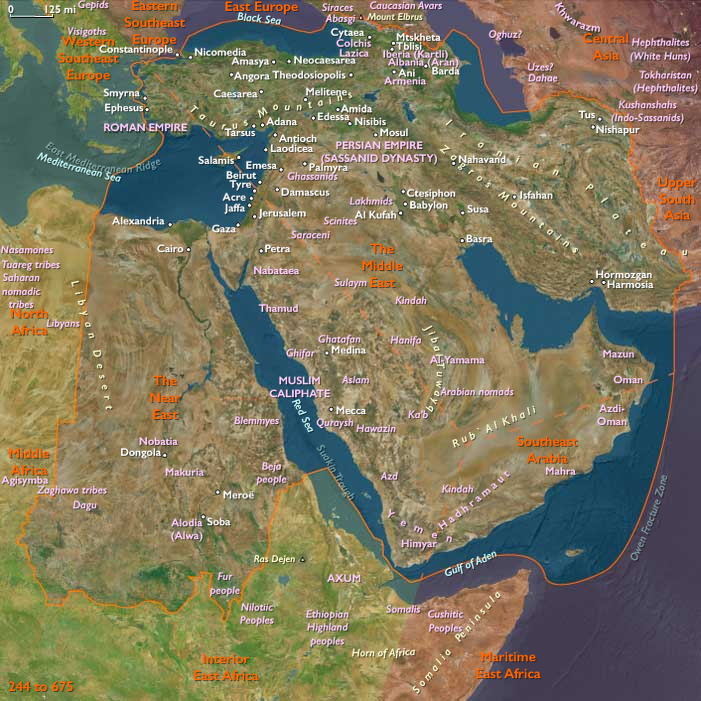
Some persons in Yathrib, who had satirized Muhammad in verse, speaking of his cruelties, are assassinated, possibly with his connivance, following the Muslim victory over the Meccans at Badr.
Asma Bint Merwan, a married woman with five children, and reputedly Median's most popular poetess, is stabbed to death by a group of Muslims who break into her house at night as she lies in her bedroom breast-feeding her newborn child, who is then hacked to pieces.
Soon afterward, Abu Afek, an elderly poet respected for his sense of fairness, meets a similar fate.
Another, a renowned Arab poet named Kaab Ibn Ashraf of the Tribe of Tai, who resides with the Jewish clan Banu Nadir, had composed a lament for the Quraysh leaders of who had been massacred in the battle of Badr.
Four Muslims drag ibn Ashraf from his bed and stab him to death in full view of his family.
Muhammad also uses a minor disturbance as a pretext for expelling the Jewish clan that operates the market.
This weakens his most serious opponent there, the “hypocrite” (munafiq), or nominal Muslim, 'Abd Allah ibn Ubayy, who is allied with the local Jews.
As the remaining fence sitters among the Arabs of Yathrib probably become Muslims about this time, the victory of Badr greatly strengthens Muhammad.
Concurrently, he employs marriage relationships to bring greater cohesion to the emigrants.
His daughter Fatimah is married to Abu Talib's son Ali (later fourth caliph), and Umm Kulthum to Uthman (third caliph).
Muhammad himself marries the newly widowed Hafsah, daughter of 'Umar (later second caliph), whose previous husband was one of the Muslims killed at Badr.
He continues, with some success, to lead larger Muslim forces on razzias against hostile nomadic tribes.
Abu Sufyan, meanwhile, has energetically mobilized vengeful Meccan forces, who declare their intention to make the Muslims pay several times over for Badr.
On March 11, 625, with Abu Sufyan at the helm, the Meccans—anxious to avenge their defeat at Badr—raise another force numbering three thousand and set out for the Muslim base in Medina.
Rather than attacking Medina itself, which is populated by numerous strongholds that would require long sieges to overcome, they camp on the pastures north of the city, hoping that the Muslims will come out to meet them.
According to the early Muslim historian Ibn Ishaq, a number of Meccan women are said to have accompanied Abu Sufyan's army to provide vocal support, including Hind bint Utbah, his wife.
A scout alerts Muhammad of the Meccan army's presence and numbers late on Thursday March 21.
The next morning, a Muslim conference of war convenes, and there is dispute over how best to repel the Meccans.
Muhammad and many of the senior figures suggest that it would be safer to fight within Medina and take advantage of its heavily fortified strongholds.
Younger Muslims argue that the Meccans are destroying their crops, and that huddling in the strongholds will destroy Muslim prestige.
Muhammad eventually concedes to the wishes of the latter, and readies the Muslim force for battle.
Locations
People
Groups
Topics
Commodoties
Subjects
Regions
Subregions

Years: 625 - 625
Locations
People
Groups
Topics
Commodoties
Subjects
Regions
Subregions