Forces loyal to the Hos battle the …
Years: 1405 - 1405
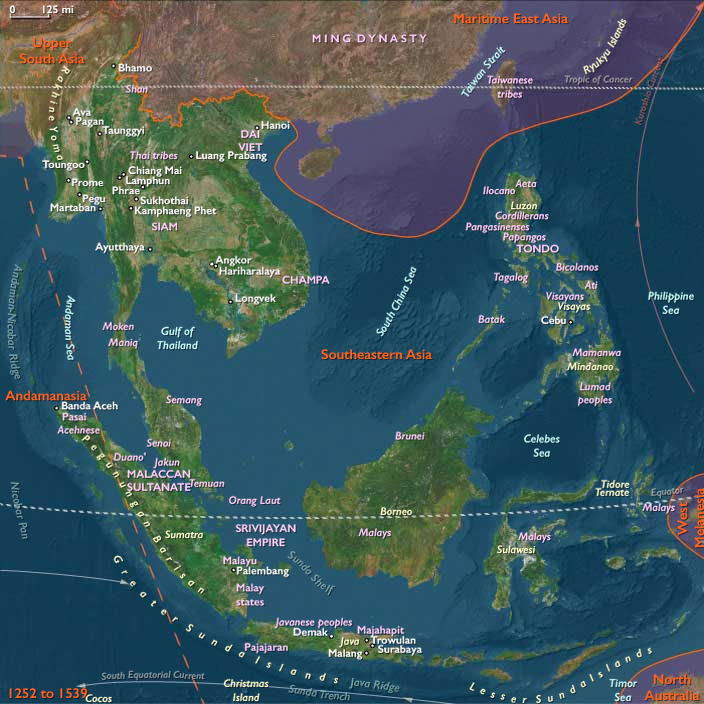
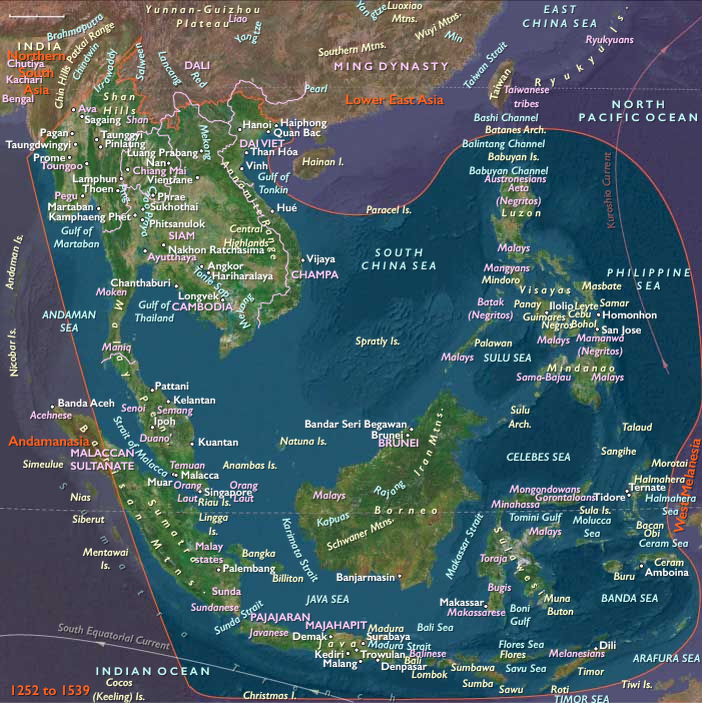
Forces loyal to the Hos battle the Tran supporters, who, supported by the Chams, seek the restoration of the ousted royal family.
The Trans request aid from Ming emperor Yongle, who responds by dispatching a naval force to the Vietnam region in 1405.
Locations
People
Groups
Topics
Commodoties
Subjects
Regions
Subregions
Related Events
Filter results
Showing 10 events out of 42577 total
Taejong's next act as king had been to revise the existing legislation concerning the taxation of land ownership and the recording of state of subjects.
Although many aristocrats who had benefited from King Taejo's laws redistributing property from the Gwonmun aristocrats to the members of the Sinjin faction have managed to avoid taxation by deliberately hiding land they acquired, King Taejong's re-investigation of land ownership in 1405 puts an end to such practices.
With the discovery of previously hidden land, national income doubles.
The Yongle Emperor sponsors the massive and long term Zheng He expeditions as part of his desire to expand Chinese influence.
These are China's only major seagoing explorations of the world (although the Chinese had been sailing to Arabia, Africa, and Egypt since the Tang Dynasty, from 618-907).
The first expedition launches in 1405 (eighteen years before Henry the Navigator will begin Portugal's voyages of discovery).
The expeditions are all under the command of China's greatest admiral, Zheng He.
At least seven expeditions will be launched, each bigger and more expensive than the last.
Some of the boats used are apparently the largest sail-powered boats in history (National Geographic, May 2004).
The Yongle emperor, intent on reasserting Chinese supremacy, expands overland trade with Central Asia, and sponsors ambitious maritime expeditions to the West.
His fleet admiral Zheng He (Cheng Ho), a eunuch of Semu/Khwarezmian descent, embarks on a voyage to what the Chinese call "the Western Ocean" (Indian Ocean).
aimed at establishing tributary relations with Japan and several Southeast Asian kingdoms.
Over the next twenty-eight years, he will make the seven voyages collectively referred to as the travels of "Eunuch Sanbao to the Western Ocean" or "Zheng He to the Western Ocean.".
Zheng He's first voyage consists of a fleet of three hundred and seventeen ships holding almost twenty-eight thousand armed troops.
Many of these ships are mammoth nine-masted "treasure ships" which are by far the largest marine craft the world had yet seen.
His first voyage, from 1405 to 1407, will take his fleet to Champa, Java, Palembang, Malacca, Aru, Sumatra, Lambri, Ceylon, Kollam, Cochin, and Calicut.
(Gavin Menzies's book, 1421, asserts that Zheng He circumnavigated the globe and arrived in America in the fifteenth century before Ferdinand Magellan and Christopher Columbus.
His 1421 hypothesis is highly controversial and not accepted by mainstream scholars.)
Samarkand’s Masjid-i Jami', or Congregational Mosque, had been built immediately after Timur's return in 1399 from his campaign in India.
According to Ruy Gonzáles de Clavijo, ninety captured elephants were employed merely to carry precious stones looted from this conquest, so as to erect a mosque at Samarkand—what historians today believe is the Bibi-Khanym Mosque.
Construction had been completed around 1404.
(However, the mosque slowly fell into disuse, and crumbled to ruins over the centuries, likely due to the fact it pushed the construction techniques of the time to the very limit, and the fact it was built too quickly.
It eventually partially collapsed in 1897 when an earthquake occurred, but in 1974 began to undergo reconstruction by the Government of Uzbekistan.
The current mosque is effectively a brand-new building, as no original work remains.)
Timur’s impressive mausoleum, the azure-domed Gur-e Amir, is completed in 1405, as is Samarkand’s Shah-i Zinda Necropolis, featuring over a dozen domed tombs lining a narrow hillside lane.
The octahedral Gur-e Mir, famous for its simplicity of construction and for its solemn monumentality of appearance, occupies an important place in the history of Islamic Architecture as the precursor and model for the great Mughal tombs of Humayun in Delhi and the Taj Mahal in Agra, built by Timur's descendants, the ruling Mughal dynasty of North India.
The construction of the mausoleum itself began in 1403 after the sudden death of Muhammad Sultan, Tamerlane's heir apparent and his beloved grandson, for whom it was intended.
Timur had built himself a smaller tomb in Shahrisabz near his Ak-Saray palace.
However, when Timur died in 1405 on campaign on his way to conquer China, the passes to Shahrisabz were snowed in, so he is buried here instead.

Timur, attacked by fever and plague when encamped on the farther side of the Sihon (Syr-Daria), dies at Atrar (Otrar) in mid-February 1405.
His scouts had explored Mongolia before his death, and the writing they had carved on trees in Mongolia's mountains could still be seen even in the twentieth century.
Of Timur's four sons, two (Jahangir and Umar Shaykh) have predeceased him.
His third son, Miran Shah, dies soon after Timur, leaving the youngest son, Shah Rukh.
Although his designated successor is his grandson Pir Muhammad (born Jahangir), Timur is ultimately succeeded in power by his son Shah Rukh.
His most illustrious descendant, Babur, will found the Mughal Empire and rule over most of North India.
Babur's descendants, Akbar, Jahangir, Shah Jahan and Aurangzeb, will expand the Mughal Empire to most of the Indian subcontinent along with parts of modern Afghanistan.
The House of Schwarzenberg, a Frankish and Bohemian aristocratic family which had first been mentioned in 1172, acquires noble status in Franconia when Erkinger I of Seinshein acquires the Frankish barony of Schwarzenberg, the castle Schwarzenberg and the title Baron of Schwarzenberg, in 1405–21.
The House of Schwarzenberg, related to a number of European aristocratic families, notably to the Lobkowicz (Czech: Lobkovicové) family, will go on through centuries to produce many exceptional military commanders, politicians, church dignitaries (including an Archbishop of Prague), innovators and patrons of the arts.
They will create ponds, plant forests and introduce new technologies in agriculture.
The thriving commercial and cultural center of Klausenburg (Hungarian: Koloszvar), in the Somesul-Mic valley of Transylvania, becomes a free city in 1405, the voivode of Transylvania having lost his supremacy over Kuluzsvar in 1331.
By this time the number of Saxon and Hungarian inhabitants is equal, the immigrant Saxons having been here for some one hundred and twenty-five years.
(As Cluj-Napoca, the city will develop into what is today one of the most important academic, cultural, industrial and business centers in Romania.
Among others, it hosts the largest university in the country, state-renowned cultural institutions, as well as the largest Romanian-owned commercial bank.)
Timur had put his son Mirza Halil in charge of the affairs of Armenia, Trebizond, and Georgia, but with his father's death in 1405, Halil rushes off to assume the throne at Samarkand, leaving Trebizond and the local Turkmen princes of the region effectively free.
The Mamluks release both Qara Yusuf and Sultan Ahmad Jelair when Timur dies in 1405.
The death of Timur and the weakness of Iran in the ensuing century will pit the Mamluks against the rising power of the Ottoman Turks for the control of western Asia.
The rise of the Circassian Mamluk dynasty has contributed to what will be a gradual economic deterioration and a decrease in security in Palestine.
The last onslaught of the Mongols, which makes the name of Timur a synonym of destruction and plunder, takes place during the reign of the dynasty's second sultan, Nasir Faraj.
Although Palestine is spared the pillage of his hordes, it cannot escape its disastrous repercussions as the Mamluks move through in a vain attempt to defend Damascus against the invader.