Formal control of Shkodër passes in 1479 …
Years: 1479 - 1479
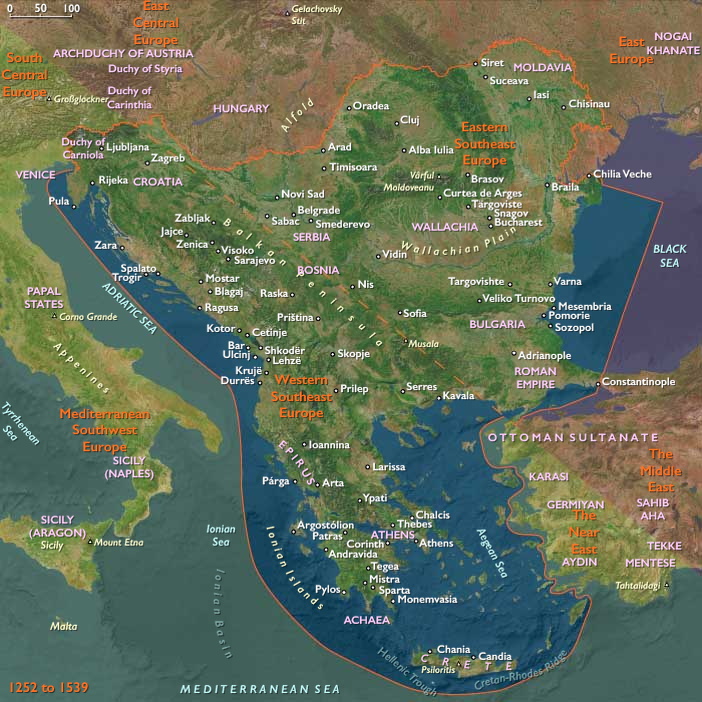
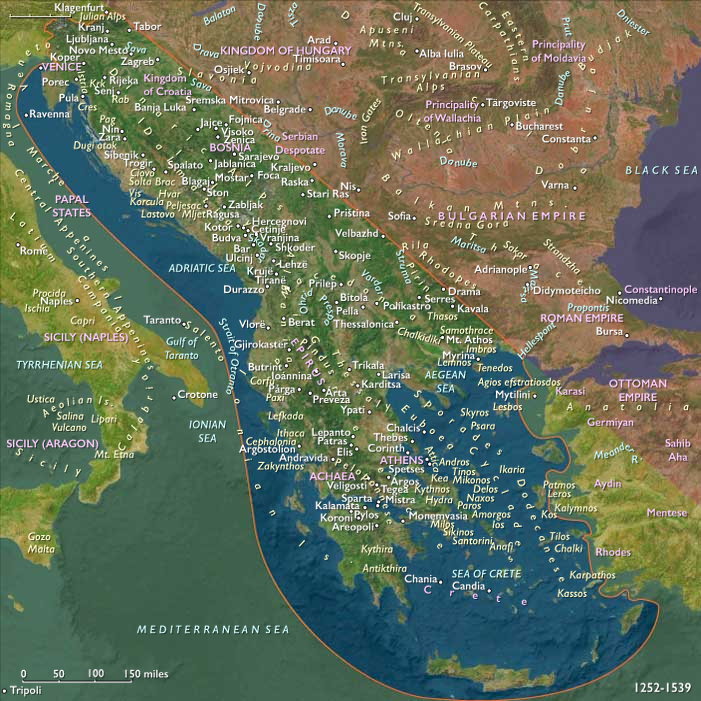
Formal control of Shkodër passes in 1479 to the Ottoman Turks, but local families continue to rule.
Locations
Groups
Topics
Commodoties
Subjects
Regions
Subregions
Related Events
Filter results
Showing 10 events out of 40712 total
Christian I has undertaken several costly travels in the 1470s, including a visit in 1474 to Pope Sixtus IV, during which he had obtained permission to found the University of Copenhagen, which opens in 1479.
The dynastic marriage of Maximilian Habsburg to Mary, the duchess and heiress of Burgundy, in 1477 would seem to confirm the imperial monogram of his father, Holy Roman Emperor Frederick III: AEIOU, for “Austriae est imperare orbi universo” (Latin, “Austria’s will to rule the world”), or “Alles Erdreich ist Osterreich untertan” (German, “all the earth is under Austria’s rule”).
King Matthias Corvinus of Hungary, however, challenges imperial Habsburg authority with the support of Frederick’s adversaries in Austria and Germany, who continually plague the emperor with feudal claims.
Corvinus has initiated military campaigns against the Habsburgs in 1477 and 1479, ravaging much of Austria and managing to acquire Lower Austria and much of Styria.
From 1479, he maintains a residence in Vienna.
Emperor Frederick only pays off the half of the indemnity due to Matthias according to their treaty of 1477.
Matthias concludes a treaty with the Swiss Confederacy on March 26, 1479, hindering the recruitment of Swiss mercenaries by the Emperor.
Matthias also enters into an alliance with Archbishop of Salzburg Bernhard II of Rohr, who allows him to take possession of the fortresses of the Archbishopric in Carinthia, Carniola and Styria.
The Venetians cede all of the regions conquered by the Turks, including Scutari, Negropont, the island of Lemnos, and other Venetian outposts in the Aegean Sea, by the Treaty of Constantinople concluded in 1479 between Venice and the Ottoman empire.
Venice also pays an indemnity of one hundred thousand ducats and promises to pay annual tributes to the Ottomans in return for trading concessions.
An Ottoman army supported by Basarab Țepeluș of Wallachia invades Transylvania and sets fire to Szászváros (Orăștie in Romania) in late 1479.
The Hungarian army under the leadership of Pál Kinizsi and Stephen Báthory on October 13, 1479, faces Ottoman and Wallachian troops led by Ali Kodsha bey and Basarab Ţepeluş cel Tânăr, respectively, in the Battle of Breadfield, near Zsibót.
Vuk Grgurević, titular Despot of Serbia, along with Dmitar Jakšić, lead Serbian light cavalry squadrons.. At the decisive moment, the Hungarian and Serbian cavalries charge the Turkish center and break its ranks, which decides the outcome of the battle in favor of Hungary.
The Breadfield battle is a great psychological victory for the Hungarians, and as a result the Ottoman Turks will not attack southern Hungary and Transylvania for many years hereafter.
Matthias unites the command of all forts along the Danube to the west of Belgrade in the hand of Paul Kinizsi to improve the defense of the southern frontier.
The Sharqi rulers of Jaunpur have become known for their patronage of learning and architecture.
Jaunpur is known as the Shiraz of India during this period.
The most notable examples of the Sharqi style of architecture in Jaunpur are the Atala Masjid, the Lal Darwaja Masjid and the Jama Masjid.
The foundation of the Atala Masjid, although it had been laid by Firuz Shah Tughluq in 1376, had been completed only during the rule of Ibrahim Shah in 1408.
Ibrahim Shah also built another mosque, the Jhanjhiri Masjid, in 1430.
The Lal Darwaja Masjid as built in 1450 during the reign of the next ruler, Mahmud Shah.
The Jama Masjid was built in 1470, during the rule of the last ruler, Mahmud’s third son, Hussain Shah.
Hussain Shah, who assumed the title of Gandharva, has contributed significantly to the development of Khayal, a genre of Hindustani classical music.
He has also composed several new ragas (melodies).
Most notable among these are Malhār-śyāma, Gaur-śyāma, Bhopāl-śyāma, Hussaini- or Jaunpurī-āśāvari (presently known as Jaunpuri) and Jaunpuri-basant.
The intermittent warfare between the sultanates of Delhi and Jaunpur had remained indecisive.
Hussain Shah had signed a four years' peace treaty with Bahlul Lodi, ruler of the Delhi Sultanate, in 1458.
Later, in order to invade Delhi , Hussain Shah had reached the banks of the Yamuna with a very large army in 1478.
Sultan Bahlul Lodi had attempted to secure peace by offering to retain only Delhi and govern it as a vassal of Hussain Shah, but the latter rejected the offer.
As a result, Sultan Bahlul had crossed the Yamuna and defeated him.
Hussain Shah had agreed to a truce but again captured Etawah and marched towards Delhi with a huge army and was again defeated by Bahlul Lodi.
Able to make peace this time also, he again arrives at the banks of Yamuna in March, 1479.
Defeated by Bahlul Lodi, Hussain lose the parganas (administrative units) of Kampil, Patiali, Shamsabad, Suket, Koil, Marhara and Jalesar to the advancing army of the Delhi Sultan.
After successive defeats in the battles of Senha, Rapri and Raigaon Khaga, he is finally defeated on the banks of the Rahab.
Hussain retires to …

…Bihar, where his occupation is confined to a small territory.
The island of Lemnos had been added to the domain of the Gattilusi of Lesbos after the Fall of Constantinople to the Ottomans in 1453.
The Ottoman Sultan Mehmed II in 1456 had attacked and captured the Gattilusi domains in Thrace (Ainos and the islands of Samothrace and Imbros).
During the subsequent negotiations with the lord of Lesbos, Domenico Gattilusio, the Greek populace of Lemnos had risen up against Domenico's younger brother Niccolò Gattilusio, and submitted themselves to the Sultan, who had appointed a certain Hamza Bey as governor under the Bey of Gallipoli, Isma'il.
The island had been captured in 1457 by a Papal fleet.
Pope Callixtus III had hoped to establish a new military order on the island, which controls the exit of the Dardanelles, but nothing had come of it as Isma'il Bey soon recovered Lemnos for the Sultan.
Following the fall of the Despotate of the Morea in 1460, Sultan Mehmed II had given the proceeds from Lemnos to the last Despot, Demetrios Palaiologos.
During the First Ottoman–Venetian War, Lemnos and other former Gattilusi possessions had been seized in 1467 by the Venetians, but are returned to the Ottomans in 1479 under the Treaty of Constantinople.
The Ottoman Turks have overrun Albania and have raided the outskirts of core Venetian territory.
The Venetian garrison of Scutari courageously defends itself, repulsing numerous Turkish assaults in 1478-79.