Fribourg, another Habsburg city, had come under …
Years: 1454 - 1454
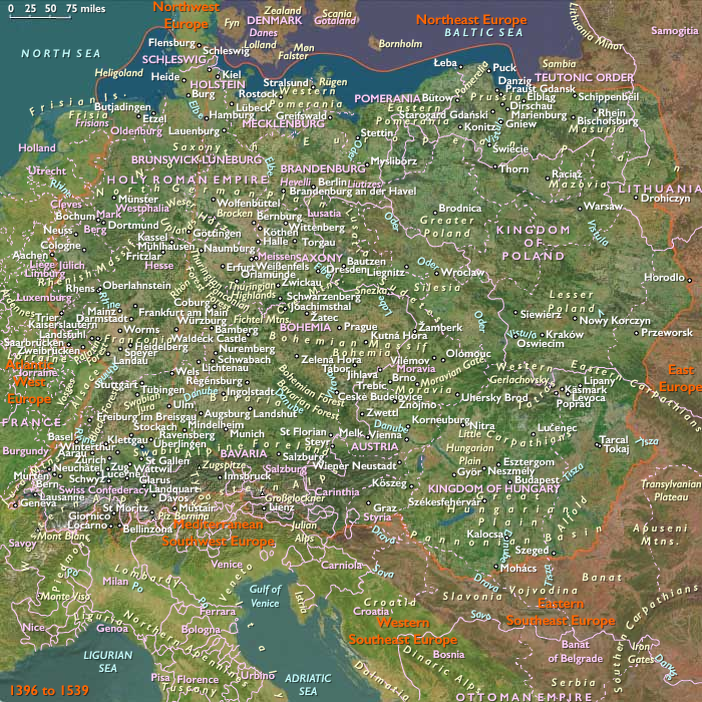
Fribourg, another Habsburg city, had come under the rule of the Duke of Savoy during the 1440s and had had to accept the duke as its lord in 1452.
Nevertheless, it also enters an alliance with Berne in 1454, becoming an associate state of the Swiss Confederacy.
Related Events
Filter results
Showing 10 events out of 41462 total
Ayutthayan King Borommatrailokkanat, in 1454, decrees the Sakdi Na system, which divides his Thai subjects into classes and specifies the amounts of land to which each is entitled.
Abu Sa'id Mirza fights an inconclusive war with Babur of Khorasan in 1454, when the latter invades Transoxiana in retaliation for the latter's seizure of Balkh and quickly lays siege to Samarkand.
The conflict between the two soon ends, however, with the Oxus River agreed to as the border.
This will remain in effect until Babur's death in 1457.
The restoration of the city now popularly called Istanbul as a worthy capital of a worldwide empire is one of the tasks to which Mehmed II sets his heart.
To encourage the return of the Greeks and the Genoese of Galata (the trading quarter of the city), who have fled, he returns their houses and provides them with guarantees of safety.
In order to repopulate the city, he deports Muslim and Christian groups in Anatolia and the Balkans and forces them to settle in Constantinople.
He restores the Greek Orthodox Patriarchate on January 6, 1454, and establishes a Jewish grand rabbi and an Armenian patriarch in the city.
In addition, he founds, and encourages his viziers to found, a number of Muslim institutions and commercial installations in the main districts of Constantinople.
The victorious Turks had immediately converted the Hagia Sophia for use as a mosque, adding four minarets at the perimeter of the structure.
The Ottomans convert Saint Savior in the Chora to a mosque, calling it Kariye Djami, and whitewash (and thus protect, perhaps inadvertently) its magnificent mosaics and frescoes.
Construction begins on the Ottoman sultan’s Topkapi Palace.
Mehmed II, following his conquest of Constantinople, initiates new pressure on the Hungarians and other European Christians, abducting some fifty thousand Serbs.
Hunyadi invades again in 1454, eventually driving the Turks from Semendria (Smederevo) to Krusevac, where he meets with Mehmed, but the two do not conclude a peace.
The victorious Ottoman Turks under Sultan Mehmed II move on from their conquest of Constantinople to conquer Albania and Greece, isolating Venetian outposts here.
The despots of Morea, Demetrios Palaiologos and Thomas Palaiologos, brothers of the last emperor, had failed to send him any aid, as Morea was reeling from a recent Ottoman attack.
Their own incompetence at rule leads to an Albanian-Greek revolt against them, when they invite in Ottoman troops to help them put down the revolt.
At this time, a number of leading Moreote Greeks and Albanians make private peace with Mehmed.
The city of St. Gallen, accepted as an associate state on June 13, 1454, had become free in 1415, but was in a conflict with its abbot, who had tried to bring it under his influence.
However, as the Habsburg dukes are unable to support him in any way, he had been forced to seek help from the confederates, and the abbey had become a protectorate of the Swiss Confederacy on August 17, 1451.
Enguerrand Quarton or Charonton, who lives from about 1410 to about 1466, is a French painter and manuscript illuminator whose few surviving works are among the first masterpieces of a distinctively French style, very different from either Italian or Early Netherlandish painting.
Six paintings by him are documented, of which only two survive, and in addition the Louvre now follows most art historians in giving him the famous Avignon Pietà.
His two documented works are the remarkable Coronation of the Virgin (1453-54, Villeneuve-les-Avignon) and The Virgin of Mercy (1452, Musée Condé, Chantilly).
Two smaller altarpieces are also attributed to him.
A significant concession concerning slavery, given by Nicholas in a brief issued to King Alfonso in 1454, extends the rights granted to existing territories to all those that might be taken in the future.
The new humanist learning had been regarded with suspicion in Rome as a possible source of schism and heresy from an unhealthy interest in paganism.
Nicholas V, reversing this trend, employs Lorenzo Valla to translate Greek histories, pagan as well as Christian, into Latin.
This industry, coming just before the dawn of printing, contributes enormously to the sudden expansion of the intellectual horizon.
Pope Nicholas V’s chief interest is his library, for which his agents, in pursuit of rare codices, scour Europe.
With assistance from Enoch of Ascoli and Giovanni Tortelli, Nicholas founds a library of nine thousand volumes.
The Pope himself is vastly erudite, and his friend Aeneas Silvius Piccolomini, later Pope Pius II, will later say of him that "what he does not know is outside the range of human knowledge" but will add that the luster of his pontificate would be forever dulled by the fall of Constantinople to the Ottoman Turks in 1453, a double blow to Christendom and to Greek letters.
"It is a second death," wrote Aeneas Silvius, "to Homer and Plato."
Nicholas V preaches a crusade and endeavors to reconcile the mutual animosities of the Italian states, but without much success.
He will not live long enough to see the effect of the Greek scholars who began to find their way to Italy armed with unimagined manuscripts.

Desiderio da Settignano adopts Donatello's technique of rilievo schiacciato ("flattened relief") and employs it with the greatest delicacy.
Born around 1430 in the stone cutting center of Settignano near Florence, and possibly a pupil of Donatello, Desiderio’s tomb of the humanist Carlo Marsuppini, completed after 1453 for the church of Santa Croce, is made to complement the tomb opposite it done by Bernardo Rosselino, but Desiderio's is lighter and more graceful. (Other works attributed to Desiderio, on the basis of their stylistic relation to these two major monuments, include a frieze of putti heads for Santa Croce’s Pazzi Chapel, a relief of “Saint John,” and a “Madonna and Child,” all believed to have been completed before the completion of the Marsuppini tomb.)
Italian sculptor-architect Mino da Fiesole, at about twenty-four, had created a bust of Piero de' Medici in 1453, inspired by antique Roman models.
This is the earliest-known dated Renaissance portrait bust.
Mino’s other important busts of the era, notable for their realism and vigor, include those of Niccolo Strozzi, executed in 1454, and Astorgio Manfredi, in 1455.
Years: 1454 - 1454
Locations
Groups
- Austria, Archduchy of
- Swiss Confederacy, Old (Swiss Confederation)
- St. Gallen (Saint Gall), Imperial free city
- Savoy, Duchy of