
Geng Jingzhong and ...
Years: 1674 - 1674
Geng Jingzhong and ...
Locations
People
Groups
Topics
Commodoties
Subjects
Regions
Subregions
Related Events
Filter results
Showing 10 events out of 30617 total
Anna Bonnici, the eleven-year-old daughter of the merchant Matteo Bonnici, becomes sick and develops red petechial hemorrhages and enlarged lymph nodes, and she dies on December 28.
She is examined by the doctor Giacomo Cassia, who informs the protomedicus Domenico Sciberras of the case, but they do not identify the disease as the plague.
The source of the disease is not certain.
At the time, there are claims that the plague arrived from a squadron of English ships that was fighting the Barbary pirates, which visits Malta a number of times in 1675–76 before and during the epidemic.
It is more likely that the disease arrived with infected rats along with some merchandise.
Ġan Franġisk Bonamico, who will survive the plague, will write that it had entered the island in a cargo of textiles from Tripoli that had been delivered to Bonnici.
The Order's archives record only eight thousand seven hundred and twenty-six deaths, while other sources give the death toll as eight thousand seven hundred and thirty-two. Others estimate it to have been between eleven thousand and twelve thousand.
This death toll makes the epidemic Malta's deadliest plague outbreak
About nine thousand of the twenty-two thousand people living in cities die in the epidemic, amounting to forty-one percent of the population.
Of these, at least two thousand and fifty-seven die in Valletta, eighteen hundred and eighty-five in Senglea, seventeen hundred and ninety in Birgu and thirteen hundred and twenty in Cospicua.
Some sources give higher death tolls of four thousand, two thousand, eighteen hundred and fifteen hundred respectively for these four cities.
In the rural settlements, about two thousand of some twenty-nine thousand people die, or six point nine percent of the population (one source gives a death toll of only two hundred).
These include three hundred and nine deaths in Qormi, two hundred and seventy in Żabbar, one hundred and sixty-nine in Żebbuġ and eighty-eight in Rabat.
Among the clergy, the dead include a Knight Grand Cross, eight other knights, ten parish priests, one canon, ninety-five other priests and thirty-four monks.
Ten physicians, sixteen surgeons and over one thousand hospital attendants also die in the plague.
The cause of these deaths is still not identified when another member of the family, seven-year-old Teresa, dies from similar symptoms on January 13.
Members of the Agius family, relatives of the Bonnicis, also become ill and die, and this raises alarm and the authorities close the houses of the victims.
Matteo Bonnici contracts the disease as well and dies on January 25.
Further cases appear in the next few days, and on January 28, the health authorities hold a secret meting and conclude that the disease is probably the plague.
Attempts to contain the epidemic begin immediately and all suspected cases are isolated, but the disease continue to spread rapidly.
Some people panic and leave the cities for the countryside, leave the island or lock themselves in their homes, but there are many others who maintain their daily routines, contributing to the spread of the disease.
By March 2, there are one hundred deaths.
The first death outside Valletta occurs on 8 March in Attard.
The disease appears in the Three Cities, starting from Senglea on 14 February, followed by Cospicua on March 8 and Birgu on March 11.
The epidemic continues to spread throughout the rural towns and villages, including Birkirkara on March 10, Rabat on March 11 and eventually to Kirkop, Qrendi, Qormi, Balzan, Siġġiewi, Żebbuġ and Żurrieq by the end of the month.
In April, the epidemic appears in Lija, Tarxien, Luqa, Għargħur, Naxxar and Mqabba, and in May it appears in Gudja, Żejtun and Mosta.
The course of the epidemic is somewhat variable and it goes through a number of ebbs and flows, and it spreads extensively throughout the main island of Malta at its peak, particularly the densely populated urban area around the Grand Harbor.
The city of Mdina, the village of Safi and the island of Gozo remain free of the disease.
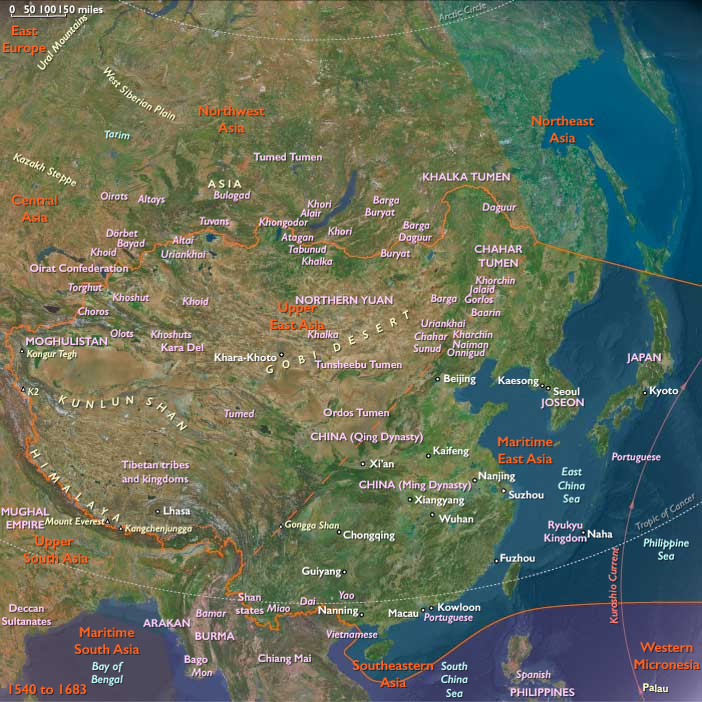
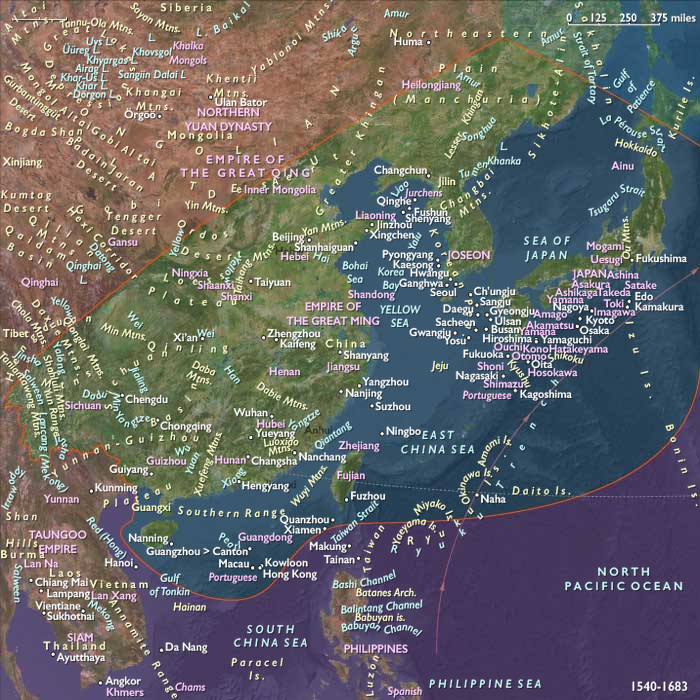
Wu Sangui starts the rebellion in 1674 in the name of "overthrowing Qing and restoring Ming”.
Wu's forces capture Hunan and Sichuan provinces.
...Shang Kexi follow suit in Fujian and Guangdong provinces.
At the same time, ...
...Sun Yanling and ...
...Wang Fuchen also rise in revolt in Guangxi and Shaanxi provinces.
...Zheng Jing, ruler of the Kingdom of Tungning, leads a one hundred and fifty thousand strong army from Taiwan and ...
...lands on Fujian to join the rebel forces.
On the Qing government's side, the Kangxi Emperor rallies the imperial armies to crush the rebellions.
The current war between Poland and the Ottoman Empire has reactivated the work of Bulgarian Catholic notables Petar Bogdan and Petar Parchevich, who have long sought the support of the powerful Catholic states for a long planned uprising against the Ottomans in the Catholic regions of Bulgaria.
A coalition against the Ottomans fails to form, however, with Parchevich dying in Rome on July 23, 1674 and Bogdan following in September of the same year.
