
The philosopher Christian Wolff is ousted from …
Years: 1723 - 1723
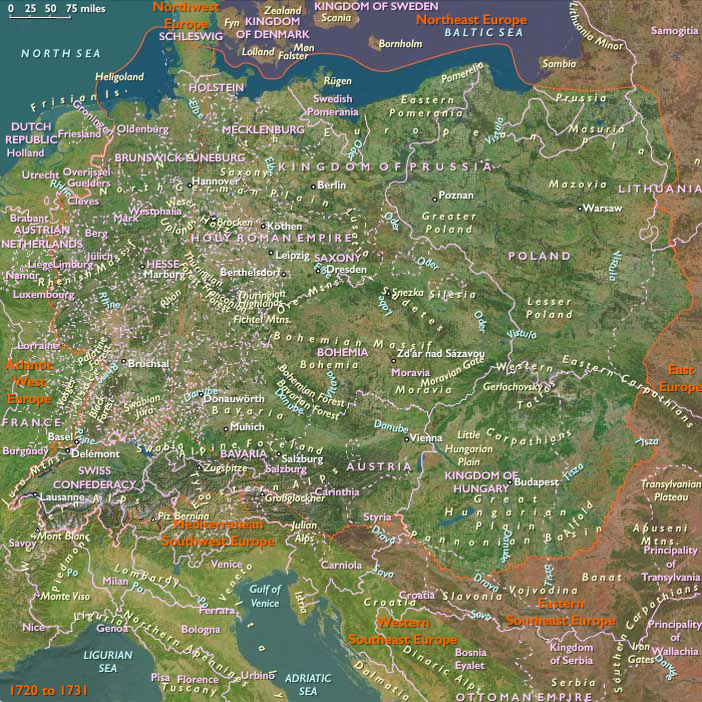
The philosopher Christian Wolff is ousted from his first chair at Halle in 1723 in one of the most celebrated academic dramas of the eighteenth century.
Born in Breslau, Silesia, in modest circumstances, Wolff had studied first mathematics and physics at the University of Jena, to which he had soon added philosophy.
He had qualified in 1703, has Privatdozent in the University of Leipzig, where he lectured till 1706, when he had been called as professor of mathematics and natural philosophy to Halle.
He had earlier made the acquaintance of the German polymath Gottfried Wilhelm Leibniz, of whose philosophy his own system is a modification.
In Halle, Wolff had limited himself at first to mathematics, but on the departure of a colleague he had added physics, and presently included all the main philosophical disciplines.
The claims that Wolff advanced on behalf of the philosophic reason, however, had appeared impious to his theological colleagues.
Halle is the headquarters of Pietism, which, after a long struggle against Lutheran dogmatism, has itself assumed the characteristics of a new orthodoxy.
Wolff's professed ideal is to base theological truths on evidence of mathematical certitude, and strife with the Pietists had broken out openly in 1721, when Wolff, on the occasion of laying down the office of pro-rector, had delivered an oration "On the Practical Philosophy of the Chinese,” in which he had praised the purity of the moral precepts of Confucius, pointing to them as an evidence of the power of human reason to attain by its own efforts to moral truth.
His enemies had gained the ear of the king Frederick William I and represented to him that, if Wolff's determinism were recognized, no soldier who deserted could be punished, since he would only have acted as it was necessarily predetermined that he should.
This so enraged the king that he had at once deprived Wolff of his office, and commanded him to leave Prussian territory within forty-eight hours or be hanged.
Locations
People
Groups
Subjects
Regions
Subregions
Years: 1723 - 1723
Locations
People
Groups
Subjects
Regions
Subregions