
Girisawardhana, son of Kertawijaya, who had assumed …
Years: 1492 - 1503
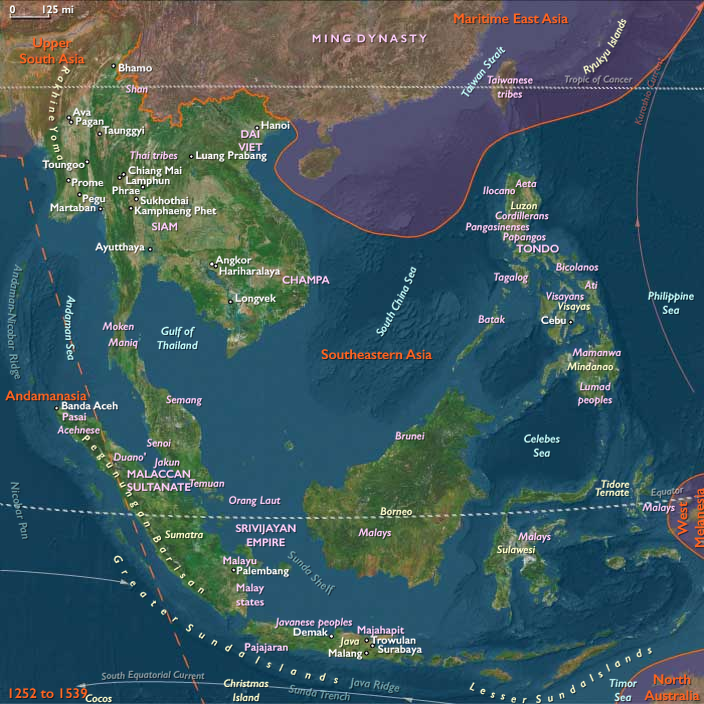
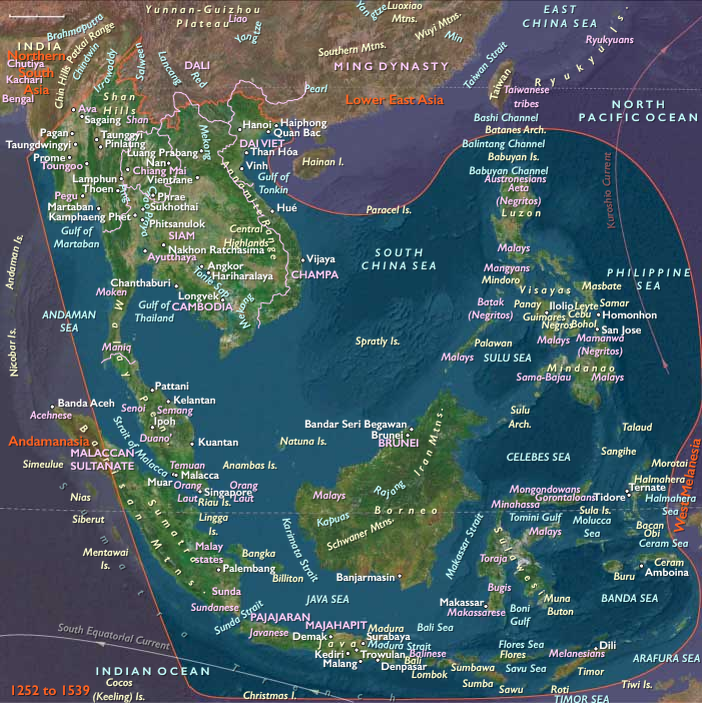
Girisawardhana, son of Kertawijaya, who had assumed power in 1456, had died ten years later and been succeeded by Singhawikramawardhana.
In 1468, Prince Kertabhumi had rebelled against Singhawikramawardhana, styling himself king of Majapahit.
Singhawikramawardhana had responded by moving the kingdom’s capital further inland to Daha (the former capital of Kediri kingdom), effectively splitting Majapahit, under Singhawikramawardhana in Daha and …
Locations
Groups
Subjects
Regions
Subregions
Related Events
Filter results
Showing 10 events out of 40412 total
Because it is spread by returning French troops, the disease is known as "French disease", and it will not be until 1530 that the Italian physician and poet Girolamo Fracastoro first applies the term "syphilis" to the disease.
The exact origin of syphilis is unknown.
There are two primary hypotheses: one proposes that syphilis was carried to Europe from the Americas by the crew of Christopher Columbus, the other proposes that syphilis previously existed in Europe (as a mutated variety of yaws) but went unrecognized.
Evidence published in late 2011 will suggest that the Columbian hypothesis is the valid one.
The Columbian theory holds that syphilis was a New World disease brought back by Columbus and Martín Alonso Pinzón.
Columbus's voyages to the Americas had occurred three years before the Naples syphilis outbreak of 1494.
This theory is supported by genetic studies of venereal syphilis and related bacteria, which found a disease intermediate between yaws and syphilis in Guyana, South America.
Researchers concluded that syphilis was carried from the New World to Europe after Columbus' voyages.
Many of the crew members who served on this voyage had later joined the army of King Charles VIII in his invasion of Italy in 1495, resulting in the spreading of the disease across Europe and as many as five million deaths.
The findings suggested Europeans could have carried the nonvenereal tropical bacteria home, where the organisms may have mutated into a more deadly form in the different conditions and low immunity of the population of Europe.
The syphilis virus, spreading quickly, reaches Switzerland and Germany in 1495, and by 1500 reaches epidemic proportions.
Europeans begin treating syphilis with mercury compounds, based on Arabic use of these compounds to treat skin diseases.
Portuguese mariner Vasco da Gama becomes, in 1498, the first European to sail around Africa to reach India, opening the East to Portuguese commerce.; his crew members may have brought syphilis to South India.
Syphilis is almost immediately stigmatized: each country blames the outbreak on a neighbor country or rival bloc.
The Danish, the Portuguese and the inhabitants of the Mahgreb name it ‘the Castilian disease’ or ’the Spanish Disease.
The French call it ‘the Neapolitan disease’.
Italians, Germans, and English name syphilis ‘the French disease’; the Poles call it ‘the German disease’ and the Russians name it ‘Polish disease’.
The Turks call syphilis the ‘Christian disease’.
In northern India, the Muslims blame the Hindus for the outbreak; the Hindus blame the Muslims.
Both parties ultimately blame the Europeans.
A group of Māori migrates east before 1500 to the tiny Chatham Islands east of New Zealand, where, by adapting to the local climate and the availability of resources, they develop a culture known as the "Moriori"—related to but distinct from Māori culture in mainland New Zealand.
Evidence supporting this theory comes from the characteristics that the Moriori language has in common with the dialect of Māori spoken by the Ngāi Tahu tribe of the South Island, and comparisons of the genealogies of Moriori ("hokopapa") and Māori ("whakapapa").
Prevailing wind patterns in the southern Pacific add to the speculation that the Chatham Islands were the last part of the Pacific to be settled during the period of Polynesian discovery and colonization.
he word Moriori derives from Proto-Polynesian *ma(a)qoli, which has the reconstructed meaning "true, real, genuine".
It is cognate with the Māori language word Māori and likely also had the meaning "(ordinary) people".
The earliest indication of human occupation of the Chathams, inferred from middens exposed due to erosion of sand dunes, has been established as 450 years BP.
The Moriori, who are culturally Polynesian, will develop a distinct culture in the Chatham Islands as they adapt to local conditions.
Nan Serunai, an ancient kingdom in South Kalimantan, had been replaced by the Buddhist kingdom of Tanjungpuri.
In the fourteenth century, the Banjarmasin region had been part of the Hindu kingdoms of Negara Dipa and Negara Daha, a vassal of Majapahit, but its ruler, Pangeran Samudera, converts to Islam in the late fifteenth century.
The rulers of the crumbling Majapahit empire have found themselves unable to control the rising power of the Sultanate of Malacca in the western part, which in the mid-fifteenth century had begun to gain effective control of the Malacca Strait and to expand its influence to Sumatra.
…Bhre Kertabumi in Trowulan.
Singhawikramawardhana had continued his rule until he was succeeded by his son Ranawijaya in 1474.
Several other former Majapahit vassals and colonies had begun to release themselves from Majapahit domination and suzerainty, but Kertabhumi manages to reverse this trend.
He has allied Majapahit with Muslim merchants, giving them trading rights on the north coast of Java, with Demak as its center; in return he asks for their loyalty to Majapahit.
This policy has boosted the Majapahit treasury and power but has weakened Hindu-Buddhism as its main religion because Islam spreads faster.
Hindu-Buddhist followers' grievances later pave the way for Ranawijaya to defeat Kertabhumi.
Chinese metallurgists achieve large-scale production of zinc by the sixteenth century.
Japan’s Sengoku, or Civil War, Era has seen the creation of a permanent wartime economy that results in markedly increased GNP.
Daimyos encourage the development and expansion of rice farming, support flood control programs, and open new mines.
The era sees the introduction of new iron refining technology.
On the negative side, the war era sees the devolution of social and ethical mores and the erosion of loyalty, honesty and other virtues associated with Bushido, the warriors’ code of behavior.
As daimyo began to be slain by their own men, a new word comes into use: Gekokujo, meaning “one of lower class slays one of the higher”.
The in scale begins to be common in Japanese folk songs and music.
The in scale (also known as the Sakura pentatonic scale due to its use in the well-known folk song Sakura Sakura) is, according to a traditional theory, one of two pentatonic scales used in much Japanese music, excluding gagaku and Buddhist chanting.
The in scale, which contains semitones, is used specifically in music for the koto and shamisen and is contrasted with the yo scale, which does not contain semitones.
The Swift Development of Printing, Typography, and Mathematical Symbols in Renaissance Europe
By the late 15th and early 16th centuries, European printing and typography advanced rapidly, revolutionizing literacy, knowledge dissemination, and scientific progress. At the same time, standardized mathematical notation, including the + (plus) and – (minus) symbols, was introduced, streamlining arithmetic and algebraic calculations.
The Growth of Book Printing and Typography
- Johannes Gutenberg’s invention of the printing press (c. 1440) with movable type transformed European communication.
- By 1500, printing presses were operating in more than 200 European cities, with major centers in Germany, Italy, France, and the Low Countries.
- This explosion of printed books (incunabula) facilitated:
- The spread of Renaissance humanism through easily accessible texts.
- The standardization of typefaces and fonts, leading to early typographic designs such as Roman type (Antiqua) and Italic type (developed by Aldus Manutius in 1501).
- The proliferation of scientific and mathematical works, advancing European knowledge.
The Introduction of + and − Symbols in Mathematics
- Before the 15th century, arithmetic operations were described in words rather than symbols.
- The plus (+) and minus (−) signs were introduced in printed European mathematical texts by:
- Johannes Widmann (1489) – A German mathematician who first used "+" and "−" in commercial arithmetic.
- Luca Pacioli (1494) – The Italian mathematician, in his Summa de Arithmetica, helped popularize the notation.
- Robert Recorde (1557) – A Welsh mathematician who later introduced the "=" (equals) symbol, further improving algebraic notation.
Impact on Science, Commerce, and Education
- Printing enabled the mass production of mathematical texts, ensuring the rapid spread of algebra, arithmetic, and bookkeeping methods across Europe.
- The use of + and − simplified calculations, benefiting merchants, bankers, and scientists.
- The combination of typography advancements and mathematical symbols laid the foundation for the Scientific Revolution, making knowledge more accessible, standardized, and widely used.
Thus, the parallel growth of printing technology and mathematical notation in the Renaissance marked a critical turning point in European intellectual history, influencing education, commerce, and scientific inquiry for centuries to come.
