
The Republic of Colombia, in addition to …
Years: 1816 - 1827
The Republic of Colombia, in addition to acquiring a fine new constitution, is the first Spanish American nation to obtain diplomatic recognition from the United States, in 1822; British recognition follows three years later.
In 1824 Colombia even raises a foreign loan on the London market for the extraordinary sum of thirty million pesos (at this time equivalent to dollars).
This consists in part of mere refinancing of earlier obligations incurred during the independence struggle.
It will prove impossible to maintain debt service, but the fact that the loan is even granted, on what for the time are quite favorable terms, attests to the prestige of Bolivar's creation.
Another sign of the Republic of Colombia's international prestige is the fact that it plays host to Bolivar's Congress of Panama of 1826, which in the end accomplishes little but is the first in a long line of Pan-American gatherings.
Yet even before this meeting begins, the fragility of the republic's unity is becoming apparent.
The first serious crack comes in Venezuela, where many people have been unhappy from the start with formal subjection to authorities in Bogota, particularly when the head of government turns out to be the New Granadan, Vice President Santander, who becomes acting chief executive when Bolivar continues personally leading his armies against Spain.
Indeed, Bolivar carries the struggle into Peru and stays there even after the Battle of Ayacucho, won by Sucre in December 1824, puts an end to serious royalist resistance.
Venezuelans do have some real grievances, but equally important is the feeling that their present status is a step down from that of the colonial captaincy general, which for most purposes took orders (not necessarily obeyed) directly from Madrid.
Thus, when General José Antonio Páez, the leading military figure in Venezuela, is summoned to Bogota early in 1826 to answer charges against him in the Congress of the Republic (Congreso de la Republica), he refuses to go, and most of Venezuela joins him in defiance.
Both Páez and Santander look for support to Bolivar, still absent in Peru, but he proves less interested in the immediate dispute than in the opportunity that the crisis seems to offer to revamp Colombian institutions in a form more to his liking.
Bolivar knows that Venezuelan regionalism is not the only problem to be faced.
There is similar, if less critical, unrest in Ecuador.
In 1824 Colombia even raises a foreign loan on the London market for the extraordinary sum of thirty million pesos (at this time equivalent to dollars).
This consists in part of mere refinancing of earlier obligations incurred during the independence struggle.
It will prove impossible to maintain debt service, but the fact that the loan is even granted, on what for the time are quite favorable terms, attests to the prestige of Bolivar's creation.
Another sign of the Republic of Colombia's international prestige is the fact that it plays host to Bolivar's Congress of Panama of 1826, which in the end accomplishes little but is the first in a long line of Pan-American gatherings.
Yet even before this meeting begins, the fragility of the republic's unity is becoming apparent.
The first serious crack comes in Venezuela, where many people have been unhappy from the start with formal subjection to authorities in Bogota, particularly when the head of government turns out to be the New Granadan, Vice President Santander, who becomes acting chief executive when Bolivar continues personally leading his armies against Spain.
Indeed, Bolivar carries the struggle into Peru and stays there even after the Battle of Ayacucho, won by Sucre in December 1824, puts an end to serious royalist resistance.
Venezuelans do have some real grievances, but equally important is the feeling that their present status is a step down from that of the colonial captaincy general, which for most purposes took orders (not necessarily obeyed) directly from Madrid.
Thus, when General José Antonio Páez, the leading military figure in Venezuela, is summoned to Bogota early in 1826 to answer charges against him in the Congress of the Republic (Congreso de la Republica), he refuses to go, and most of Venezuela joins him in defiance.
Both Páez and Santander look for support to Bolivar, still absent in Peru, but he proves less interested in the immediate dispute than in the opportunity that the crisis seems to offer to revamp Colombian institutions in a form more to his liking.
Bolivar knows that Venezuelan regionalism is not the only problem to be faced.
There is similar, if less critical, unrest in Ecuador.
Locations
People
Groups
- Tairona
- Muisca (Amerind tribe)
- Spaniards (Latins)
- Venezuela Province
- Britain, Kingdom of Great
- United States of America (US, USA) (Washington DC)
- New Granada, United Provinces of
- Colombia, Republic of (Gran Colombia)
Topics
- Colonization of the Americas, Spanish
- Colombian War of Independence
- Bolivar's War
- Bolívar's campaign to liberate New Granada
- Ayacucho, Battle of
Commodoties
Subjects
Regions
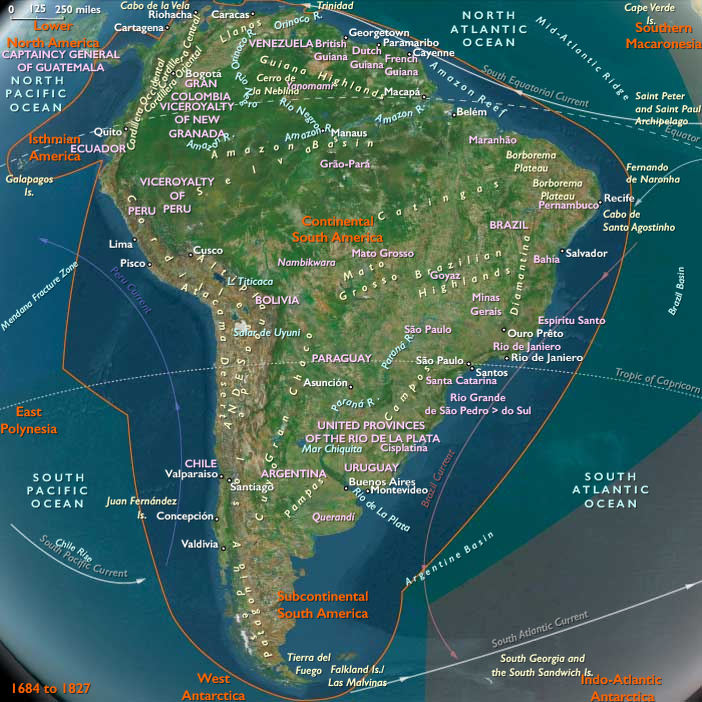
Subregions
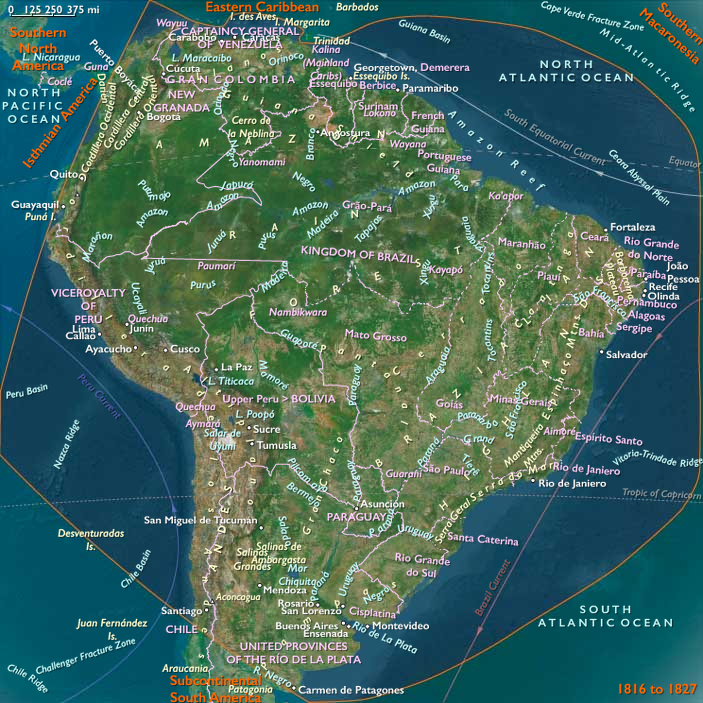
Related Events
Showing 10 events out of 20863 total
Years: 1816 - 1827
Locations
People
Groups
- Tairona
- Muisca (Amerind tribe)
- Spaniards (Latins)
- Venezuela Province
- Britain, Kingdom of Great
- United States of America (US, USA) (Washington DC)
- New Granada, United Provinces of
- Colombia, Republic of (Gran Colombia)
Topics
- Colonization of the Americas, Spanish
- Colombian War of Independence
- Bolivar's War
- Bolívar's campaign to liberate New Granada
- Ayacucho, Battle of
Commodoties
Subjects
Regions
Subregions