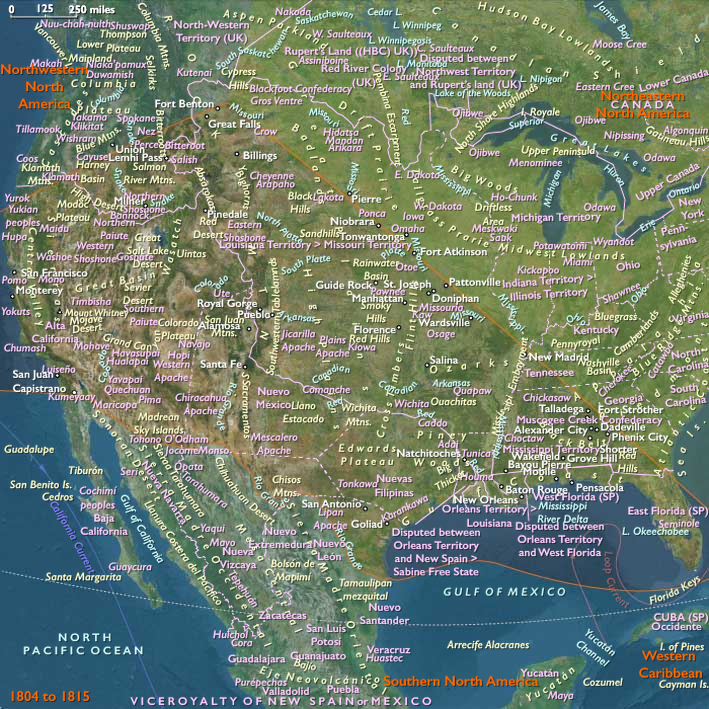
Gulf and Western North America (1804–1815 CE): …
Years: 1804 - 1815
Gulf and Western North America (1804–1815 CE): Territorial Expansion and Indigenous Transformations
American Territorial Expansion and Indigenous Alliances
Following the Louisiana Purchase of 1803, the United States government seeks alliances with local indigenous peoples to solidify its new territorial claims. Among these, the Caddo tribes maintain neutrality, providing vital information and acting as intermediaries. Their strategic non-alignment spares them from the brutal reprisals seen by other indigenous nations during the War of 1812, such as the Creeks, who suffer significantly under generals like William Henry Harrison, William Clark, and Andrew Jackson.
Exploration and Documentation of the West
This period sees intensified exploration of the newly acquired western territories. In 1805–1806, Army Lieutenant Zebulon Pike leads expeditions to the headwaters of the Mississippi River and explores the Red and Arkansas Rivers, venturing deep into Spanish-held territories and sighting the peak in Colorado now bearing his name. Naturalists such as Thomas Nuttall and John Bradbury accompany expeditions, documenting flora and fauna extensively. Nuttall's later work, including his influential book "A Journal of Travels into the Arkansas Territory," significantly contributes to early American natural history, despite the eventual loss of many of his specimens and records.
Comanche Power and Plains Warfare
The Comanche experience substantial demographic growth during this period, bolstered by plentiful buffalo herds, continuous Shoshone migrations, and the integration of large numbers of captives from various groups. Their skill in capturing and training wild horses further enhances their military and economic strength. With an estimated population of thirty to forty thousand people, the Comanche manage herds exceeding one hundred thousand horses, making them one of the most formidable equestrian powers on the Plains. Their strategic use of the full moon—known as the "Comanche Moon"—to conduct raids into Mexican territories, particularly the state of Chihuahua, underscores their military effectiveness.
Spanish Territorial and Administrative Changes
Spain adjusts administrative structures to reinforce its hold on the region. In 1804, the Spanish crown divides Las Californias into Baja California in the south and Alta California in the north. This administrative reorganization, combined with extensive land grants, encourages increased Spanish settlement and ranching activities, laying the foundations for California's distinct ranchero culture.
Key Historical Developments
-
The U.S. government establishes alliances with neutral indigenous nations such as the Caddo, leveraging their strategic neutrality.
-
Exploration led by figures like Zebulon Pike and Thomas Nuttall significantly expands American knowledge of the western territories.
-
The Comanche solidify their position as a dominant force on the southern Plains, utilizing their immense equestrian resources and strategic warfare practices.
-
Spanish administrative restructuring of California enhances settlement and development, reinforcing Spanish influence in the region.
Long-Term Consequences and Historical Significance
The years from 1804–1815 mark a critical era of territorial exploration, indigenous adaptation, and strategic alignments in Gulf and Western North America. The United States' westward expansion, coupled with the resilient adaptations of indigenous groups such as the Comanche, sets the stage for future conflicts and alliances, profoundly shaping the demographic and geopolitical landscape of the American West.
Years: 1804 - 1815
People
Groups
- Muscogee, or Creek, people (Amerind tribe)
- Caddo (Amerind tribe)
- New Spain, Viceroyalty of
- Spain, Habsburg Kingdom of
- Comanche (Amerind tribe)
- Californias, the
- United States of America (US, USA) (Washington DC)
- Alta California
- Baja California
Topics
Subjects
Regions
Subregions