
Gulf and Western North America (1864–1875 CE): …
Years: 1864 - 1875
Gulf and Western North America (1864–1875 CE): Reconstruction, Conflict, and Change
Post-Civil War Reconstruction
Following the American Civil War (1861–1865), the Reconstruction era begins as the United States seeks to reintegrate and rebuild the South. Initially aiming to restore unity and heal divisions, the assassination of President Abraham Lincoln in April 1865 reignites tensions between the North and South. Republicans in Congress push aggressively to ensure civil rights and protections for African Americans, efforts that persist until the Compromise of 1877, when federal protections are withdrawn in exchange for political concessions.
Epidemics and Health Crises
The spread of cholera and typhus continues to devastate populations during this period. Cholera outbreaks in the 1870s claim approximately fifty thousand lives, spreading from New Orleans along the Mississippi River and its tributaries. Typhus epidemics also strike cities such as Baltimore, Memphis, and Washington, DC, between 1865 and 1873, exacerbating postwar social and economic challenges.
Indigenous Displacement and Military Conflict
Indigenous peoples face ongoing displacement and conflict. In the Southwest, the United States Army battles the Navajo and Apache (1860–1865). On the Great Plains, the United States intensifies efforts to confine Native tribes to reservations. The Treaty of Medicine Lodge (1867) attempts to restrict the Comanche, Kiowa, Cheyenne, Arapaho, and Apache tribes to smaller lands, promising protections that ultimately fail to materialize. In response, the Comanche under Isa-tai launch the Second Battle of Adobe Walls in 1874, suffering a decisive defeat. This leads to the Red River War, culminating in the Battle of Palo Duro Canyon, where the last independent Comanche bands, led by Quanah Parker, surrender in 1875.
The Decline of the Plains Buffalo
During this period, the systematic slaughter of buffalo herds reaches catastrophic levels, significantly undermining the traditional ways of life for Plains tribes, especially the Comanche, Kiowa, and Sioux. Within a decade, the once-massive herds are nearly extinct, dealing a severe blow to indigenous economies and cultures dependent on buffalo hunting.
Pawnee and Osage Struggles and Alliances
The Pawnee play crucial roles as scouts for the U.S. Army between 1864 and 1877, notably participating in conflicts against traditional rivals, including the Sioux, Cheyenne, Arapaho, Comanche, and Kiowa. Their service is pivotal during the Powder River Expedition (1865) and the Great Sioux War of 1876. Meanwhile, the Osage tribe endures severe hardships, caught between Union and Confederate forces during the Civil War, experiencing significant famine and instability as their lands continue to be reduced through treaties.
Railroads and Western Expansion
The completion of transcontinental railways following the Civil War accelerates westward migration, economic expansion, and conflict with indigenous populations. Railroads facilitate increased settlement, trade, and migration to formerly remote areas, profoundly transforming the regional economy and accelerating the displacement of native tribes.
Key Historical Developments
-
Reconstruction efforts reshape the postwar South but falter due to political compromise.
-
Severe cholera and typhus epidemics devastate populations throughout the 1860s and 1870s.
-
The Comanche and other Plains tribes resist confinement but ultimately suffer military defeat and displacement.
-
Near-extinction of buffalo herds severely impacts Plains indigenous cultures and economies.
-
Pawnee scouts actively assist the U.S. Army in military campaigns against rival tribes.
-
Rapid railroad expansion accelerates westward migration and intensifies conflicts with indigenous peoples.
Long-Term Consequences and Historical Significance
The period from 1864 to 1875 is marked by dramatic changes across Gulf and Western North America. Reconstruction efforts, despite initial promise, fall short in securing lasting civil rights. Meanwhile, indigenous populations endure significant losses of land, autonomy, and traditional livelihoods, setting the stage for profound economic and cultural transformations that shape the region's future.
People
Groups
- Wichita, or Kitikitish (Amerind tribe)
- Osage Nation (Amerind tribe)
- Dakota, aka Santee Sioux (Amerind tribe)
- Lakota, aka Teton Sioux (Amerind tribe)
- Hidatsa people (Amerind tribe)
- Blackfoot Confederacy
- Cheyenne people (Amerind tribe)
- Arapaho people (Amerind tribe)
- Gros Ventre or “Atsina” people (Amerind tribe)
- Kiowa people (Amerind tribe)
- Apache (Na-Dené tribe)
- Navajo people (Na-Dené tribe)
- Pawnee (Amerind tribe)
- Mandan (Amerind tribe)
- Comanche (Amerind tribe)
- Seminole (Amerind tribe)
- United States of America (US, USA) (Washington DC)
- Mormons, or Church of Jesus Christ of Latter-day Saints
- California Republic
- Confederate States of America (C.S.A.)
Topics
- Sioux Wars
- Apache and Navaho War of 1860-65
- American Civil War (War between the States, War of the Rebellion, War of Secession, War for Southern Independence)
- American Civil War & Reconstruction; 1864 through 1875
- Powder River Expedition (1865)
Commodoties
Subjects
- Commerce
- Watercraft
- Public health
- Labor and Service
- Conflict
- Government
- Custom and Law
- Human Migration
Regions
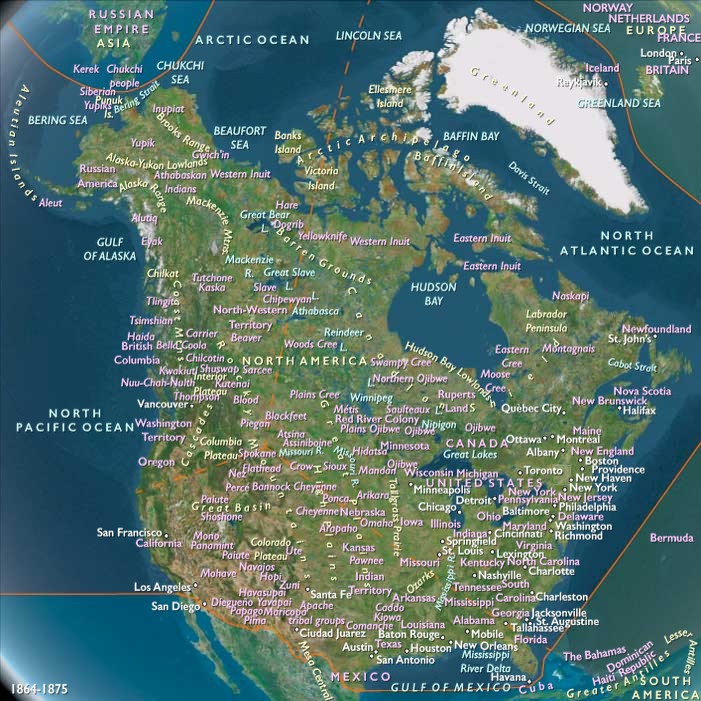
Subregions
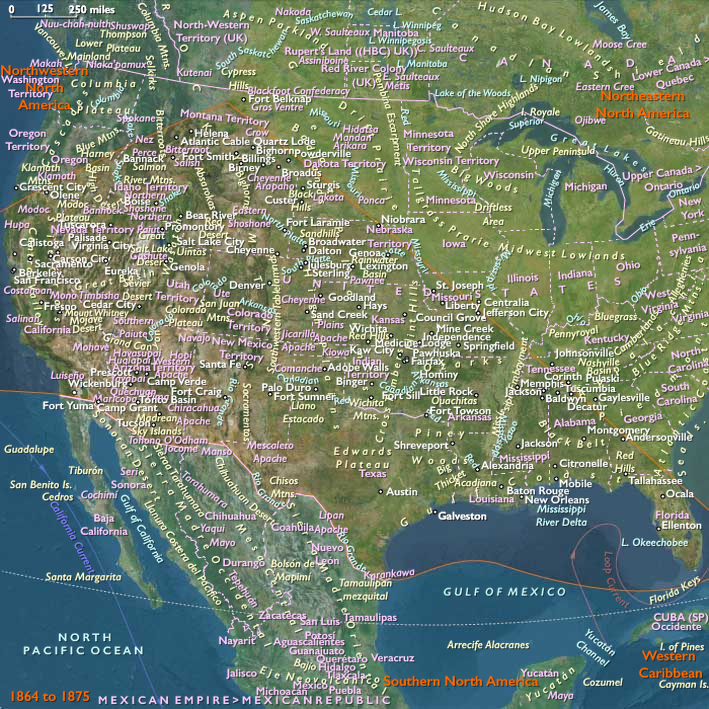
Years: 1864 - 1875
People
Groups
- Wichita, or Kitikitish (Amerind tribe)
- Osage Nation (Amerind tribe)
- Dakota, aka Santee Sioux (Amerind tribe)
- Lakota, aka Teton Sioux (Amerind tribe)
- Hidatsa people (Amerind tribe)
- Blackfoot Confederacy
- Cheyenne people (Amerind tribe)
- Arapaho people (Amerind tribe)
- Gros Ventre or “Atsina” people (Amerind tribe)
- Kiowa people (Amerind tribe)
- Apache (Na-Dené tribe)
- Navajo people (Na-Dené tribe)
- Pawnee (Amerind tribe)
- Mandan (Amerind tribe)
- Comanche (Amerind tribe)
- Seminole (Amerind tribe)
- United States of America (US, USA) (Washington DC)
- Mormons, or Church of Jesus Christ of Latter-day Saints
- California Republic
- Confederate States of America (C.S.A.)
Topics
- Sioux Wars
- Apache and Navaho War of 1860-65
- American Civil War (War between the States, War of the Rebellion, War of Secession, War for Southern Independence)
- American Civil War & Reconstruction; 1864 through 1875
- Powder River Expedition (1865)
Commodoties
Subjects
- Commerce
- Watercraft
- Public health
- Labor and Service
- Conflict
- Government
- Custom and Law
- Human Migration
Regions
Subregions