…Halicarnassus, the result of a synoecism in …
Years: 381BCE - 370BCE
…Halicarnassus, the result of a synoecism in which Greeks and native Carians (“Lelegians”) are integrated into a new city physically beautified with monumental buildings, a great wall circuit, and a secret dockyard and canal, while its population is swollen by the enforced transference of the neighboring Lelegians.
Locations
People
Groups
Topics
Commodoties
Subjects
Regions
Subregions
Related Events
Filter results
Showing 10 events out of 64846 total
Thracian society is tribal in structure, with little inclination toward political cohesion.
In what is to become a persistent phenomenon in Balkan history, unity is brought about mostly by external pressure.
The Persian invasions of the sixth and fifth centuries BCE have brought the Thracian tribes together in the Odrysian kingdom, in which members of the Odrysae tribe briefly unify their fellow Thracians into an empire.
The Middle East: 381–370 BCE
Evagoras’ Final Struggle and Persian Reassertion
The conflict between Evagoras of Salamis and the Persian Empire under Artaxerxes II continues, turning decisively against Evagoras in 381 BCE. At the critical Battle of Citium, Evagoras' fleet suffers a devastating defeat, forcing him to retreat to Salamis, where he is effectively besieged by Persian forces. Despite these setbacks, Evagoras exploits internal Persian discord, notably disagreements between Persian generals, to negotiate peace terms in 376 BCE. Under this settlement, Evagoras retains nominal kingship over Salamis but is compelled to acknowledge Persian sovereignty and pay annual tribute, effectively becoming a Persian vassal.
Celebrated in contemporary Greek literature, notably Isocrates’ panegyric, Evagoras is portrayed as an exemplary ruler committed to fostering Greek culture and civilization within Cyprus. His reign sees the adoption of the Greek alphabet in place of the traditional Cypriot syllabary, marking a significant cultural shift that integrates Cyprus more firmly into the Greek cultural sphere.
Despite his achievements, Evagoras meets an untimely end when he is assassinated in 374 BCE by a eunuch motivated by personal vengeance. He is succeeded by his likely son, Nicocles, who continues the delicate balance of nominal independence under Persian oversight.
A rebellion of several satraps in the Achaemenid Empire against the authority of the Great King Artaxerxes II Mnemon begins in 372 BCE.
Evagoras of Salamis, according to Isocrates's panegyric, is a model ruler, whose aim is to promote the welfare of his state and of his subjects by the cultivation of Greek refinement and civilization.
Isocrates also states that many people migrated from Greece to Cyprus because of the noble rule of Evagoras.
Other sources of this period—Diodorus Siculus 14.115, 15.2-9; Xenophon, Hellenica 4.8—are not as unrestrainedly complimentary.
Evagoras has been called a pioneer of the adoption of the Greek alphabet in Cyprus in place of the older Cypriot syllabary.
Although Cypriots are Greeks and their language a dialect of Greek, the Arcadocypriot, they formerly wrote in an older and more difficult system, called Cypriot syllabary.
The war between Evagoras and Artaxerxes turns in the Persian favor in 381 BCE, when Evagoras' fleet is destroyed at the Battle of Citium, and he is compelled to flee to Salamis.
Here, although closely blockaded, Evagoras manages to hold his ground, and takes advantage of a quarrel between the two Persian generals to conclude peace in 376.
Evagoras is allowed to remain nominally king of Salamis, but in reality a vassal of Persia, to which he is to pay a yearly tribute.
The chronology of the last part of his reign is uncertain.
In 374, he is assassinated by a eunuch from motives of private revenge.
He is succeeded by his (probable) son, Nicocles.

A second Buddhist council, convened by King Kalasoka, takes place at Vaishali in about 383 BCE, during which the advocates of certain relaxations in the vinaya rules are condemned.
Traditions regarding the Second Council are confusing and ambiguous, but it is agreed that the overall result was the first schism in the Sangha, between the Sthaviras and the Mahāsāṃghikas, although the cause of the split is not universally agreed upon.
The origins of the Mahāsāṃghika sect of Buddhism are still extremely uncertain, and the subject of debate among scholars.
One reason for the interest in the origins of the Mahāsāṃghika school is that their Vinaya recension appears in several ways to represent an older redaction overall.
Many scholars also look to the Mahāsāṃghika branch for the initial development of Mahāyāna Buddhism.
Near East (381–370 BCE): Carian Autonomy and the Samaritan Temple
Between 381 and 370 BCE, important regional developments highlight ongoing shifts in power and identity within the Near East. Hecatomnus, appointed satrap of the newly formed Persian satrapy of Caria, asserts a relatively independent authority under Persian oversight until his death in 377 BCE. His rule marks a notable period of regional autonomy, reflected by inscriptions dedicated in Greek script at various local sanctuaries.
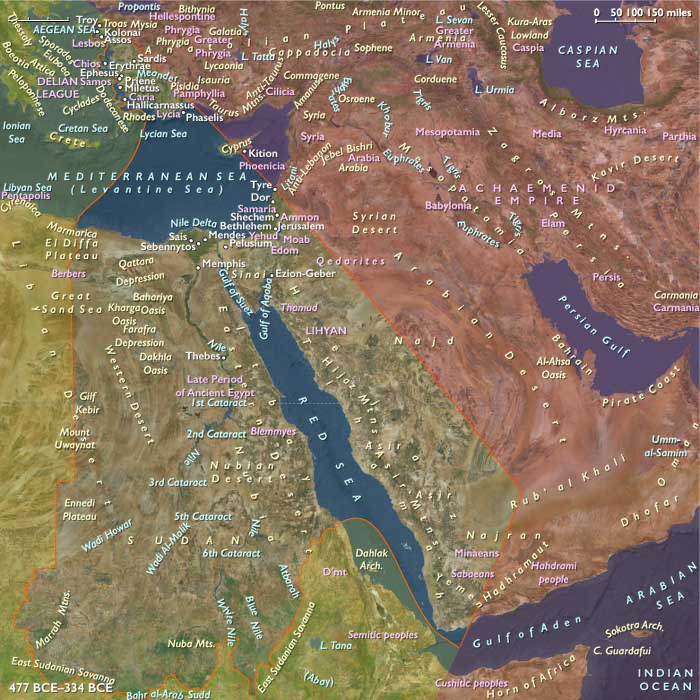
His successor, Mausolus, notably transfers the Carian capital from inland Mylasa to the coastal city of Halicarnassus, resulting in significant urban and cultural transformation. Halicarnassus is dramatically expanded and beautified through monumental architecture, a robust defensive wall, and a secret dockyard connected by canal. The city's population swells with the integration of local Carians, reflecting Mausolus's efforts to consolidate Carian power and identity amid Persian hegemony.
Simultaneously, in the province of Samaria, regional autonomy is reinforced as the local Samaritans, their overtures rejected by the returned Judahites, establish their own distinct religious identity. They construct a temple at Shechem, near the base of Mount Gerizim, asserting their religious independence from Jerusalem and shaping the lasting cultural and religious landscape of the region.
Hecatomnus, who had been appointed satrap of the new separate satrapy of Caria, perhaps in the mid-390s, as a counterpoise to Sparta, rules his pocket principality under light Persian authority until 377, making dedications in Greek script at a number of local sites and sanctuaries.
His son Mausolus, a major Hellenizing force, transfers his capital from inland Mylasa to ...
The Persian provinces of Samaria and Ammon remain under governors of the houses of Sanballat and Tobiahin in the fourth century BCE.
The Samarians, their overtures spurned by Judahites returned from the Babylonian Captivity, build their own temple in Shechem, at the base of Mount Gerizim.
The collapse of Athenian power in the Peloponnesian War (431-404 BCE), the weakening of the Spartans by their oliganthropia (demographic decline), and the inconclusive Corinthian War (395-386 BCE) has paved the way externally for Theban ascendancy.
Sparta's involvement in Persian civil wars in Asia Minor under Agesilaus II (ruled 399-360) and the subsequent Spartan occupation (382) of the Theban citadel, Cadmea, overextends Spartan power.
The Boeotian or Theban War, which breaks out in 378 BCE as the result of a revolt in Thebes against Sparta, lasts six years.
A peace treaty is agreed but things go seriously awry at the signing—Epaminondas insists that he should sign for the Boeotians as a whole rather than just Thebes, at which the Spartan king Agesilaus strikes the name of Thebes off the list of signatories.
Most of Greece implements the treaty, which means that Thebes faces the Spartan expedition against her alone.
However, the resulting battle at Leuktra in 371 BCE is a decisive Spartan defeat and ushers in the era of Theban hegemony.
Epaminondas goes on to liberate Messenia from Spartan control.
The Illyrians, ethnically akin to the Thracians, had originally inhabited a large area from the Istrian Peninsula to northern Greece and as far inland as the Morava River, but Celtic invasions during the fourth century BCE push the Illyrians southward from the northern Adriatic coast, and hereafter their territory does not extend much farther north than the Drin River.
Illyrian society, like that of the Thracians, is organized around tribal groups who often fight wars with one another and with outsiders.