
Hans Holbein evidently retains favor under the …
Years: 1532 - 1532
Hans Holbein evidently retains favor under the new order.
The reformist council pays him a retaining fee of fifty florins and commissions him to resume work on the Council Chamber frescoes.
They now choose themes from the Old Testament instead of the previous stories from classical history and allegory.
Holbein's frescoes of Rehoboam and of the meeting between Saul and Samuel are more simply designed than their predecessors.
Holbein works for traditional clients at the same time.
His old patron Jakob Meyer pays him to add figures and details to the family altarpiece he had painted in 1526.
Holbein's last commission in this period is the decoration of two clock faces on the city gate in 1531.
The reduced levels of patronage in Basel may have prompted his decision to return to England early in 1532.
Until the later 1530s, Holbein will often place his sitters in a three-dimensional setting.
At times, he includes classical and biblical references and inscriptions, as well as drapery, architecture, and symbolic props.
Such portraits allow Holbein to demonstrate his virtuosity and powers of allusion and metaphor, as well as to hint at the private world of his subjects.
His 1532 portrait of Sir Brian Tuke, for example, alludes to the sitter's poor health, comparing his sufferings to those of Job.
The depiction of the Five wounds of Christ and the inscription "INRI" on Tuke's crucifix are, according to scholars Bätschmann and Griener, "intended to protect its owner against ill-health".
Holbein portrays the merchant Georg Gisze among elaborate symbols of science and wealth that evoke the sitter's personal iconography.
However, some of Holbein's other portraits of Steelyard merchants, for example that of Derich Born, concentrate on the naturalness of the face.
They prefigure the simpler style that Holbein favors in the later part of his career.
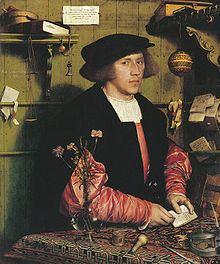
Hans Holbein the Younger; portrait of the Merchant Georg Gisze, 1532. Oil and tempera on oak, Berlin State Museums.
Locations
People
Groups
Topics
Subjects
Regions
Subregions
Related Events
Showing 10 events out of 37914 total
Years: 1532 - 1532
Hans Holbein the Younger; portrait of the Merchant Georg Gisze, 1532. Oil and tempera on oak, Berlin State Museums.
Locations
People
Groups
Topics
Subjects
Regions
Subregions