
Genetic studies suggest that the functional DNA …
Years: 857997BCE - 609166BCE
Genetic studies suggest that the functional DNA of modern humans and Homo neanderthalensis diverged five hundred thousand years before the present time.
Similarly, the few specimens of Homo rhodesiensis have also occasionally been classified as a subspecies, but this is not widely accepted.
The analysis indicated that modern humans, Neanderthals, and the Denisova hominin last shared a common ancestor around one million years ago and that this new hominin species was the result of an early migration out of Africa, distinct from the later out-of-Africa migrations associated with Neanderthals and modern humans, but also distinct from the earlier African exodus of Homo erectus.
The estimated time of divergence between Denisovans and Neanderthals is six hundred and forty thousand years ago.
That between both these groups and modern Africans is eight hundred and four thousand years ago.
The divergence of the Denisova mtDNA may result either from the persistence of a lineage purged from the other branches of humanity through genetic drift or else an introgression from an older hominin lineage.
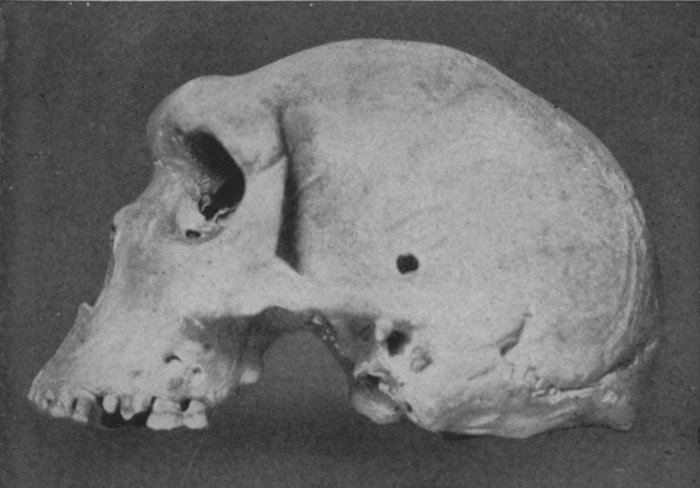
Photo: British Museum (Natural History). SIDE-VIEW OF A PREHISTORIC HUMAN SKULL DISCOVERED IN 1921 IN BROKEN HILL CAVE, NORTHERN RHODESIA Very striking are the prominent eyebrow ridges and the broad massive face. The skull looks less domed than that of modern man, but its cranial capacity is far above the lowest human limit. The teeth are interesting in showing marked rotting or "caries," hitherto unknown in prehistoric skulls. In all probability the Rhodesian man was an African representative of the extinct Neanderthal species hitherto known only from Europe. Date 1922. Source http://www.gutenberg.org/files/20417/20417-h/20417-h.htm Author J. Arthur Thomson.
Topics
Subjects
Related Events
Showing 8 events out of 8 total
Years: 857997BCE - 609166BCE
Photo: British Museum (Natural History). SIDE-VIEW OF A PREHISTORIC HUMAN SKULL DISCOVERED IN 1921 IN BROKEN HILL CAVE, NORTHERN RHODESIA Very striking are the prominent eyebrow ridges and the broad massive face. The skull looks less domed than that of modern man, but its cranial capacity is far above the lowest human limit. The teeth are interesting in showing marked rotting or "caries," hitherto unknown in prehistoric skulls. In all probability the Rhodesian man was an African representative of the extinct Neanderthal species hitherto known only from Europe. Date 1922. Source http://www.gutenberg.org/files/20417/20417-h/20417-h.htm Author J. Arthur Thomson.