
Humans—the genus Homo—may have descended from …
Years: 3097485BCE - 2848654BCE
Humans—the genus Homo—may have descended from australopithecine ancestors, while the genus Ardipithecus is a possible ancestor of the australopithecines.
Australopithecine is the general term for any species in the related genera of Australopithecus and Paranthropus.
They are bipedal and dentally similar to humans, but with a brain size not much larger than that of modern apes.
It appears that the Australopithecus genus evolved in eastern Africa around four million years ago before spreading throughout the continent and eventually becoming extinct two million years ago.
During this time period several australopith species emerges, including Australopithecus afarensis, A. africanus, A. anamensis, A. bahrelghazali, A. garhi and A. sediba.
Opinions differ as to whether the species aethiopicus, boisei, and robustus should be included within the genus Australopithecus, and there is no current consensus as to whether they should be placed in the distinct group of hominids now called the "robust australopiths” or, Paranthropus (Greek para, "beside"; Greek anthropos, “human”).
The fossil record seems to indicate that Australopithecus is the common ancestor of Paranthropus, and most likely the genus Homo, which includes modern humans.
Though the intelligence of these early hominids is likely no more sophisticated than modern apes, the bipedal stature is the key evidence that distinguishes the group from previous primates, who were quadrupeds.
Most species of Australopithecus are no more adept at tool use than modern nonhuman primates, yet modern African apes, chimpanzees, and most recently gorillas, have been known to use crack open nuts with stones and use long sticks to dig for termites in mounds, and chimpanzees have been observed using spears (not thrown) for hunting.
However, some have argued that A. garhi used stone tools due to a loose association of this species and butchered animal remains.
Trace element studies of the strontium/calcium ratios in robust australopith fossils in 1992 suggested the possibility of animal consumption, as they did in 1994 using stable carbon isotopic analysis.
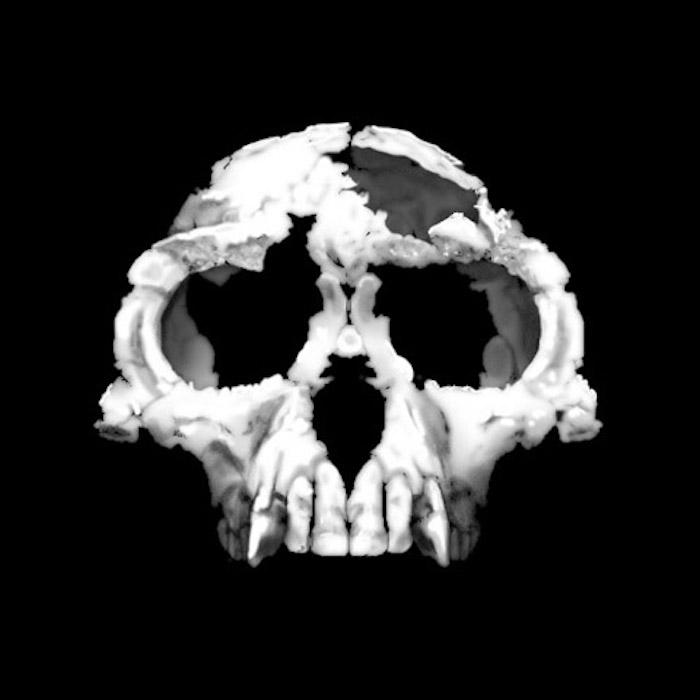
Ardipithecus ramidus specimen, nicknamed ?Ardi?. After Gen Suwa, Berhane Asfaw, Reiko T. Kono, Daisuke Kubo, C. Owen Lovejoy, Tim D. White (2009): "The Ardipithecus ramidus Skull and Its Implications for Hominid Origins." Science, 2 October 2009: Vol. 326. no. 5949, pp. 68e1-68e7, Fig. 2 14 November 2009, 16:50 Source Zanclean skull Uploaded by FunkMonk Author T. Michael Keesey
Topics
Commodoties
Subjects
Years: 3097485BCE - 2848654BCE
Ardipithecus ramidus specimen, nicknamed ?Ardi?. After Gen Suwa, Berhane Asfaw, Reiko T. Kono, Daisuke Kubo, C. Owen Lovejoy, Tim D. White (2009): "The Ardipithecus ramidus Skull and Its Implications for Hominid Origins." Science, 2 October 2009: Vol. 326. no. 5949, pp. 68e1-68e7, Fig. 2 14 November 2009, 16:50 Source Zanclean skull Uploaded by FunkMonk Author T. Michael Keesey