
The first steam engines had been installed …
Years: 1780 - 1791
The first steam engines had been installed in 1776 and were working in commercial enterprises.
These first engines were used to power pumps and produced only reciprocating motion to move the pump rods at the bottom of the shaft.
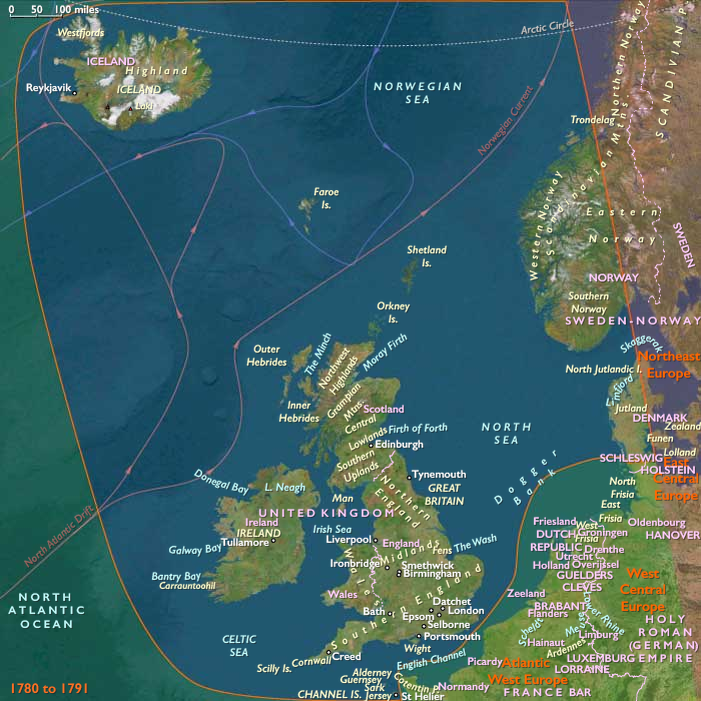
The design was commercially successful, and for the next five years James Watt had been very busy installing more engines, mostly in Cornwall for pumping water out of mines.
These early engines were not manufactured by Boulton and Watt, but were made by others according to drawings made by Watt, who served in the role of consulting engineer.
The erection of the engine and its shakedown was supervised by Watt, at first, and then by men in the firm's employ.
These were large machines.
The first, for example, had a cylinder with a diameter of some fifty inches and an overall height of about twenty-four feet, and required the construction of a dedicated building to house it.
Boulton and Watt charged an annual payment, equal to one third of the value of the coal saved in comparison to a Newcomen engine performing the same work.
The field of application for the invention is greatly widened when Boulton urges Watt to convert the reciprocating motion of the piston to produce rotational power for grinding, weaving and milling.
Although a crank seems the obvious solution to the conversion, Watt and Boulton are stymied by a patent for this, whose holder, James Pickard, and associates propose to cross-license the external condenser.
Watt adamantly opposes this and they circumvent the patent by their sun and planet gear in 1781.
Over the next six years, Watt makes a number of other improvements and modifications to the steam engine.
A double acting engine, in which the steam acts alternately on the two sides of the piston, is one.
He describes methods for working the steam "expansively" (i.e., using steam at pressures well above atmospheric).
A compound engine, which connects two or more engine, is described.
Two more patents are granted for these in 1781 and 1782.
Numerous other improvements that make for easier manufacture and installation are continually implemented.
One of these includes the use of the steam indicator, which produces an informative plot of the pressure in the cylinder against its volume, which he keeps as a trade secret.
Another important invention, one which Watt is most proud of, is the Parallel motion, which is essential in double-acting engines as it produces the straight line motion required for the cylinder rod and pump, from the connected rocking beam, whose end moves in a circular arc.
This is patented in 1784.
A throttle valve to control the power of the engine, and a centrifugal governor, patented in 1788, to keep it from "running away" are very important.
These improvements taken together produce an engine which is up to five times as efficient in its use of fuel as the Newcomen engine.
Because of the danger of exploding boilers, which are in a very primitive stage of development, and the ongoing issues with leaks, Watt restricts his use of high pressure steam—all of his engines use steam at near atmospheric pressure.
Locations
People
Groups
Topics
Subjects
Regions
Subregions
Years: 1780 - 1791
Locations
People
Groups
Topics
Subjects
Regions
Subregions