
The first diamond had been discovered in …
Years: 1871 - 1871
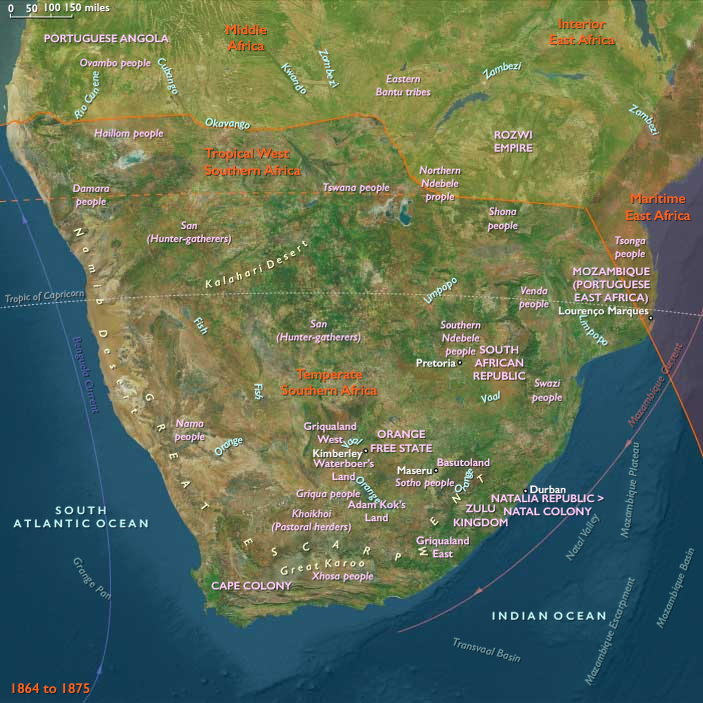
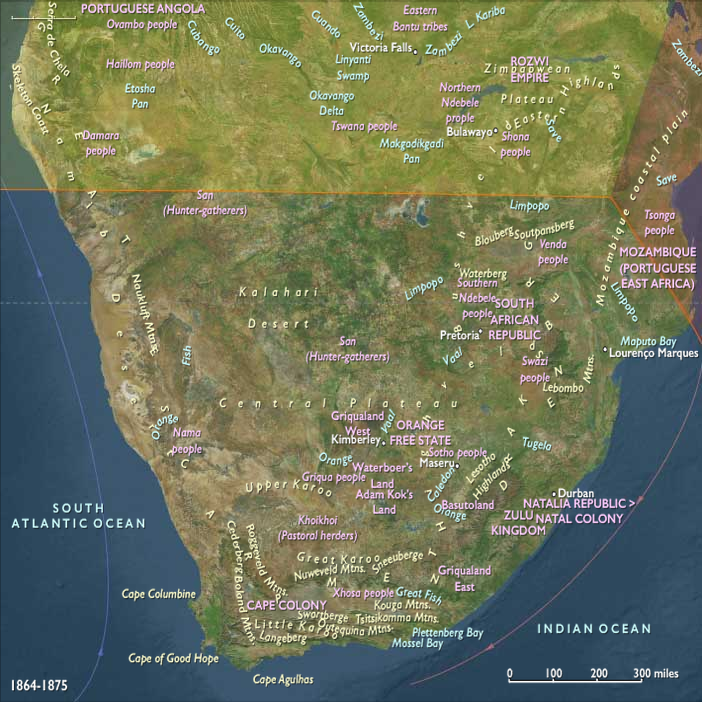
The first diamond had been discovered in South Africa in 1866, when Erasmus Jacobs found a small brilliant pebble on the banks of the Orange River, on the farm De Kalk, leased from local Griquas, near Hopetown, which is his father's farm.
He had showed the pebble to his father, who had sold it Schalk van Niekerk, who later resold it.
It has proved to be a 21.25 carat (4.25 gram) diamond, and becomes known as the Eureka.
Three years later Schalk van Niekerk had sold another diamond also found in the De Kalk vicinity, the Star of South Africa, for £11,200.
The second diamond had been promptly resold in the London market for £25,000.
In 1871, an even larger 83.50 carat (16.7 gram) diamond is found on the slopes of Colesberg Kopje on the farm Vooruitzigt, belonging to the De Beers brothers.
Henry Richard Giddy recounts how Esau Damoense (or Damon), the cook for prospector Fleetwood Rawstone's "Red Cap Party", had made the discovery on Colesberg Kopje after he had been sent there to dig as punishment.
Rawstorne had taken the news to the nearby diggings of the De Beer brothers—his arrival there sparking off the famous "New Rush" which, as historian Brian Roberts puts it, was practically a stampede.
Within a month, eight hundred claims had been cut into the hillock, which are worked frenetically by two to three thousand men.
As the land is lowered, the hillock becomes a mine—in time, the world renowned Kimberley Mine. (Kimberley, turbulent city by Brian Roberts, pp.45-49 (1976, published by David Phillip & Historical Society of Kimberley and the Northern Cape))
The Cape Colony, Transvaal, Orange Free State and the Griqua leader Nikolaas Waterboer all lay claim to the diamond fields.
The Free State Boers in particular want the area, as it lies inside the natural borders created by the Orange and Vaal Rivers.
Following mediation, overseen by the governor of Natal, the Keate Award goes in favor of Waterboer, who immediately places himself under British protection.
Consequently, the territory known as Griqualand West is proclaimed on October 27, 1871.
Colonial Commissioners arrive in New Rush on November 17 to exercise authority over the territory on behalf of the Cape Governor.
Locations
Groups
- Griqua people
- Britain (United Kingdom of Great Britain and Ireland)
- Cape Colony, British
- Orange Free State, Republic of the (Boer Republic)
- Transvaal, Republic of the
- Griqualand West
Commodoties
Subjects
Regions
Subregions
Years: 1871 - 1871
Locations
Groups
- Griqua people
- Britain (United Kingdom of Great Britain and Ireland)
- Cape Colony, British
- Orange Free State, Republic of the (Boer Republic)
- Transvaal, Republic of the
- Griqualand West
Commodoties
Subjects
Regions
Subregions