
In 1960, the elected members of the …
Years: 1960 - 1960
In 1960, the elected members of the union councils vote to confirm Ayub Khan's presidency.
The ban on political parties is operational at the time of the first elections to the National Assembly and provincial legislative assemblies in January 1960, as is the prohibition on “EBDO” politicians.
Many of those elected are new and merge into factions whose bases are personal or provincial loyalties.
Despite the ban, political parties function outside the legislative bodies as vehicles of criticism and formers of opinion.
The Basic Democrats are at once asked to endorse Ayub's presidency and to give him a mandate to frame a constitution.
Of the 80,000 Basic Democrats, 75,283 affirm their support for Ayub in a referendum in February 1960.
Later that month, an eleven-member constitutional commission was established to advise on a suitable form of government.
The commission's recommendations for direct elections, strong legislative and judicial organs, free political parties, and defined limitations on presidential authority go against Ayub Khan's philosophy of government, so he orders other committees to make revisions.
Ayub accepts some of the proposals and substitutes some of his own, aiming, he says, for “a blending of democracy with discipline.” The Press and Publications Ordinance is amended in 1960 to specify broad conditions under which newspapers and other publications can be commandeered or closed down.
Trade organizations, unions, and student groups are closely monitored and cautioned to avoid political activity, and imams at mosques are warned against including political matters in sermons.
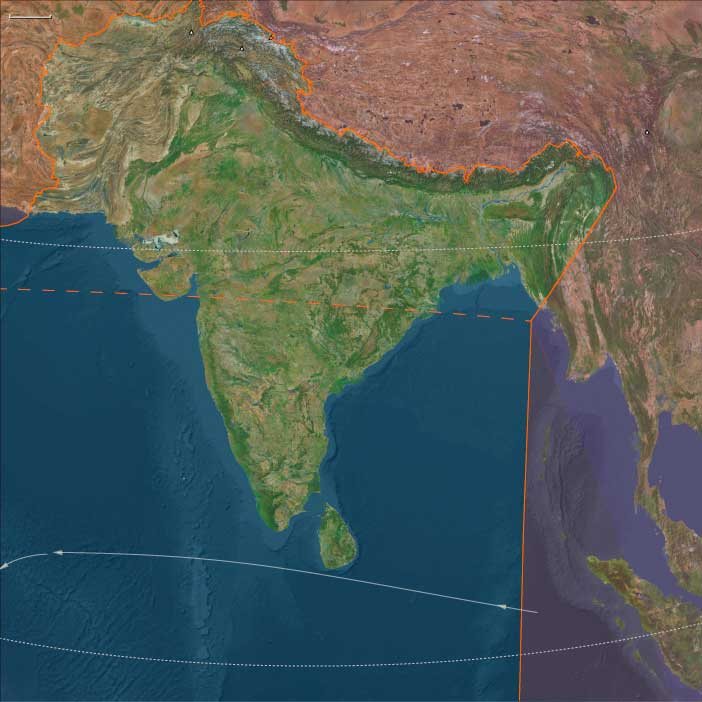
Other than ideology and Kashmir, the main source of friction between Pakistan and India is the distribution of the waters of the Indus River system.
As the upper riparian power, India controls the headworks of the pre-partition irrigation canals.
After independence India had, in addition, constructed several multipurpose projects on the eastern tributaries of the Indus.
Pakistan fears that India might repeat the 1948 incident that curtailed the water supply as a means of coercion.
A compromise that appeared to meet the needs of both countries was reached during the 1950s; it is not until 1960 that a solution finally finds favor with Ayub Khan and Jawaharlal Nehru.
The World Bank and the United States back the Indus Waters Treaty of 1960.
Broadly speaking, the agreement allocates use of the three western Indus rivers (the Indus itself and its tributaries, the Jhelum and the Chenab) to Pakistan and the three eastern Indus tributaries (the Ravi, Beas, and Sutlej) to India.
The basis of the plan is that irrigation canals in Pakistan that have been supplied by the eastern rivers will begin to draw water from the western Indus rivers through a system of barrages and link canals.
The agreement also details transitional arrangements, new irrigation and hydroelectric power works, and the waterlogging and salinity problems in Pakistan's Punjab.
The Indus Basin Development Fund is established and financed by the World Bank, the major contributors to the Aid-to-Pakistan Consortium, and India.
Locations
People
Groups
- United States of America (US, USA) (Washington DC)
- World Bank Group
- India, Republic of
- Pakistan, Islamic Republic of
Subjects
Regions
Related Events
Showing 10 events out of 3698 total
Years: 1960 - 1960
Locations
People
Groups
- United States of America (US, USA) (Washington DC)
- World Bank Group
- India, Republic of
- Pakistan, Islamic Republic of
Subjects
Regions