
Filters:
France is interested as Britain in maintaining …
Years: 1778 - 1778
January
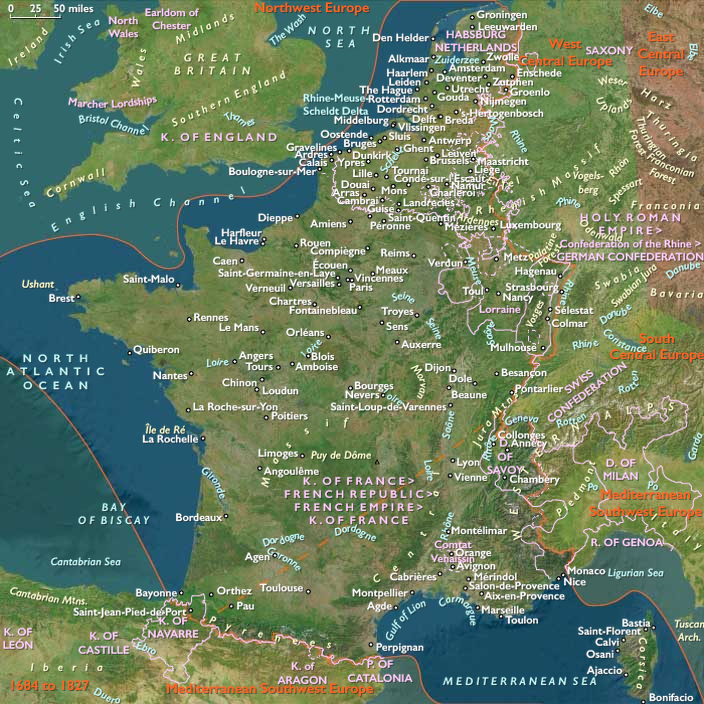
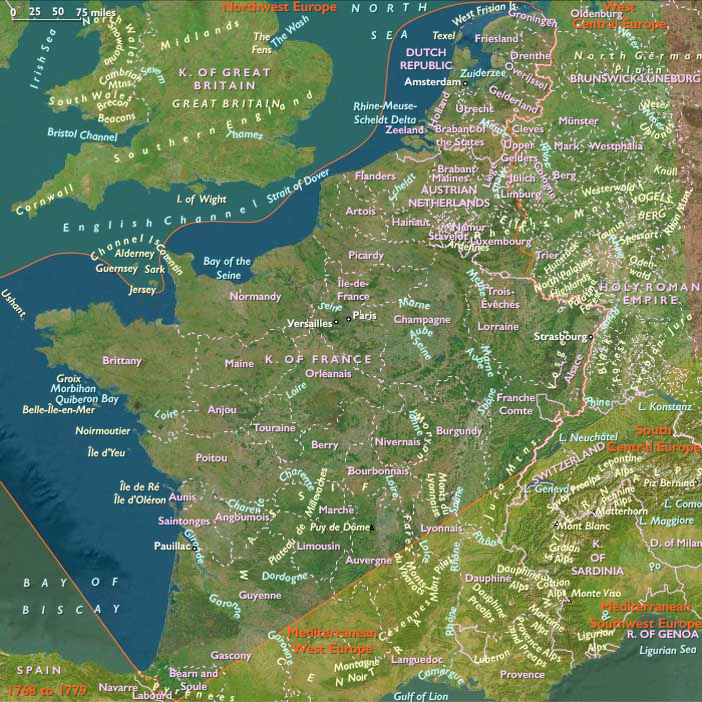
France is interested as Britain in maintaining its influence among the German states, but it has a double problem.
As a supporter of the rebellious British colonies in North America, it is in France's interest to avoid a continental engagement.
France can do more damage to the British in North America than in Europe.
The diplomatic realignment in 1756 had overthrown two hundred years of French foreign policy that united the French Crown and the French populace against the House of Habsburg, bringing to France massive territorial gains in repeated wars with Habsburg Austria and Spain.
A reversal of this policy in 1756 had tied French foreign policy in Europe to Vienna.
Despite this restructuring, there exists in the French Court at Versailles, and in France generally, a strong anti-Austrian sentiment.
The diplomatic revolution of 1756, sealed in 1770 with the personal union (the diplomatic term for marriage) of Louis, the Dauphin of Viennois, and the Austrian Archduchess Marie Antoinette, is considered both a political and matrimonial mésalliance in the eyes of many Frenchmen.
It flies in the face of two hundred years of French foreign policy.
The French foreign minister, the Comte de Vergennes, maintains deep-seated hostility to the Austrians that pre-dates the alliance of 1756.
He had not approved of the shift of France's traditional bonds, and considers the Austrians untrustworthy.
He manages to extricate France from immediate military obligations to Austria by 1778.
As a supporter of the rebellious British colonies in North America, it is in France's interest to avoid a continental engagement.
France can do more damage to the British in North America than in Europe.
The diplomatic realignment in 1756 had overthrown two hundred years of French foreign policy that united the French Crown and the French populace against the House of Habsburg, bringing to France massive territorial gains in repeated wars with Habsburg Austria and Spain.
A reversal of this policy in 1756 had tied French foreign policy in Europe to Vienna.
Despite this restructuring, there exists in the French Court at Versailles, and in France generally, a strong anti-Austrian sentiment.
The diplomatic revolution of 1756, sealed in 1770 with the personal union (the diplomatic term for marriage) of Louis, the Dauphin of Viennois, and the Austrian Archduchess Marie Antoinette, is considered both a political and matrimonial mésalliance in the eyes of many Frenchmen.
It flies in the face of two hundred years of French foreign policy.
The French foreign minister, the Comte de Vergennes, maintains deep-seated hostility to the Austrians that pre-dates the alliance of 1756.
He had not approved of the shift of France's traditional bonds, and considers the Austrians untrustworthy.
He manages to extricate France from immediate military obligations to Austria by 1778.
Locations
People
Groups
- Habsburg, House of
- Austria, Archduchy of
- France, (Bourbon) Kingdom of
- Habsburg Monarchy, or Empire
- Britain, Kingdom of Great
- United States of America (US, USA) (Philadelphia PA)
Topics
- American Revolution
- American Revolutionary War, or American War of Independence
- Anglo-French War (1778–1783)
Subjects
Regions
Subregions
Years: 1778 - 1778
January
Locations
People
Groups
- Habsburg, House of
- Austria, Archduchy of
- France, (Bourbon) Kingdom of
- Habsburg Monarchy, or Empire
- Britain, Kingdom of Great
- United States of America (US, USA) (Philadelphia PA)
Topics
- American Revolution
- American Revolutionary War, or American War of Independence
- Anglo-French War (1778–1783)
Subjects
Regions
Subregions