
The most illustrious phase of Polish cultural …
Years: 1540 - 1683
The most illustrious phase of Polish cultural history is arguably the sixteenth century.
Poland-Lithuania during this period draws great artistic inspiration from the Italians, with whom the Jagiellon court cultivates close relations.
Styles and tastes characteristic of the late Renaissance are imported from the Italian states.
These influences survive in the renowned period architecture of Kraków, which will serve as the royal capital until that distinction passes to Warsaw in 1611.
The University of Kraków gains international recognition as a cosmopolitan center of learning, and in 1543 its most illustrious student, Nicolaus Copernicus (Mikolaj Kopernik), literally revolutionizes the science of astronomy.
The period also bears the fruit of a mature Polish literature, once again modeled after the fashion of the West European Renaissance.
The talented dilettante Mikolaj Rej is the first major Polish writer to employ the vernacular, but the elegant classicist Jan Kochanowski (1530-84) is acknowledged as the genius of the age.
Accomplished in several genres and equally adept in Polish and Latin, Kochanowski is widely regarded as the finest Slavic poet before the nineteenth century.
Locations
People
Groups
- Jews
- Lithuanians (Eastern Balts)
- Germans
- Poles (West Slavs)
- Belarusians (East Slavs)
- Ukrainians (East Slavs)
- Poland of the Jagiellonians, Kingdom of
- Lithuania, Grand Duchy of
Topics
Subjects
Regions
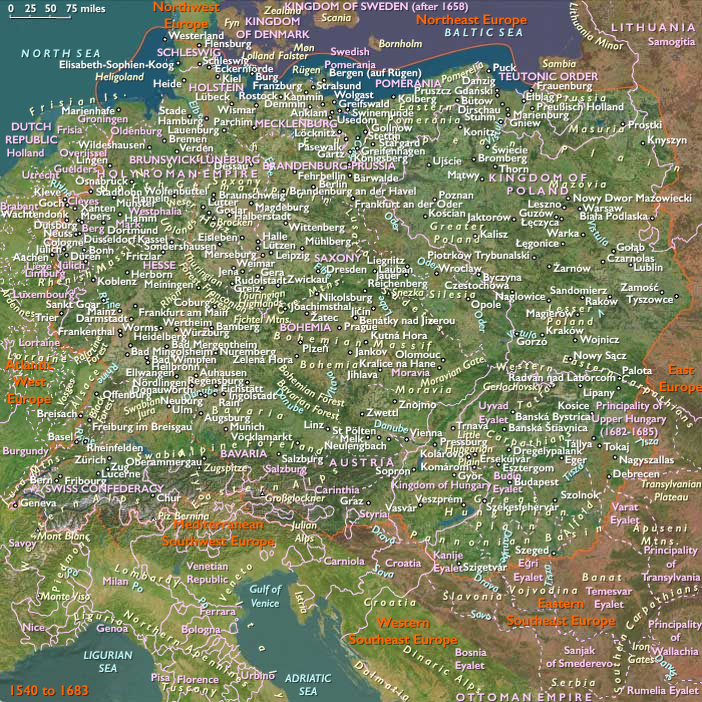
Subregions

Years: 1540 - 1683
Locations
People
Groups
- Jews
- Lithuanians (Eastern Balts)
- Germans
- Poles (West Slavs)
- Belarusians (East Slavs)
- Ukrainians (East Slavs)
- Poland of the Jagiellonians, Kingdom of
- Lithuania, Grand Duchy of
Topics
Subjects
Regions
Subregions