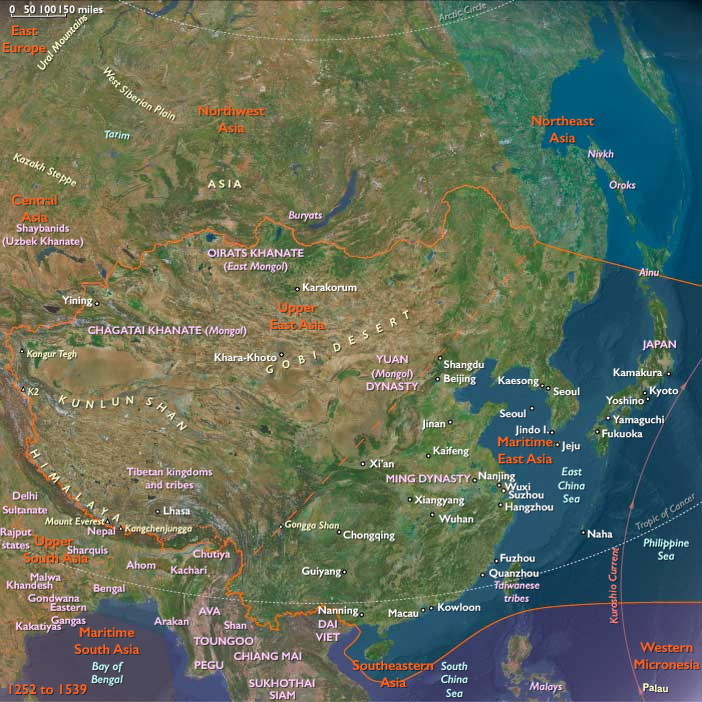
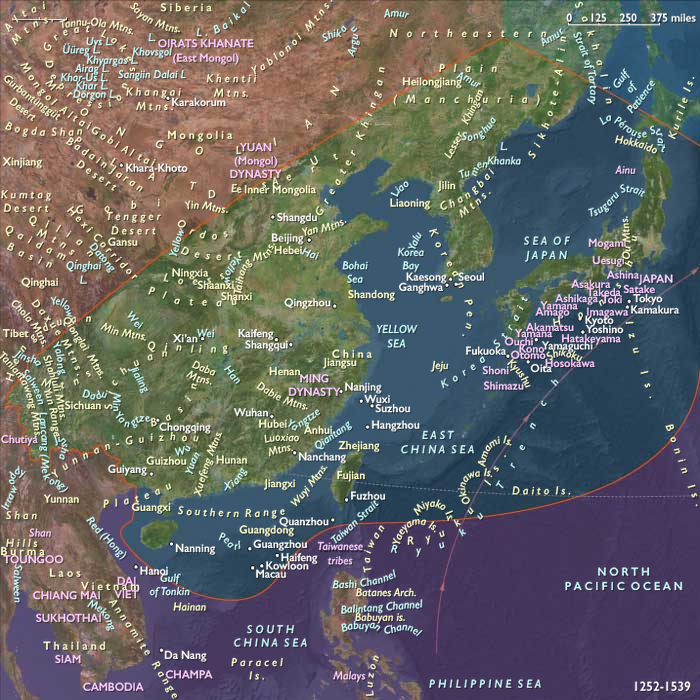
Several revolts in China begin in 1346 …
Years: 1346 - 1346
Locations
Groups
Subjects
Regions
Subregions
Related Events
Filter results
Showing 10 events out of 44373 total
Danish king Valdemar IV, in the middle of his campaign to liberate central Jutland from the Holsteiners, in August 1346 goes to Estonia to negotiate with the Teutonic Knights who control the region, where Danes had never migrated in any numbers.
Valdemar gives up restive Danish Estonia, a far-off eastern province that can be controlled only with great difficulty, for nineteen thousand marks,
This allows him to pay off mortgages of parts of Denmark that are more important to him.
The Teutonic Knights give the territory’s administration to their brother order, the Livonian Knights.
A fishing settlement called Bydgozcya ("Bydgostia" in Latin), located in north central Poland near the confluence of the Brda and Vistula rivers, had during the early Slavic times become a stronghold on the Vistula trade routes.
It was in the thirteenth century the site of a castellany, mentioned in 1238.
The city had been occupied in 1331 by the Teutonic Knights, and incorporated into the monastic state of the Teutonic Knights.
With their signing of the Treaty of Kalisz in 1343, the Knights had relinquished the city along with Dobrzyń and the remainder of Kuyavia.
King Casimir III of Poland on April 19, 1346, grants Bydgoszcz city rights.
The city will increasingly see an influx of Jews after this date.
Charles of Luxembourg succeeds to the Bohemian throne, following the death of his father John of Luxembourg in the Battle of Crécy.
He is elected as King of the Romans, on July 11, 1346.
Rejecting the ebullient chivalry of his father, the Paris-educated thirty-year-old monarch rules with practical realism and sound political sense.
An earthquake in Constantinople in 1346 causes the collapse of part of the great dome of the Hagia Sophia, but effective repairs once again leave the church essentially in its original form.
Emperor John VI Kantakouzenos, having from 1343 to 1345 arranged alliances with the Turks, in 1346 marries his second daughter, Theodora, or Nilüfer Hatun, as she will become known, to Orhan, the sixty-two-year-old Ottoman sultan, despite differences of creed and the disparity of age; she elects to remain a Christian.
Theodora's marriage is intended to cement her father's alliance with the rising Ottoman emirate and to prevent the Ottomans from giving their aid to the Empress-regent Anna of Savoy during the ongoing civil war.
Her parents and sisters escort her to Selymbria, where Orhan's representatives, including grandees of his court and a cavalry regiment, arrive on a fleet of thirty ships.
A ceremony is held at Selymbria, where Orhan's envoys receive her and escort her to the Ottoman lands in Bithynia, across the Marmara Sea, where the actual wedding takes place
The splendor of the wedding between Orhan and Theodora at Selymbria (Silivri) is elaborately described by Byzantine writers.
Ottoman Sultan Orhan, turning to the neighboring Turkmen states, annexes the principality founded by Karasi in the Balikesir-Çanakkale region of western Anatolia, which had been weakened by dynastic struggles around 1345, and he extends his control to the extreme northwest corner of Anatolia.
The Ottomans become the principal ally of the future emperor John VI Kantakouzenos in 1346 by crossing over into the Balkans to assist him against his rivals, the regents for John V Palailologos.
Philippe de Mézières, who had joined the crusader relief force led by Humbert II, Dauphin of Vienne, is knighted after defending Smyrna (modern Izmir, Turkey) against Turkish assault in 1346.
Born of poor nobility, Mézières had initially been a soldier of fortune in Italy, serving Lucchino Visconti, lord of Milan, but within a year he entered the service of the husband of Joan I of Naples and Andrew, Duke of Calabria, who was the son of the King Charles I of Hungary.
Andrew had very soon been assassinated very soon in September 1345, and in the autumn of that year, Mézières had set out for the East in the French army.