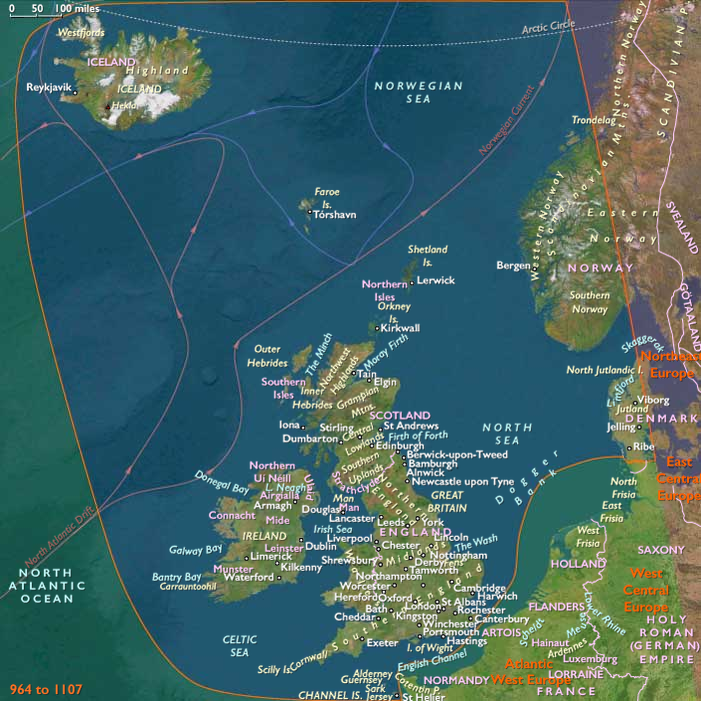
…Ireland.
Years: 1048 - 1048
…Ireland.
Locations
People
Groups
- Polytheism (“paganism”)
- Christianity, Chalcedonian
- Norse
- Ireland, medieval
- Isles, Kingdom of the
- Orkney, Earldom of
- Alba (Scotland), Scots Kingdom of
Subjects
Regions
Subregions
Related Events
Filter results
Showing 10 events out of 10 total
A meeting of the 13-nation International Opium Commission, held in Shanghai on February 1, 1909, results in recommendations that form the basis of the first opium convention, to be held at The Hague in 1912.
(Source: The Politics of Heroin: CIA Complicity in the Global Drug Trade)
A meeting of the 13-nation International Opium Commission, held in Shanghai on February 1, 1909, results in recommendations that form the basis of the first opium convention, to be held at The Hague in 1912.
(Source: The Politics of Heroin: CIA Complicity in the Global Drug Trade)
China's early attempts at eradication create a demand for illicit morphine and opium.
As Szechwan's opium production declines, Shanghai's licensed syndicates, notably the Green Gang, begin importing morphine and heroin from Europe.
Moreover, this localized suppression in Szechwan stimulates both the spread of cultivation to other provinces and smuggling of illicit opiates into China.
In 1911, there are reportedly 87 licensed opium dens in Shanghai.
After the revolution of 1911, China's new Republican government had proved corrupt and its opium suppression campaign had faltered.
Between 1911 and 1915, Japanese traders had smuggled major supplies of morphine and heroin into China.
China's poppy cultivation had revived, morphine and heroin pills appeared as substitutes for smoking opium, and the new Republic's cabinet had been discovered taking a bribe from an opium syndicate.
Nonetheless, in January 1919, the Republic burns the last chest of Indian opium at a public ritual before invited guests at Shanghai.
After more than 300 years, the India-China opium trade has ended.
Although there is no indication of any decline in overall level of addiction in China, opium smoking has declined and heroin use has increased rapidly.
By 1923, Shanghai syndicates are importing 10.25 tons of heroin from Japan and Europe annually to meet consumer demand.
The U.S. Treasury attaché in Shanghai in 1934, just three years after the League of Nations had imposed restrictions on the manufacture of heroin in Europe, notes a sudden shift of the traffic in narcotics from Europe to the Orient
According to his report, after the annual harvest in the southwestern highlands at least eighteen thousand tons of Sichuan and ten thousand tons of Yunnan opium passes through the major river ports downriver to Shanghai.
He reports that China's Opium King is Green Gang leader Tu Yueh-shen, whose close relations with the Nationalist regime makes his cartel a major force in the Yangtze River opium trade that dominates China's drug traffic.
At the central Chinese city of Han-k'ou (Hankow), at the confluence of the Han Shui and Yangtze rivers, the government's Special Tax Bureau collects $20 million in annual opium transit fees.
The head of the government's Opium Suppression Bureau is an active member of the Green Gang who remains loyal to his benefactor, Tu Yueh-shen.
The League's attempt at global regulation and the Nationalist regime's local suppression effectively, if unintentionally, combines to expand illicit narcotics traffic in China, which has in two decades become the world's primary heroin manufacturer.
Beginning in the late 1920s, China's rising criminal syndicates shift from the import of heroin to its manufacture and distribution.
On balance, the growth of the heroin trade in northeast China is a market response to both global and local attempts at suppression.
In the decade following the League of Nations' first attempt at opiates control in 1925, Shanghai emerges as a major center for illicit heroin.
In the early 1930s, leading European drug dealers such as the notorious Eliopoulos brothers, pushed by Istanbul's violent criminal milieu and pulled by the scale of the Asian drug trade, move to Shanghai and Tianjin (Tientsin), where the majority of illegal heroin smuggled into the US in the 1930s is refined.
The Jewish syndicates that dominate New York's drug trade under the leadership of Yasha Katzenberg and Louis "Lepke" Buchalter, founder of the murder-for-hire organization popularly known as Murder, Inc., dispatch agents to purchase heroin through European dealers based in Shanghai.
Green Gang leader Tu Yueh-sheng simultaneously emerges as the city's leading drug dealer and a key intelligence operative for the Nationalist Government—an alliance that protects the narcotics network from the regime's anti-opium campaign of the 1930s.
(Source: The Politics of Heroin: CIA Complicity in the Global Drug Trade)

As League regulations prevent diversion of heroin from legal laboratories to criminals, Shanghai's Green Gang emerges as Asia's first major heroin producing syndicate in the 1930s.
During the Second World War, China sustains its large addict population from domestic production, with considerable assistance from the Japanese occupation forces who actively participate in the heroin traffic.
(Source: The Politics of Heroin: CIA Complicity in the Global Drug Trade)
The collapse of the Nationalist Chinese regime in 1949 forces Shanghai's narcotics syndicate to flee to Hong Kong where they soon open heroin refineries.
The Green Gang, suffering reverses in a struggle for control of the colony's heroin trade against local syndicates, fades by the mid 1950s and is replaced by small syndicates of ethnic Chiu Chau criminals who trace their origins to nearby Swatow on China's south coast.
Employing the Green Gang's chemists, these new narcotic networks expand the colony's heroin consumption during the 1950s.
Years: 1048 - 1048
Locations
People
Groups
- Polytheism (“paganism”)
- Christianity, Chalcedonian
- Norse
- Ireland, medieval
- Isles, Kingdom of the
- Orkney, Earldom of
- Alba (Scotland), Scots Kingdom of