
The militancy of the "Red Stick" Creeks …
Years: 1813 - 1813
The militancy of the "Red Stick" Creeks is a response to the increasing United States cultural and territorial encroachment into their traditional lands, and leads to the Creek War of 1813-1814.
The alternate designation as the Creek Civil War comes from the divisions within the tribe over cultural, political, economic, and geographic matters.
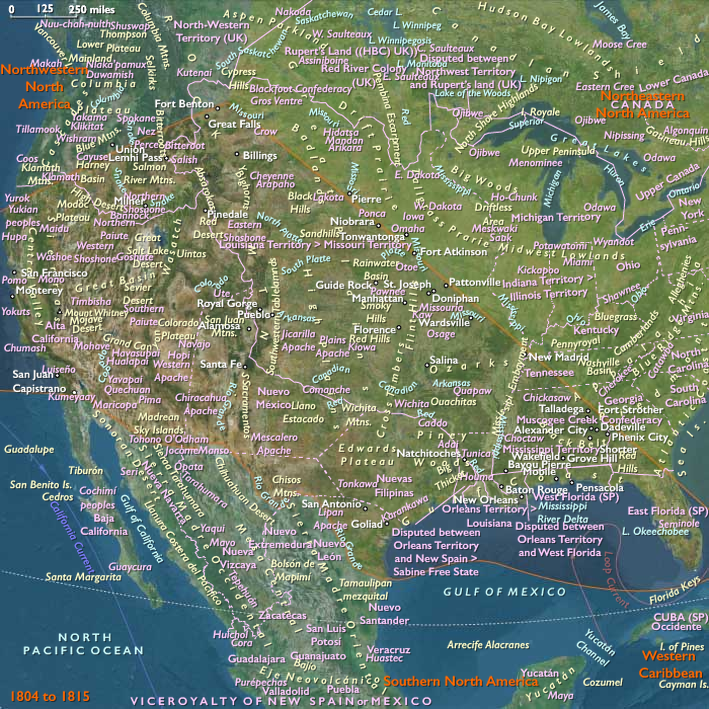
At the time of the Creek War, the Upper Creeks control the Coosa, Tallapoosa, and Alabama Rivers that lead to Mobile, while the Lower Creeks control the Chattahoochee River, which flows into Apalachicola Bay.
The Lower Creek are trading partners with the United States, and unlike the Upper Creeks have adopted more of their cultural practices.
The Provinces of East and West Florida are governed by the Spanish, and British firms like Panton, Leslie, and Co. provide most of the trade goods into Creek country.
Pensacola and Mobile, in Spanish Florida, control the river mouths of the U.S. Mississippi Territory established in 1798.
Territorial conflicts between France, Spain, Britain, and the United States along the Gulf Coast that had previously helped the Creeks to maintain control over most of the United States' southwestern territory have shifted dramatically due to the Napoleonic Wars, the Florida Rebellion, and the War of 1812.
This has made long-standing Creek trade and political alliances more tenuous than ever.
During and after the Revolution, the United States wished to maintain the Indian Line that had been established by the Royal Proclamation of 1763.
The Indian Line had created a boundary for colonial settlement in order to prevent illegal encroachment on Indian lands, and has also helped the U.S. government maintain control over the Indian trade.
Traders and settlers often violated the terms of the treaties establishing the Indian Line, and frontier settlements by colonials in Indian lands was one of the arguments the United States used to expand its territory.
In the Treaty of New York (1790), Treaty of Colerain (1796), Treaty of Fort Wilkinson (1802), and the Treaty of Fort Washington (1805), the Creek had ceded their Georgia territory east of the Ocmulgee River.
In 1804, the United States had claimed the city of Mobile under the Mobile Act.
The 1805 treaty with the Creek had also allowed the creation of a Federal Road linking Washington to the newly acquired port city of New Orleans, which partially stretches through Creek territories.
These increasing territorial grabs westward into Creek territory (which includes parts of Spanish Florida), coupled with the Louisiana Purchase (which neither the British nor the Spanish had recognized at the time), had compelled the British and Spanish governments to strengthen existing alliances with the Creek.
Following the occupation of Baton Rouge during the West Florida Rebellion, the United States, in 1810, had sent an expeditionary force to occupy Mobile.
As a result, Mobile has been jointly occupied by weak American and Spanish soldiers.
Locations
People
Groups
- Muscogee, or Creek, people (Amerind tribe)
- West Florida
- Spanish Florida
- Mississippi, Territory of (U.S.A.)
- United States of America (US, USA) (Washington DC)
- Britain (United Kingdom of Great Britain and Ireland)
- France, (first) Empire of
- Spain, Bonapartist Kingdom of
Topics
Commodoties
Subjects
Regions
Subregions
Related Events
Showing 10 events out of 21229 total
Years: 1813 - 1813
Locations
People
Groups
- Muscogee, or Creek, people (Amerind tribe)
- West Florida
- Spanish Florida
- Mississippi, Territory of (U.S.A.)
- United States of America (US, USA) (Washington DC)
- Britain (United Kingdom of Great Britain and Ireland)
- France, (first) Empire of
- Spain, Bonapartist Kingdom of
Topics
Commodoties
Subjects
Regions
Subregions