
Jane Seymour had become pregnant in early …
Years: 1537 - 1537
October
Jane Seymour had become pregnant in early 1537.
During her pregnancy, she had developed a craving for quail, which Henry ordered for her from Calais and Flanders.
She had gone into confinement in September 1537 and in October she gave birth to the coveted male heir, the future King of England Edward VI of England, on October 12, 1537, at Hampton Court Palace.
Her brother Edward Seymour is created earl of Hertford.
Custom dictates that the Queen does not participate in her children's christening, as new mothers need bedrest and children have to be christened quickly, in case they die, so they do not end up in Limbo.
Consequently, Prince Edward had been christened on October 15, 1537, without his mother.
Both of the King's daughters, Mary (daughter of Catherine of Aragon) and Elizabeth (daughter of Anne Boleyn), were present and carried the infant's train during the ceremony.
After the christening, it had become clear that Jane was seriously ill. Jane's labor had been difficult, lasting two days and three nights, probably because the baby was not well positioned.
Rumors will later circulate that she died following an emergency Caesarean section, after Henry had ordered the baby to be cut from her to prevent a stillbirth, but caesarean births on live mothers are not possible at this time.
According to Edward's biographer, Jennifer Loach, Jane Seymour's death may have been due to an infection from a retained placenta.
According to Weir, death could have also been caused by puerperal fever due to a bacterial infection contracted during the birth or a tear in her perineum which became infected.
In any case, Jane dies on October 24, 1537, at Hampton Court. (In accordance with his wishes, Henry will be buried with Jane at Windsor Castle, the location of Holbein's sketch for this portrait, right.)
The painting matches the depiction of Jane in Holbein's Whitehall wall-painting, which now survives only in a copy by Remigius van Leemput.
It also follows Holbein's preparatory drawing.
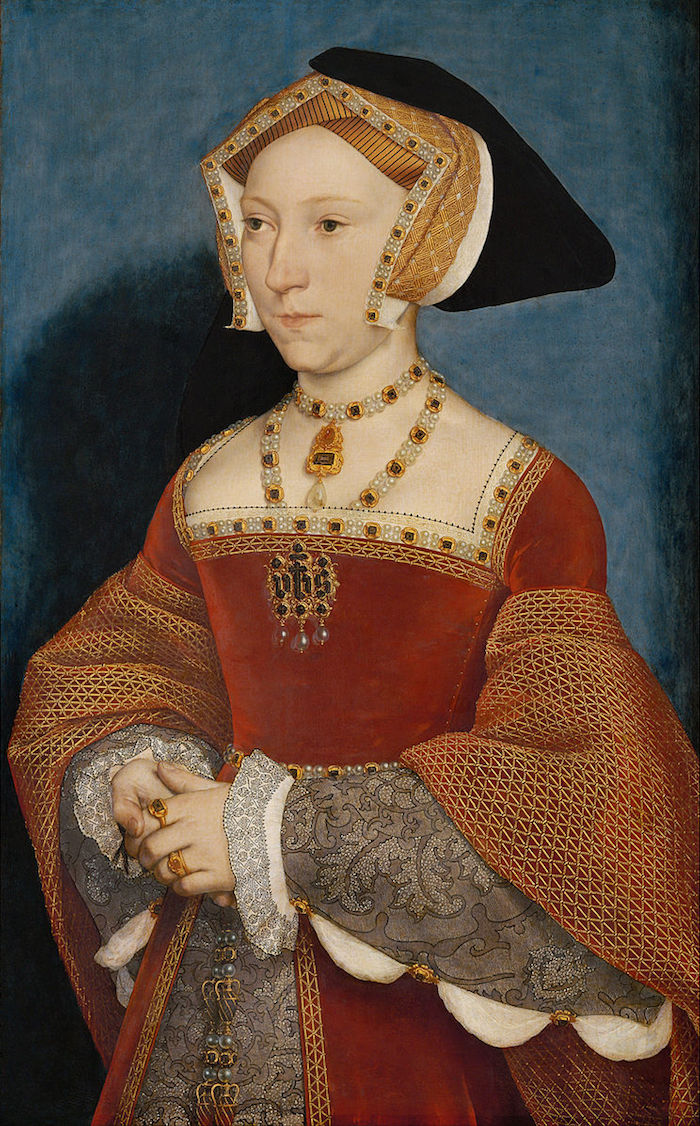
Hans Holbein the Younger: Jane Seymour(c. 1536-1537), Tempera on Oak, 89,5 × 65,5 × 6 cm, Kunsthistorisches Museum, Vienna
Locations
People
Groups
Topics
Subjects
Regions

Subregions
Related Events
Showing 10 events out of 37618 total
Years: 1537 - 1537
October
Hans Holbein the Younger: Jane Seymour(c. 1536-1537), Tempera on Oak, 89,5 × 65,5 × 6 cm, Kunsthistorisches Museum, Vienna
Locations
People
Groups
Topics
Subjects
Regions
Subregions