
Juan Ponce de León was born in …
Years: 1504 - 1504
Juan Ponce de León was born in the village of Santervás de Campos in the northern part of what is now the Spanish province of Valladolid.
Although early historians placed his birth in 1475, more recent evidence shows he was likely born in 1474.
The surname Ponce de León dates from the thirteenth century.
The Ponce de León lineage began with Ponce Vélaz de Cabrera, descendant of count Bermudo Núñez, and Sancha Ponce de Cabrera, daughter of Ponce Giraldo de Cabrera.
Before October 1235, a son of Ponce Vela de Cabrera and his wife Teresa Rodríguez Girón named Pedro Ponce de Cabrera had married Aldonza Alfonso, an illegitimate daughter of King Alfonso IX of León.
The descendants of this marriage added the "de León" to their patronymic and were known henceforth as the Ponce de León.
The identity of his parents remains unknown, but he appears to have been a member of a distinguished and influential noble family.
His relatives include Rodrigo Ponce de León, Marquis of Cádiz, a celebrated figure in the Moorish wars.
Ponce de León is related to another notable family, the Núñez de Guzmáns, and as a young man he had served as squire to Pedro Núñez de Guzmán, Knight Commander of the Order of Calatrava.
A contemporary chronicler, Gonzalo Fernández de Oviedo y Valdés, states that Ponce de León gained his experience as a soldier fighting in the Spanish campaigns that defeated the Moors in Granada and completed the reconquest of Spain in 1492.
Once the war against the Emirate of Granada ended, there was no apparent need for his military services at home, so, like many of his contemporaries, Ponce de León looked abroad for his next opportunity.
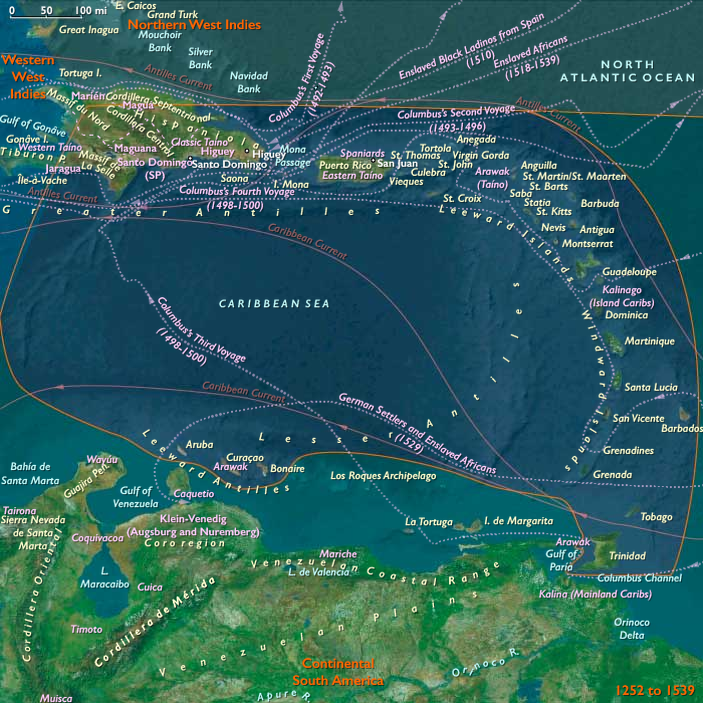
In September 1493, some twelve hundred sailors, colonists, and soldiers had joined Christopher Columbus for his second voyage to the New World.
Ponce de León had been a member of this expedition, one of two hundred "gentleman volunteers."
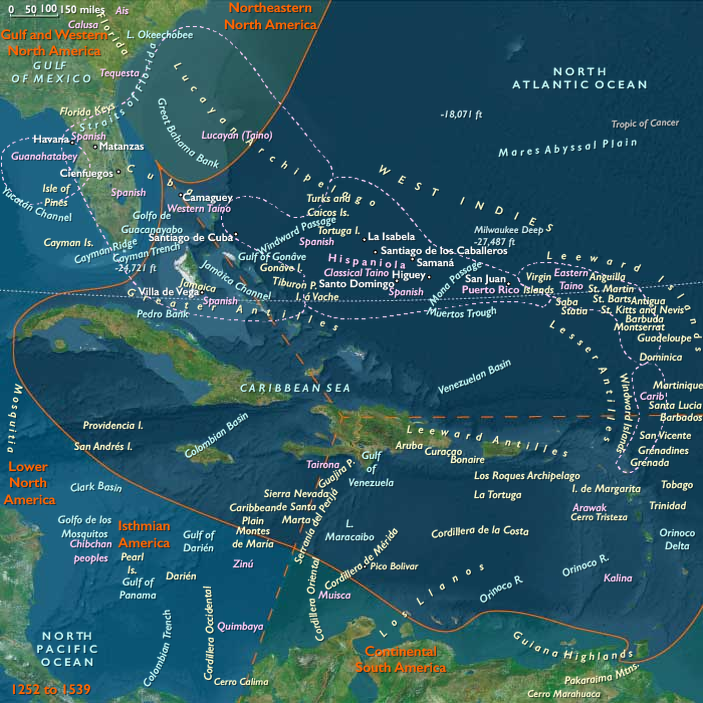
Reaching the Caribbean in November 1493, the fleet had visited several islands before arriving at their primary destination in Hispaniola.
In particular they anchored on the coast of a large island the natives call Borinquen but will eventually become known as Puerto Rico.
This had been Ponce de León's first glimpse of the place that is to play a major role in his future.
Historians are divided on what he did during the next several years, but it is possible that he returned to Spain at some point and made his way back to Hispaniola with Nicolás de Ovando, the newly appointed governor, who had arrived in Hispaniola in 1502.
The Spanish Crown had expected Ovando to bring order to a colony in disarray.
Ovando had interpreted this as authorizing subjugation of the native Taínos.
Thus, Ovando had authorized the Jaragua Massacre in November 1503.
In 1504, when Tainos overrun a small Spanish garrison in Higüey on the island's eastern side, Ovando assigns Ponce de León to crush the rebellion.
Ponce de León is actively involved in the Higüey massacre, about which friar Bartolomé de las Casas will attempt to notify Spanish authorities.
Ovando rewards his victorious commander by appointing him frontier governor of the newly conquered province, at this time named Higüey also.
Ponce de León receives a substantial land grant that authorizes sufficient Indian slave labor to farm his new estate.
Locations
People
- Bartolomé de las Casas
- Christopher Columbus
- Ferdinand II of Aragon
- Juan Ponce de León y Figueroa
- Nicolás de Ovando
Groups
Topics
Commodoties
Subjects
Regions
Subregions
Related Events
Showing 10 events out of 39659 total
Years: 1504 - 1504
Locations
People
- Bartolomé de las Casas
- Christopher Columbus
- Ferdinand II of Aragon
- Juan Ponce de León y Figueroa
- Nicolás de Ovando
Groups
Topics
Commodoties
Subjects
Regions
Subregions