
Herod, confirmed by the Roman Senate as …
Years: 45BCE - 99
Herod, confirmed by the Roman Senate as king of Judah in 37 BCE in the period of wars subsequent to the Roman occupation of the country, reigns until his death in 4 BCE.
Nominally independent, Judah is actually in bondage to Rome, and the land is formally annexed in 6 BCE as part of the province of Syria Palestina.
Rome does, however, grant the Jews religious autonomy and some judicial and legislative rights through the Sanhedrin.
The Sanhedrin, which traces its origins to a council of elders established under Persian rule (333 BCE to 165 BCE) is the highest Jewish legal and religious body under Rome.
The Great Sanhedrin, located on the Temple Mount in Jerusalem, supervises smaller local Sanhedrins and is the final authority on many important religious, political, and legal issues, such as declaring war, trying a high priest, and supervising certain rituals.
Scholars have sharply debated the structure and composition of the Sanhedrin.
The Jewish historian Josephus and the New Testament present the Sanhedrin as a political and judicial council whereas the Talmud describes it as a religious, legislative body headed by a court of seventy-one sages.
Another view holds that there were two separate Sanhedrins.
The political Sanhedrin was composed primarily of the priestly Sadducee aristocracy and was charged by the Roman procurator with responsibility for civil order, specifically in matters involving imperial directives.
The religious Sanhedrin of the Pharisees was concerned with religious law and doctrine, which the Romans disregarded as long as civil order was not threatened.
Foremost among the Pharisee leaders of the time are the noted teachers, Hillel and Shammai.
Locations
People
Groups
- Roman Republic
- Jews
- Greeks, Hellenistic
- Seleucid Empire
- Sadducees
- Pharisees
- Judea, Roman client kingdom of
- Samaria, Roman province of
- Judea (Roman province)
- Roman Empire (Rome): Julio-Claudian dynasty
Topics
Subjects
Regions
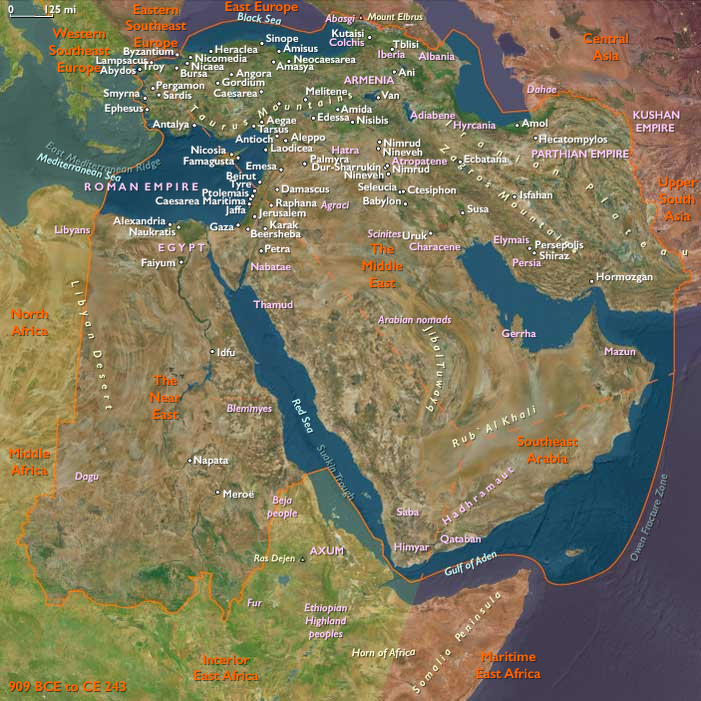
Subregions
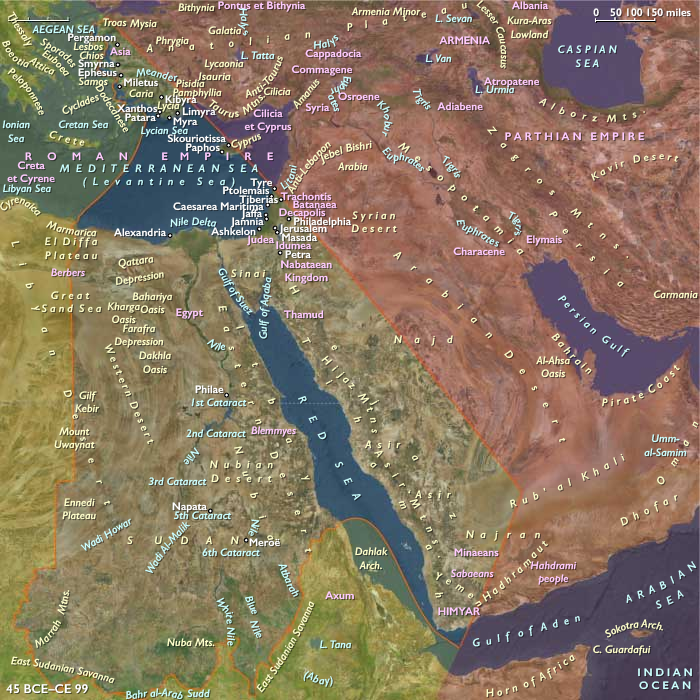
Years: 45BCE - 99
Locations
People
Groups
- Roman Republic
- Jews
- Greeks, Hellenistic
- Seleucid Empire
- Sadducees
- Pharisees
- Judea, Roman client kingdom of
- Samaria, Roman province of
- Judea (Roman province)
- Roman Empire (Rome): Julio-Claudian dynasty
Topics
Subjects
Regions
Subregions