
Jurchen leader Nurhaci had broken away from …
Years: 1636 - 1636
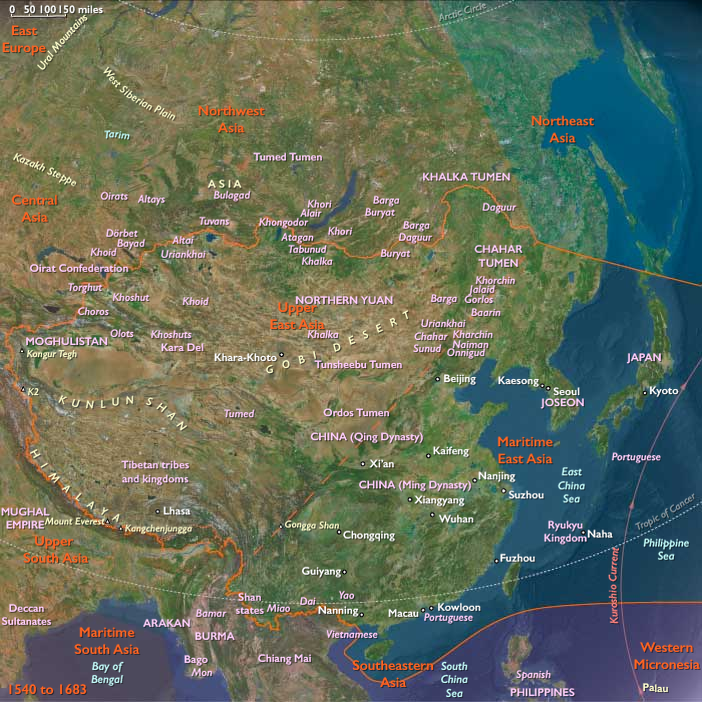
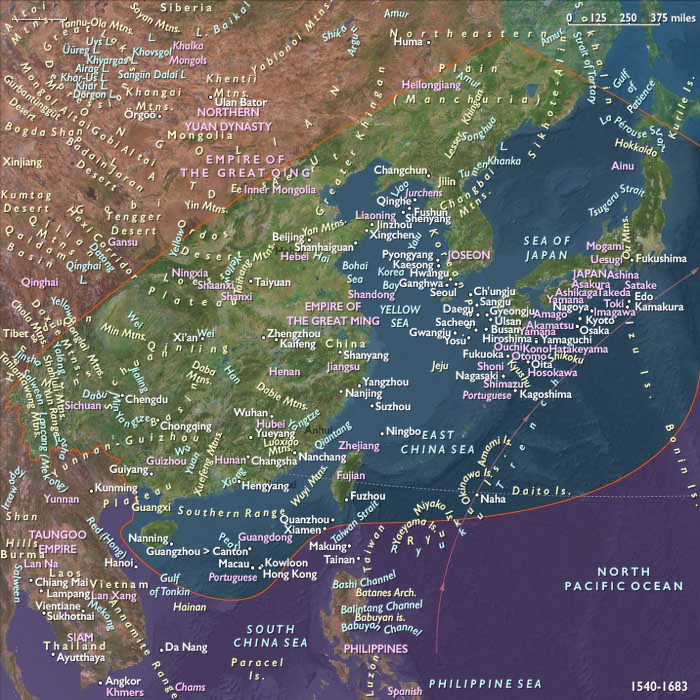
Jurchen leader Nurhaci had broken away from the power of the decaying Ming Dynasty in 1619 and established the Later Jin Dynasty, domestically called the State of Manchu from 1635, and unified Jurchen tribes, establishing (or at least expanding) the Banner system, a military structure which has made their forces quite resilient in the face of superior Ming Dynasty numbers in the field.
Nurhaci had eventually conquered Mukden (modern-day Shenyang) in northern China’s Liaoning region and built it into the new capital in 1621.
Nurhaci's eighth son, Huang Taiji, who had succeeded his father a decade earlier, in 1636 reorganizes the Jurchen, including those other groups (such as Hans and Mongols) who had joined them, changes the nation's name to the Qing (”Pure”) Dynasty, and formally changes the name of the ethnic designation to Manchu.
The early significance of Manchu has not been established satisfactorily.
It may have been an old term for the Jianzhou Jurchens.
One theory claims that the name came from the Bodhisattva Mañjuśrī (the Bodhisattva of Wisdom), of which Nurhaci claimed to be an incarnation.
Another theory is that the Manchus, like a number of other Tungusic peoples, take their name from the common Tungusic word for 'a great river'.
Huang Taji continues the expansion of the state in the region later known as Manchuria, pushing deeper into Mongolia and raiding Korea and Ming China.
Huang Taiji in 1636 invades the Joseon Dynasty, as the latter does not accept that Huang Taiji has become emperor.
Locations
People
Groups
- Chinese (Han) people
- Jurchens
- Joseon (Yi) kingdom of
- Chinese Empire, Ming Dynasty
- Later Jin (Manchu Khanate)
Topics
Commodoties
Subjects
Regions
Subregions
Years: 1636 - 1636
Locations
People
Groups
- Chinese (Han) people
- Jurchens
- Joseon (Yi) kingdom of
- Chinese Empire, Ming Dynasty
- Later Jin (Manchu Khanate)
Topics
Commodoties
Subjects
Regions
Subregions