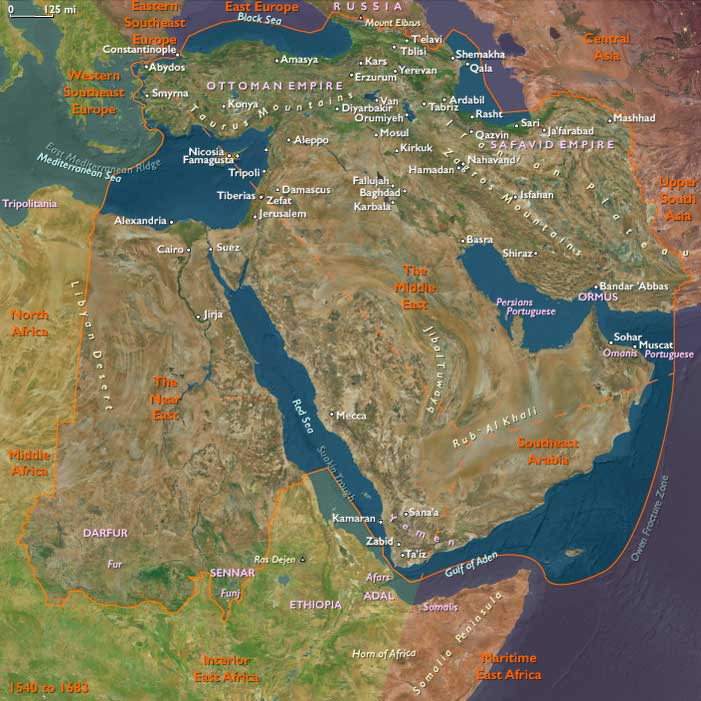
...Kamaran. Thus ends the first period …
Years: 1635 - 1635
...Kamaran.
Thus ends the first period of Ottoman rule in Yemen.
Locations
People
Groups
Commodoties
Subjects
Regions
Subregions
Related Events
Filter results
Showing 10 events out of 31 total
Parliament, having learned of the King's actions in Nottingham, dispatches its own army northward under the Earl of Essex, to confront the King.
Essex marches first to Northampton, where he musters almost twenty thousand men.
Learning of the King's move westwards, ...
...Essex now marches northwestwards towards Worcester.
In the first clash between the main Royalist and Parliamentarian armies, Royalist cavalry under Prince Rupert of the Rhine rout the cavalry of Essex's vanguard at the Battle of Powick Bridge on September 23.
The Royalists, lacking infantry, nevertheless abandon Worcester.
Prince Rupert of the Rhine, a younger son of Frederick V, Elector Palatine and Elizabeth Stewart, and the nephew of King Charles I of England, who had created him Duke of Cumberland and Earl of Holderness, had on January 11, 1649, following a degree of reconciliation with Charles II, led eight undermanned ships to Kinsale in Ireland in an attempt to prevent the Parliamentarians taking Ireland from the Royalists.
Blake has blockaded Rupert's fleet in Kinsale from May 22, ...
...allowing Oliver Cromwell to land on August 15 at Dublin.
Blake is driven off by a storm in October and Rupert escapes via Spain.
Blake’s Blockade of Lisbon and the Naval Confrontation with Prince Rupert (1650)
In February 1650, Admiral Robert Blake, leading a Parliamentarian fleet of twelve ships, sailed to Lisbon in an effort to pressure King John IV of Portugal to expel Prince Rupert of the Rhine, who had taken refuge there with his Royalist fleet. Prince Rupert, a Royalist privateer supporting the exiled Charles II, had expanded his squadron to thirteen ships, posing a threat to English Parliamentarian shipping.
Blake’s Standoff with the Portuguese and Rupert’s Fleet
- Blake anchored off Lisbon for two months, hoping to convince John IV to withdraw his support for Rupert.
- However, King John IV, despite negotiations, ultimately decided to back Rupert, as Portugal was historically aligned with the Royalists against Parliament.
- By April 1650, Blake’s fleet was reinforced by four additional warships under Edward Popham, who brought official authorization to go to war with Portugal.
Consequences and Escalation
-
The Anglo-Portuguese Naval Conflict Begins
- With Portugal siding with Rupert, Blake prepared to take military action, launching a naval blockade of Lisbon.
- This marked the beginning of hostilities between the English Commonwealth and Portugal, which lasted until 1654.
-
The Pursuit of Rupert’s Fleet
- Rupert eventually escaped Lisbon, leading Parliamentarian forces on a high-seas chase through the Atlantic and into the Caribbean.
- Blake pursued Rupert relentlessly, defeating part of his fleet at the Battle of the Tagus (1650) and later in the Azores.
-
Long-Term Impact
- Blake’s campaign weakened Royalist naval power, cutting off an important base for Charles II’s supporters.
- The conflict pressured Portugal into negotiating peace with the English Commonwealth, culminating in a treaty in 1654, which favored English trading interests.
Conclusion: Blake’s Naval Strategy and the Commonwealth’s Growing Power
Blake’s blockade of Lisbon and pursuit of Prince Rupert in 1650 was a critical naval action in the English Civil War’s aftermath, strengthening Parliament’s control of the seas. This event marked the rise of the English Commonwealth’s naval dominance, setting the stage for future conflicts and colonial expansion.
Prince Rupert’s Failure at Lisbon and Blake’s Victory Over the Portuguese Fleet (1650)
Prince Rupert of the Rhine, commanding a Royalist fleet, made two unsuccessful attempts to break Robert Blake’s blockade of Lisbon. However, the blockade was only lifted after Blake decisively defeated the Portuguese fleet in battle and then sailed for Cádiz with seven captured ships.
Blake’s Engagement with the Portuguese Fleet
- While maintaining his blockade of Lisbon, Blake faced a major challenge from the Portuguese navy, which sought to protect its harbor and trade routes.
- In a three-hour naval engagement, Blake’s fleet of seventeen ships confronted a larger Portuguese force of twenty-three ships.
- Despite being outnumbered, the English fleet emerged victorious:
- Seven Portuguese ships were captured.
- One of the Portuguese Vice-Admirals’ ships was sunk.
With this victory, Blake effectively crippled Portugal’s ability to resist the English fleet.
Blake Lifts the Blockade and Sails for Cádiz
- Having secured a decisive advantage, Blake lifted the blockade and sailed south to Cádiz, bringing his seven captured Portuguese ships with him.
- The defeat humiliated Portugal and demonstrated English naval superiority, further isolating Prince Rupert, who soon fled from Lisbon.
- The losses suffered by the Portuguese navy contributed to Portugal’s eventual peace negotiations with England in 1654.
Conclusion: A Strategic Blow to Royalists and Portugal
Blake’s three-hour victory over the Portuguese fleet and the seizure of seven enemy ships marked a turning point in English naval dominance. Rupert’s failure to break the blockade and Blake’s triumph over the Portuguese navy secured English Commonwealth control of the seas, weakening both Royalist and Portuguese resistance.
General-at-Sea Robert Blake re-engages with Prince Rupert of the Rhine, now with six ships, on November 3 near Málaga, capturing one ship.
Two days later, ...
...the other of Rupert's ships in the area are driven ashore attempting to escape from Cartagena, securing Parliamentarian supremacy at sea, and the recognition of the Parliamentary government by many European states.
Robert Holmes had first appeared in 1643 on the Cavalier side of the Civil War, in Prince Maurice's regiment of horse as a cornet in the troop of Captain Richard Atkyns.
Thus began a lifelong friendship with Maurice's brother, Prince Rupert, whom he accompanied onto the battlefields of the continent once the Royalists had been defeated.
When in 1648 a part of the fleet went over to the exiled king, Holmes (now an army captain), following Maurice and Rupert, had come into his first contact with the navy, participating in the epic cruise of the Royalist fleet of 1649 – 1652 to Kinsale, the Mediterranean, West Africa (where, between the Gambia and Cape Verde, he was temporarily captured by the natives), and the West Indies.
The drain of manpower, through storm, action, and mutiny, was so large that at the end of the cruise, Holmes had advanced to commanding the four prizes the force brought back to France.
With Rupert returning to the exiled court, it had fallen to Holmes to see the fleet paid off.
Subsequently, Cromwell's intelligence service reported Holmes having obtained a privateer commission from the King of Spain (Thurloe State Papers VII, p. 248, 18 July 1658.
N.S.
), although the total absence of other evidence makes his actually setting out as a privateer improbable.
He may, like other Royalist, and notably Irish, officers, have taken up service with the Imperial army.
Immediately before the Restoration, Holmes had acted as a courier between Charles II and Edward Montagu, by whose commission he had obtained his first command in the navy, the Medway guardship Bramble.
Upon Charles II's return to England, Holmes had been rewarded for his services with the captaincy of Sandown Castle, Isle of Wight together with a new commission (for another guardship), this time from the Duke of York himself, who had assumed the position of Lord High Admiral.
Rupert’s initial report from the Gambia of a "Mountain of Gold" for the taking prompted the Royal African Company, whose director is the Duke of York (and whose paperwork is carried out by William Coventry) to launch an expedition to the Guinea Coast, at this time mostly in Dutch hands.
Holmes is appointed captain of the flagship, Henrietta, and a squadron of four other of the King's ships: Sophia, Amity, Griffin, and Kinsale.
His orders (drafted by Coventry) are to assist the company's factors in every way conceivable and to construct a fort.
Privately, he is instructed to gather intelligence as to the expected "Mountain of Gold".
Touching at Goree, Holmes bluntly informs the Dutch governor that the King of England claims the exclusive right of trade and navigation between Cape Verde and the Cape of Good Hope (which the King and Treasury Secretary Sir George Downing are to disavow after protests from the States General and retaliatory action against English shipping).