
Khufu (in Greek known as Cheops), the …
Years: 2577BCE - 2566BCE
Khufu (in Greek known as Cheops), the second pharaoh of Egypt's Fourth Dynasty, reigned from around 2589 BCE to 2566 BCE and is generally accepted as being the builder of the Great Pyramid of Giza, the only one of the Seven Wonders of the Ancient World still standing.
The son of King Sneferu and Queen Hetepheres, Khufu, unlike his father, will be remembered in later folklore as a cruel and ruthless pharaoh.
Khufu has several sons, one of which, Djedefra, would be his immediate successor, and a daughter named Queen Hetepheres II. (It is generally thought that Khufu came to the throne in his twenties, and reigned for about twenty-three years, which is the number ascribed to him by the Turin Papyrus. Other sources from much later periods suggest a significantly longer reign: Manetho gives him a reign of sixty-five years, and Herodotus states that he reigned fifty years.)
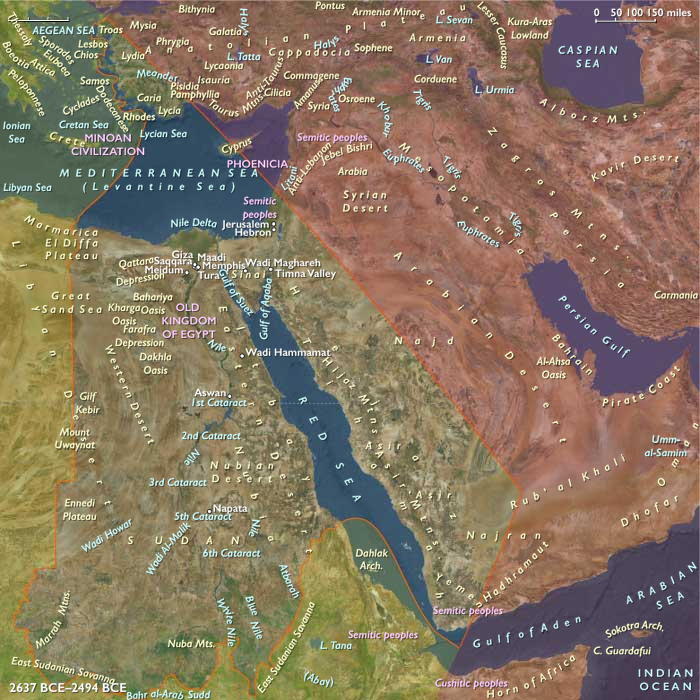
Khufu starts building his pyramid at Giza, the first to be built in this area.
Based on inscriptional evidence, it is also likely that he led military expeditions into the Sinai, Nubia and Libya.
While pyramid construction had been solely for the reigning pharaoh prior to Khufu, his reign sees the construction of several minor pyramid structures that are believed to have been intended for other members of his royal household, amounting to a royal cemetery.
Three small pyramids to the east of Khufu's pyramid are tentatively thought to belong to two of his wives, and the third has been ascribed to Khufu's mother Hetepheres I, whose funerary equipment was found relatively intact in a shaft tomb nearby.
A series of mastabas were created adjacent to the small pyramids, and tombs have been found in this "cemetery."
Locations
People
Groups
Topics
Subjects
Regions
Subregions
Related Events
Showing 4 events out of 4 total
Years: 2577BCE - 2566BCE
Locations
People
Groups
Topics
Subjects
Regions
Subregions