Krum, Khan of Bulgaria, takes advantage of …
Years: 805 - 805
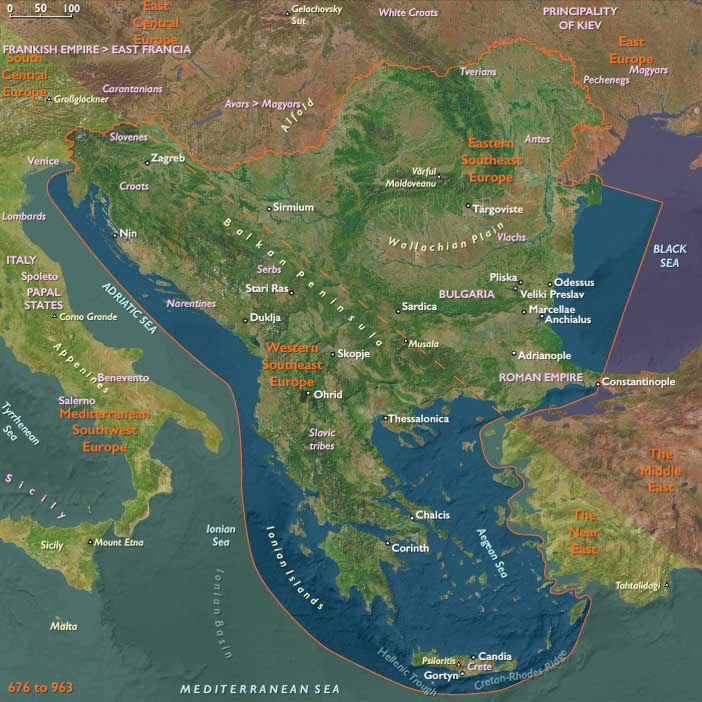
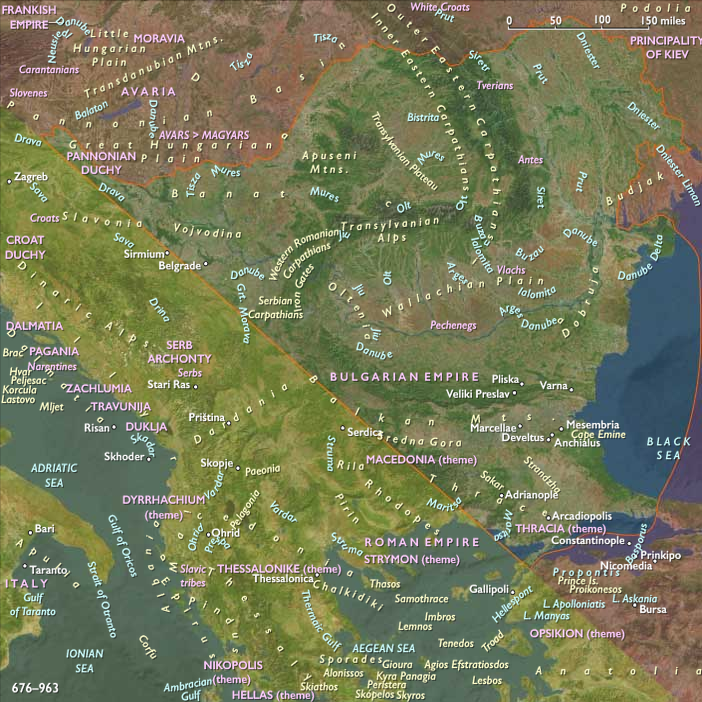
Krum, Khan of Bulgaria, takes advantage of the Frankish defeat of the Avar Khaganate to destroy the remnants of the Avars around 805, and to expand his authority across the Carpathians over Transylvania and along the Danube into eastern Pannonia.
This results in the establishment of a common border between the Frankish Empire and Bulgaria, which is to have important repercussions for the policy of Krum's successors.
Locations
People
Groups
Topics
Commodoties
Subjects
Regions
Subregions
Related Events
Filter results
Showing 10 events out of 54815 total
Kukai had taken part in a government-sponsored expedition to China in 804 in order to learn more about the Mahavairocana Sutra.
Scholars are unsure why Kukai was selected to take part in an official mission to China, given his background as a private, not state-sponsored, monk.
Theories include family connections within the Saeki-Otomo clan, or connections through fellow clergy or a member of the Fujiwara clan.
The expedition included four ships, with Kukai on the first ship, while another famous monk, Saicho was on the second ship.
During a storm, the third ship turned back, while the fourth ship was lost at sea.
Kukai's ship arrived weeks later in the province of Fujian and its passengers were initially denied entry to the port while the ship was impounded.
Kukai, being fluent in Chinese, had written a letter to the governor of the province explaining their situation.
The governor allowed the ship to dock, and the party was asked to proceed to the capital of Chang'an (present day Xi'an), the seat of power of the Tang Dynasty.
After further delays, the Tang court granted Kukai a place in the Ximingsi temple where his study of Chinese Buddhism began in earnest as well as studies of Sanskrit with the Gandharan pandit Prajna (734-810?)
who had been educated at the Indian Buddhist university at Nalanda.
In 805, Kukai finally meets Master Hui-kuo (746 – 805) the man who will initiate him into the esoteric Buddhism tradition at Chang'an's Qinglong Monastery.
Huiguo comes from an illustrious lineage of Buddhist masters, famed especially for translating Sanskrit texts into Chinese, including the Mahavairocana Sutra.
Huiguo immediately bestows upon Kukai the first level Abhisheka or esoteric initiation.
Whereas Kūkai had expected to spend twenty years studying in China, in a few short months he is to receive the final initiation, and become a master of the esoteric lineage.
Huiguo is said to have described teaching Kukai as like "pouring water from one vase into another".
Huiguo dies shortly afterwards, but not before instructing Kukai to return to Japan and spread the esoteric teachings there, assuring him that other disciples will carry on his work in China.
Meanwhile, Tang Shunzong succeeds Tang Dezong as emperor of China, but does not last until the end of the year.
Wake no Hiroyo, one of Saicho's earliest supporters in the Court, had invited Saicho to give lectures at Takaosanji along with fourteen other eminent monks.
Saicho was not the first to be invited, indicating that he was still relatively unknown in the Court, but still rising in prominence.
The success of the Takaosanji lectures, plus Saicho's association with Wake no Hiroyo, had soon caught the attention of Emperor Kanmu, who had consulted with Saicho about propagating his Buddhist teachings further, and to help bridge the traditional rivalry between the Hosso (Yogacara) and Sanron (Madhyamika) schools.
The emperor had granted a petition by Saicho to journey to China to further study Tiantai doctrine in China, and bring back more texts.
Saicho was expected to only remain in China for a short time, however.
Saicho can read Chinese language, but is unable to speak it at all, thus he is allowed to bring a trusted disciple along named Gishin, who apparently can communicate in Chinese.
Gishin will later become one of the head monks of the Tendai order after Saicho.
Saicho had been part of the four-ship diplomatic mission to Tang Dynasty China in 803.
The ships were forced to turn back due to heavy winds, where they had spent some time at Dazaifu.
During this time, Saicho had likely met Kukai, who had been sent to China on a similar mission though he was expected to stay much longer.
When the ships set sail again, two sank during a heavy storm, but Saicho's ship had arrived at the port of Ningbo, then known as Mingzhou, in northern Zhejiang Province in 804.
Shortly after arrival, permission had been granted for Saicho and his party to travel to Mount Tiantai and he had been introduced to the Seventh Patriarch of Tiantai Buddhism, named Tao-sui, who becomes his primary teacher during his time in China.
Tao-sui is instrumental in teaching Saicho about Tiantai methods of meditation, Tiantai monastic discipline and orthodox teachings.
Saicho had remained under this instruction for approximately 135 days.
Saicho spends the next several months copying various Buddhist works with the intention of bringing them back to Japan later.
While some works exist n Japan already, Saicho feels that they suffer from copyist errors or other defects, and makes fresh copies.
Once the task is completed, Saicho and his party return to Ningbo, but the ship is harbored in Fuzhou at the time, and will not return for six weeks.
During this time, Saicho goes to Yuezhou (modern-day Shaoxing) and seeks out texts and information on esoteric Buddhism.
The Tiantai school had originally only utilized "mixed" (zōmitsu) ceremonial practices, but over time, esoteric Buddhism has taken on a greater role.
By the time of Saicho, a number of Tiantai Buddhist centers offered esoteric training, and both Saicho and Gishin received initiation at a temple in Yuezhou.
However, it's unclear what transmission or transmissions(s) they received.
Some evidence suggests that Saicho did not receive the dual transmissions of the Diamond Realm and the Womb Realm.Instead, it is thought he may have only received the Diamond Realm transmission, but the evidence is not conclusive one way or the other.
Finally, on the tenth day of the fifth month of 805, Saicho and his party return to Ningbo and after compiling further bibliographies, board he ship back for Japan; they will arrive in Tsushima on the fifth day of the sixth month.
Although Saicho has only stayed in China for a total of 8 months, his return is eagerly awaited by the Court in Kyoto.

Charles, having completed the conquest of Saxony in 804, is the founder, in 805, of a trading village on the present site of Magdeburg, in the region of present Saxony-Anhalt.
Its original name is Magadoburg (probably from Old High German magado for big, mighty and burga for fortress').
Charles issues a fourth ban on the export of weapons to the Slavs in 805.
According to the Moissac Chronicle.
Charles's son, Charles the Younger, laid siege to "Canburg" (somewhere on the Elbe in Bohemia).
It is not known where exactly Canburg was situated.
The chronicle writes about the left bank of the Elbe river, but the author could easily have confused it with other rivers in the area (e.g.
Vltava - Moldau, Ohře - Eger River).
Lingual similarity is the cause of a hypothesis that Canburg was situated somewhere nearby the present-day town of Kadaň.
The first known documentation of Dachau is a medieval deed by the Noble Erchana of Dahauua to the Bishop of Freising, both descendants of the lineage of the Aribons.
With this deed dating back to August 15, 805, the Feast of the Assumption of the Blessed Virgin Mary, she donates her entire property in Dachau, including five so called Colonenhöfe and some serfs and bondsman, to devolve to the Bishop of the Diocese of Freising after her death
In prehistoric Upper Bavaria, in the southern part of Germany, the Amper River would divert into backwaters in several places, where many fords made it possible to cross the river.
The oldest findings of human presence here date back to the Stone Age.
The most noteworthy findings were discovered near Feldgeding in the adjoining municipality Bergkirchen.
The Celts had arrived in this area around 1000 BCE and settled here: the name “Dachau” originated in the Celtic Dahauua, which roughly translates to “loamy meadow”, also alludes to the loamy soil of the surrounding hills.
Some theories assume the name “Amper” river may derive from the Celtic word for “water”.
Approximately at the turn of the first millennium, the Romans conquered the area and incorporated it into the province of Rhaetia.
A Roman trade road between Salzburg and today’s Augsburg is said to have run through Dachau.
Remains of this old route are found along the Amper marshlands.
Nikephoros, during Harun's absence in Khorasan, has used the opportunity to rebuild the destroyed walls of the towns of Safsaf, Thebasa, and Ancyra.
Nikephoros launches the first raid by the Empire for two decades into the Arab frontier district (thughur) in Cilicia in summer 805.
The imperial army raids and takes prisoners as it goes, even capturing the major Abbasid stronghold of Tarsus.
At the same time, …
…another imperial force raids the Upper Mesopotamian thughur and unsuccessfully besieges the fortress of Melitene, while …
…a Constantinople-instigated rebellion against the local Arab garrison begins in Cyprus.
Nagabhata II, who ascends the Gurjara throne in 805 as the fourth Pratihara monarch, begins to reestablish his kingdom’s former size and prestige.