
Land transport vehicles in Sumer include sledges …
Years: 3213BCE - 3070BCE
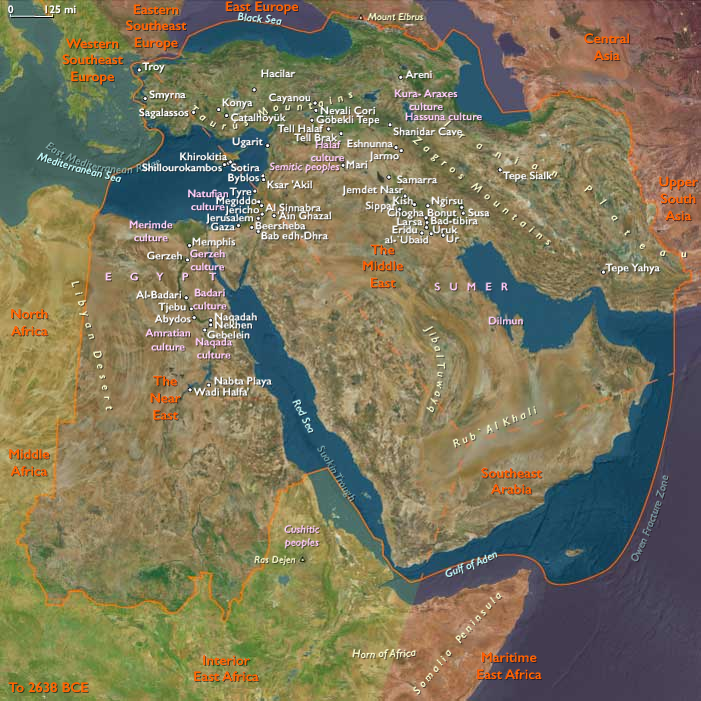
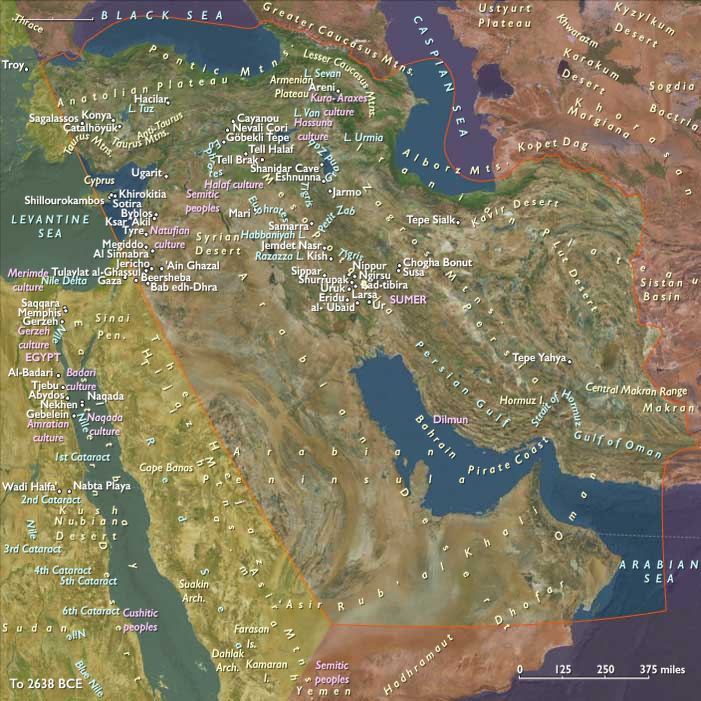
Land transport vehicles in Sumer include sledges and the earliest known wheeled carts, which appear around 3150, representing the first use of the wheel for transportation.
A clay tablet from the period 3200—3100 (found by twentieth century archaeologists in the courtyard of the Eanna Temple in Uruk) contains a pictograph of a wheeled cart.
Locations
Groups
Topics
- Subboreal Period during the Neolithic Subpluvial
- Early Bronze Age I (Near and Middle East)
- Piora Oscillation ending the Neolithic Subpluvial
- Subboreal Period
Subjects
Regions
Subregions
Related Events
Filter results
Showing 10 events out of 71 total
The Quest for Gold and the European Age of Exploration
The desire for gold was one of the primary motivations behind European explorations and conquests in Africa and the Western Hemisphere during the 15th and 16th centuries. Wealth from gold fueled economies, financed wars, and expanded European influence worldwide.
Gold and the African Expeditions
-
Portuguese Expansion (15th Century)
- Portugal, under Prince Henry the Navigator, began exploring the West African coast in search of gold sources.
- The Portuguese established trading posts (feitorias) along the coasts of Senegal, Ghana (Gold Coast), and Benin, tapping into existing African gold trade networks.
- In 1471, the Portuguese reached the Gold Coast (modern Ghana), one of the richest gold-producing regions in Africa.
- By 1482, they built Elmina Castle, their first major African trading fort, to control the gold trade.
-
The Trans-Saharan Gold Trade Declines
- Before European expansion, gold was traded across the Sahara to North Africa and the Mediterranean.
- The Portuguese diverted the gold trade to the Atlantic, weakening North African and Islamic control over West African gold.
- European access to African gold strengthened monarchies and banking systems, financing further explorations and military conquests.
Gold and the Discovery of the Western Hemisphere
-
Christopher Columbus’s Voyages (1492–1504)
- Spain’s sponsorship of Columbus was partly motivated by the promise of gold.
- In Hispaniola and Cuba, Columbus’s men searched for gold deposits, enslaving indigenous peoples to work in gold mines.
- The lack of substantial gold deposits in the Caribbean pushed Spain to explore deeper into the Americas.
-
The Spanish Conquests in the Americas
- Hernán Cortés (1519–1521) defeated the Aztec Empire, capturing its golden treasures, melting them down to finance the Spanish Crown.
- Francisco Pizarro (1532–1533) conquered the Inca Empire, where gold was considered sacred, seizing vast quantities from temples, royal tombs, and palaces.
- The gold and silver mines of Potosí (Bolivia) and Zacatecas (Mexico) became the largest sources of wealth for Spain, financing its imperial dominance in Europe.
Impact of the Gold Rush on European Empires
-
Economic and Political Power
- Gold allowed European monarchies to strengthen their military and bureaucratic systems.
- The influx of gold fueled the Commercial Revolution, expanding banking, investment, and trade.
-
The Slave Trade and Labor Exploitation
- The insatiable demand for gold led to forced labor systems like the encomienda in the Americas.
- African slave labor became essential in gold and silver mining operations.
-
Increased Rivalries and Colonization
- European powers competed fiercely for control of gold-rich territories, leading to colonial wars and empire-building.
- The search for gold pushed explorers deeper into uncharted lands, accelerating European territorial expansion.
Conclusion: Gold as the Catalyst for Global Expansion
The quest for gold was one of the strongest driving forces behind European exploration and conquest. It funded empires, fueled wars, and transformed global economies, playing a pivotal role in shaping the Age of Exploration and the creation of the Atlantic World.
Hernán (sometimes referred to as Fernando or Hernando) Cortés, a Spanish adventurer lured by stories of the riches of the Aztec, assembles a fleet of eleven ships, ammunition, and over seven hundred men and in 1519 sets sail from Cuba to Mexico.
The party lands near present-day Veracruz in eastern Mexico and starts its march inland.
Superior firepower, resentment against the Aztec by conquered tribes in eastern Mexico, and considerable luck all aid the Spanish in their conquest of the Aztec.
The Aztec and their allies have never seen horses or guns, the Spanish have interpreters who can speak Spanish, Maya, and Nahuatl (the Aztec language), and perhaps what is most important, Cortés unwittingly has the advantage of the legend of Quetzalcoatl, in which the Aztec are said to have believed that a white god would arrive in ships from the east in 1519 and destroy the native civilizations.
The Aztec emperor, Moctezuma II (anglicized as Montezuma), unwilling to confront the mysterious arrival whom he considers a god, initially welcomes the Spanish party to the capital in November 1519.
Montezuma soon is arrested, and the Spanish take control of Tenochtitlan.
The Aztec chieftains stage a revolt, however, and the Spanish are forced to retreat to the east.
The battle rages for three weeks, with the superior firepower of the Spanish eventually proving decisive.
The last of the Azrtec emperors, Cuauhtemoc, is captured and killed.
The legend of Cuauhtemoc will be revived in the nineteenth century, and the last Aztec emperor will be considered a symbol of honor and courage, the first Mexican national hero.
The first royal judicial body established in New Spain in 1527 is the audiencia of Mexico City.
The audiencia consists of four judges, who also hold executive and legislative powers.
The crown, however, is aware of the need to create a post that will carry the weight of royal authority beyond local allegiances.
Control of the bureaucracy is handed over in 1535 to Antonio de Mendoza, who is named the first viceroy of New Spain (1535-50).
His duties are extensive but exclude judicial matters entrusted to the audiencia.
The conquest of the Aztec empire had required an enormous effort and a tremendous sacrifice by Cortes's army, and after their victory, the soldiers had demanded what they have come for: prestige and wealth.
The spoils from the city largely had been lost; Cortes has to resort to some other strategy to provide for his men.
The conquistador has already surveyed all Aztec records related to tributes and tributary towns, and on the basis of this information, he decides to distribute grants of people and land among his men.
This practice has already been tried in the Caribbean, and Cortes himself had received encomiendas, grants of land and people, in Hispaniola in 1509 and in Cuba in 1511.
Granting encomiendas become an institutions throughout New Spain to ensure subordination of the conquered pop-ulations and the use of their labor by the Spanish colonizers, as well as a means to reward Spanish subjects for services rendered to the crown.
The Spaniards' task after the fall of Tenochtitlan is to settle and expand the new domains on the mainland of North and Central America that become known as New Spain.
Cortes dispatches several expeditions to survey the areas beyond the Valley of Mexico and to establish political control over the land and its inhabitants.
Once released from the central political control of Tenochtitlan, most towns surrender to Cortes's men.
The capital of the new colony, as a symbol of political continuity, is to be built squarely atop the ruins of Tenochtitlan and is renamed Mexico after the Mexica tribe.
Christopher Columbus travels to the Gulf of Honduras during his fourth voyage in 1502.
A few years later, two of his navigators, Martín Pinzon and Juan De Solis, sail northward along the coast of Belize to the Yucatan.
Hernan Cortes conquers Mexico in 1519 and Pedro Arias Davila founds Panama City.
Spain soon sends expeditions to Guatemala and Honduras, and the conquest of the Yucatan begins in 1527.
There are settlements of Ch'ol-speaking Manche in the southwestern corner of present-day Belize when Cortes passes through this area in 1525.
The Spanish will forcibly displace these settlements to the Guatemalan highlands when they "pacify" the region in the seventeenth century.
The Spanish launch their main incursions into the area from the Yucatan, however, and encounter stiff resistance from the Mayan provinces of Chetumal and Dzuluinicob.
Spanish navigators Juan Diaz de Soils and Vicente Yafiez Pinzon probably touch on part of the Honduran coast in 1508 but devote most of their efforts to exploring farther north.
Some expeditions from the islands of Cuba and Hispaniola may reach the mainland and encounter the population of the Islas de la Bahfa in the second decade of the century, but otherwise the Honduran Caribbean coast is a neglected area.
Interest in the mainland is dramatically revived as a result of the expedition of Hernán Cortés to Mexico.
Part of an expedition headed by Gil Gonzalez Davila in 1523 discovers the Golfo de Fonseca on the Pacific coast, naming it in honor of Bishop Rodriguez de Fonseca.
Four separate Spanish land expeditions began the conquest of Honduras the following year.
The nearly simultaneous invasions of Honduras in 1524 by rival Spanish expeditions begins an era of conflict among rival Spanish claimants as well as with the indigenous population.
The major initial expeditions are led by González Dávila, who hoped to carve out a territory for his own rule, and by Cristóbal de Olid, who is dispatched from Cuba by Cortés.
Once in Honduras, however, Olid succumbs to personal ambition and attempts to establish his own independent authority.
Word of this reaches Cortés in Mexico, and to restore his own authority, he orders yet another expedition, this one under the command of Francisco de Las Casas.
Then, doubting the trustworthiness of any subordinate, Cortés sets out for Honduras himself.
The situation is further complicated by the entry into Honduras of expeditions from Guatemala under Pedro de Alvarado and from Nicaragua under Hernando de Soto.
Years: 3213BCE - 3070BCE
Locations
Groups
Topics
- Subboreal Period during the Neolithic Subpluvial
- Early Bronze Age I (Near and Middle East)
- Piora Oscillation ending the Neolithic Subpluvial
- Subboreal Period
