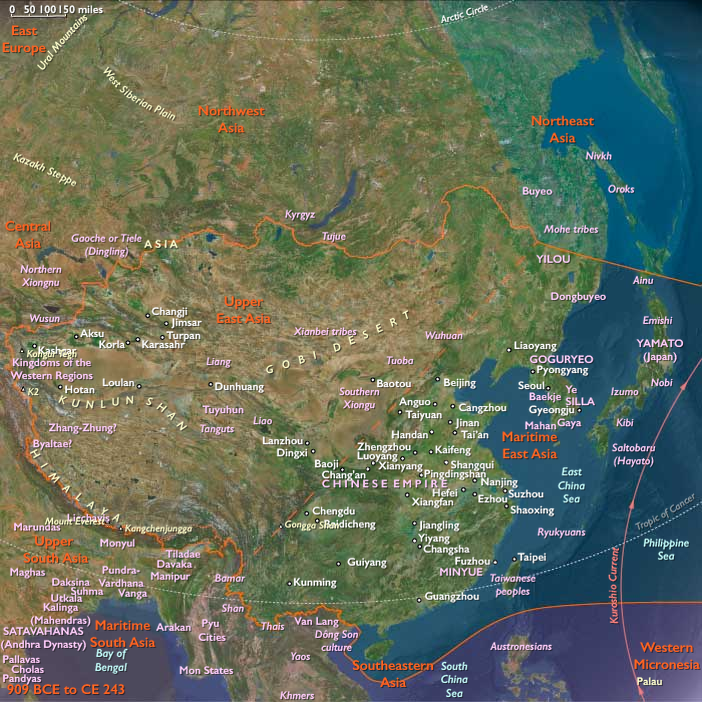
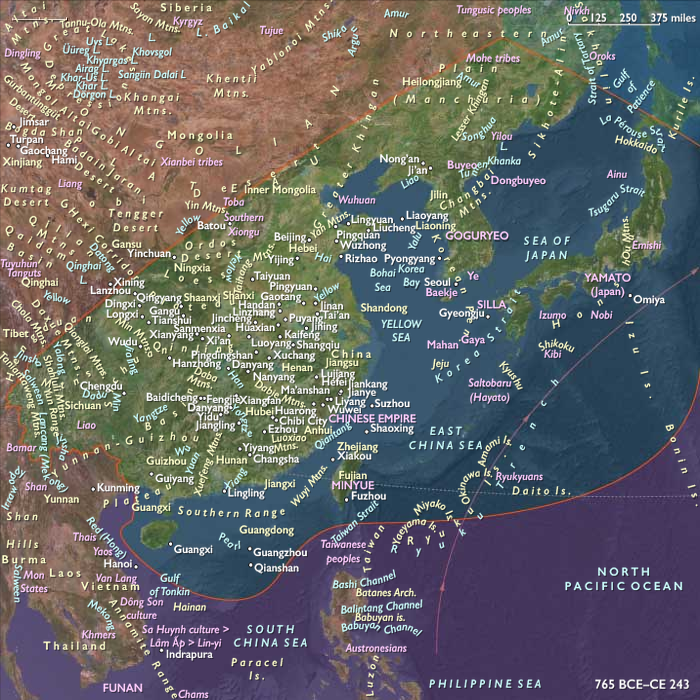
...leaving Cao Ren and Xu Huang to …
Years: 209 - 209
...leaving Cao Ren and Xu Huang to guard Jiangling, ...
Related Events
Filter results
Showing 10 events out of 60724 total
Cao Cao retreats north to his home base of Ye, ...
...Yue Jin stationed in Xiangyang, and ...
...Man Chong in Dangyang.
Caracalla, of mixed Punic–Roman–Berber and Syrian descent, was born Lucius Septimius Bassianus in Lugdunum, Gaul (now Lyon, France), the son of the later Emperor Septimius Severus and Julia Domna.
At the age of seven, his name had been changed to Marcus Aurelius Septimius Bassianus Antoninus to create a connection to the family of the philosopher emperor Marcus Aurelius.
He will later be known by the nickname Caracalla, which refers to the Gallic hooded tunic he habitually wears and which he makes fashionable.
Geta, the younger son of Septimius Severus by his second wife Julia Domna, was born in Rome, at a time when his father was only a provincial governor at the service of Emperor Commodus.
Geta has always been always in a place close to his older brother Lucius, the heir later known as Caracalla.
Perhaps due to this, the relations between the two have been difficult from their early years.
Conflicts are constant and often require the mediation of their mother.
To appease his younger son, Septimius Severus gives Geta the title of Augustus in 209.
During the campaign against the Britons of the early third century, the imperial propaganda presents the image of a happy family that shares the responsibilities of rule.
Septimus Severus entrusts his wife Julia Domna as his councilor, his older son as his second in command, and gives administrative and bureaucratic duties to his younger son.
In reality, however, the rivalry and antipathy between the brothers is far from resolved.
The Caledonians are next mentioned in 209, when they are said to have surrendered to Severus after he personally led a military expedition north of Hadrian's Wall, in search of a glorious military victory.
Herodian and Dio wrote only in passing of the campaign but describe the Caledonians ceding territory to Rome as being the result.
Cassius Dio records that the Caledonians inflicted fifty thousand Roman casualties due to attrition and unconventional tactics such as guerrilla warfare.
Dr. Colin Martin has suggested that the Severan campaigns did not seek a battle but instead sought to destroy the fertile agricultural land of eastern Scotland and thereby bring about genocide of the Caledonians through starvation. (British Archaeology, no. 6, July 1995: Features)
According to one story from around this time, when Severus' wife, Julia Domna, criticized the sexual morals of the Caledonian women, the wife of Caledonian chief Argentocoxos replied: "We fulfill the demands of nature in a much better way than do you Roman women; for we consort openly with the best men, whereas you let yourselves be debauched in secret by the vilest".
Cassius Dio's account of the invasion reads
"Severus, accordingly, desiring to subjugate the whole of it, invaded Caledonia.
But as he advanced through the country he experienced countless hardships in cutting down the forests, leveling the heights, filling up the swamps, and bridging the rivers; 2 but he fought no battle and beheld no enemy in battle array.
The enemy purposely put sheep and cattle in front of the soldiers for them to seize, in order that they might be lured on still further until they were worn out; for in fact the water caused great suffering to the Romans, and when they became scattered, they would be attacked.
Then, unable to walk, they would be slain by their own men, in order to avoid capture, so that a full fifty thousand died.
3 But Severus did not desist until he approached the extremity of the island.
Here he observed most accurately the variation of the sun's motion and the length of the days and the nights in summer and winter respectively.
4 Having thus been conveyed through practically the whole of the hostile country (for he actually was conveyed in a covered litter most of the way, on account of his infirmity), he returned to the friendly portion, after he had forced the Britons to come to terms, on the condition that they should abandon a large part of their territory."

Severus, retracing the steps of Agricola over a century previous, rebuilds and garrisons many abandoned Roman forts along the east coast, including Carpow, which can house up to forty thousand soldiers.
The post established by Cao Cao at Jiangling had fallen to Zhou Yu by the end of 209.
The borders of the land under Cao Cao's control contract by about one hundred and sixty kilometers (ninety-nine miles), to the area around Xiangyang.
Liu Bei, on the other hand, has gained territory by taking over the four prefectures (Wuling, Changsha, Lingling and Guiyang) south of the Yangtze River.
Sun Quan's troops had suffered far greater casualties than Liu Bei's in the extended conflict against Cao Ren following the Battle of Red Cliffs, and the death of Zhou Yu in 210 results in a drastic weakening of Sun Quan's strength in Jing Province.
Liu Bei also occupies Jing Province that Cao Cao had recently lost—a strategic and naturally fortified area on the Yangtze River that Sun Quan claims for himself.
The control of Jing Province provides Liu Bei with virtually unlimited access to the passage into Shu and important waterways into Wu, as well as dominion of the southern Yangtze River.
Never again will Cao Cao command so large a fleet as he had at Jiangling, nor will a similar opportunity to destroy his southern rivals present itself again.
The Battle of Red Cliffs and the capture of Jing Province by Liu Bei confirms the separation of southern China from the northern heartland of the Yellow River valley, and also foreshadows a north-south axis of hostility which will resonate for centuries.
Severus' campaigning has made significant gains by 210, despite Caledonian guerrilla tactics and purportedly heavy Roman casualties.
The Caledonians sue for peace, which Severus grants on condition they relinquish control of the Central Lowlands.
This is evidenced by extensive Severan era fortifications in the Central Lowlands.
The Caledonians, short on supplies and feeling their position becoming desperate, re-form their alliance with the Maeatae and join their fresh offensive.
Severus prepares for another protracted campaign within Caledonia.
He is now intent on exterminating the Caledonians, telling his soldiers: “Let no one escape sheer destruction, No one our hands, not even the babe in the womb of the mother, if it be male; let it nevertheless not escape sheer destruction.” (Dio Cassius (Xiphilinus) ‘Romaika’, Epitome of, Book LXXVI Chapter 15.)
A punitive expedition led by Severus' son Caracalla is sent out with the purpose of slaughtering everyone it encounters from any of the northern tribes.
Severus meanwhile prepares for total conquest but is already ill.
Liu Zhang, at the suggestion of his advisor Zhang Song, asks Liu Bei to come to his assistance in the battle against Zhang Lu in 211.
The welcoming of Liu Bei is a plan by Zhang Song, Fa Zheng, and Meng Da to ultimately make him their leader, since they consider him more ambitious and worthy of serving than Liu Zhang.
Wang Lei, Huang Quan, Li Hui, and others try to persuade Liu Zhang not to accept Liu Bei into his territory, but their pleas are ignored and Liu Bei is welcomed as a guest general of Liu Zhang who will go to the front to fight against Zhang Lu.
Zhong Yao, an advisor of Cao Cao, suggests an invasion of Zhang Lu's territory in the year 211.
However, Ma Chao and Han Sui, whose territory is between Cao Cao's and Zhang Lu's, interpret the massing of forces as an attempt to invade their own lands.
They rebel against Cao Cao, and after much fighting, Cao Cao's forces are victorious.
However, they are in no shape to continue the invasion to Hanzhong.
Ma Chao retreats to Hanzhong and pledges allegiance to Zhang Lu, who considers marrying his daughter to him.
However, a servant of Zhang Lu's, Yang Bo, says, "A man like that, who has no love for even his parents (referring to the execution of Ma Teng caused by Ma Chao's rebellion), cannot love another" and the marriage proposal is scrapped.
Ma Chao then borrows soldiers from Zhang Lu and attempts to regain some of his lost territory from Cao Cao, but is ultimately unsuccessful.
His failures cause the relationship between the two to sour.
When Liu Bei's forces surround Liu Zhang, Ma Chao chooses this time to take his leave of Hanzhong, and with his personal army he joins Liu Bei.
Ma Chao's subordinate Pang De, however, remains in Zhang Lu's service.