Ælfric of Abingdon, Archbishop of Canterbury, dies …
Years: 1005 - 1005
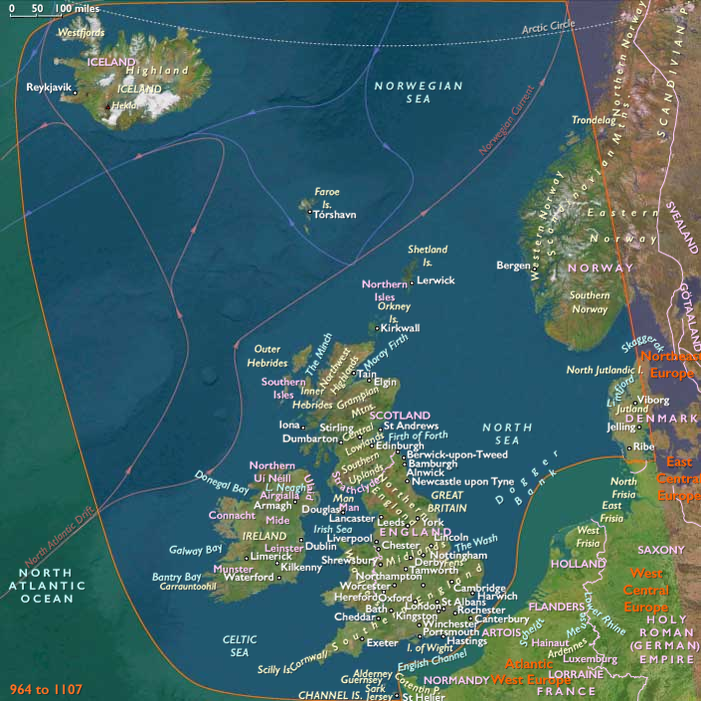
Ælfric of Abingdon, Archbishop of Canterbury, dies on November 16, 1005, leaving ships to the people of Wiltshire and Kent in his will, with his best one, equipped for sixty men, going to King Æthelred II.
Locations
People
Groups
- Anglo-Saxons
- Christianity, Chalcedonian
- Denmark, Kingdom of
- Vikings
- Danes (Scandinavians)
- England, (Anglo-Saxon) Kingdom of
Topics
Commodoties
Subjects
Regions
Subregions
Related Events
Filter results
Showing 10 events out of 51912 total
Henry II retakes Meissen during the next part of the German offensive, and …
…his army advances in 1005 as far into Poland as the city of Poznań, where a peace treaty is signed.
According to the peace treaty, Boleslaw loses Lusatia and Meissen and likely gives up his claim to the Bohemian throne.
Also in 1005, a pagan rebellion in Pomerania overturns Boleslaw's rule and results in the destruction of the just implemented local bishopric.
Bruno, or Boniface, born to a noble family of Querfurt (now in Saxony-Anhalt), is rumored to have been a relative of the Holy Roman Emperor Otto III.
At the age of six he had been sent to be educated in Magdeburg, seat of Adalbert of Magdeburg, the teacher and namesake of Saint Adalbert.
While still a youth he had been made a canon of Magdeburg cathedral.
The fifteen-year-old Otto III had made Bruno a part of his royal court.
While in Rome for Otto's imperial coronation, Bruno had met Saint Adalbert of Prague, the first Apostle of the Prussians, killed a year later, which will inspire Bruno to write a biography of St. Adalbert when he reaches the recently Christianized and consolidated Kingdom of Hungary himself.
Bruno had spent much time at the monastery where Adalbert had become a monk and where abbot John Canaparius may have written a life of Saint Adalbert.
Later, Bruno had entered a monastery near Ravenna, founded by Otto, and had undergone severe ascetic training under the guidance of St. Romuald.
Otto III had hoped to open a monastery between the Elbe and the Oder (somewhere in the pagan lands that became Brandenburg or Western Pomerania) to help convert the local population into Christianity.
Pope Sylvester II had appointed Bruno to head a mission among the pagan peoples of Eastern Europe In 1003.
Owing to the regional conflict between the Holy Roman Emperor Henry II and Duke Boleslaus I of Poland, he had delayed the plans for the monastery, and sets out for Hungary, where he visits the places that Saint Adalbert of Prague had attended.
Bruno tries to get Ajtony, or Ahtum, the Duke of Banat, who is under jurisdiction of Patriarchate of Constantinople, to come under jurisdiction of Patriarchate of Rome, but this precipitates a large controversy leading to organized opposition from local monks.
Bruno elects to gracefully exit the region after he first finishes his book, the famous "Life of St. Adalbert," a literary memorial of much worth giving a history of the (relatively recent) conversion of the Hungarians.

Mahmud's first campaign to the south is against the Ismaili Fatimid Kingdom at Multan in a bid to carry political favor and recognition with the Abbasid Caliphate; he also engages with the Fatimids elsewhere.
conducts a series of campaigns during which some Ismailis are massacred while most later convert to Sunni Hanafi fiqh.
The governor of Dyrrhachium, Ashot Taronites, surrenders his city to the imperial forces in 1005.
The defection of Dyrrhachium to Constantinople completes the isolation of Samuel's core territories in the highlands of western Macedonia.
The Expansion of Flanders Under Baldwin IV ("the Bearded") and the Seizure of Ghent (1005)
During the early 11th century, Flanders, a powerful vassal state of the Capetian Duchy of Burgundy, embarked on a period of territorial expansion under Count Baldwin IV ("the Bearded"). One of his earliest and most significant gains was the capture of Ghent in 1005, securing a crucial strategic and economic stronghold.
Flanders’ Position Within the Capetian Realm
- Though formally a vassal of the Capetian monarchy, Flanders enjoyed significant autonomy, owing to its wealth, military strength, and political ties to the Holy Roman Empire.
- The House of Flanders was a dominant force in northern France and the Low Countries, frequently engaging in territorial disputes and strategic alliances to expand its holdings.
The Capture of Ghent (1005)
- In 1005, Baldwin IV expanded his control eastward, seizing Ghent, a vital trade and river port city at the confluence of the Scheldt and Lys rivers.
- Ghent’s location made it one of the most important economic centers in northern Europe, allowing Flanders to control trade routes and further develop its textile industry.
- This expansion strengthened Flanders’ influence in the region, bringing it into closer conflict with both the Capetian monarchy and the Holy Roman Empire, which also had interests in the Low Countries.
Baldwin IV’s Continued Expansion
- Following the capture of Ghent, Baldwin IV continued to extend Flemish control southward and eastward, further consolidating his territorial power.
- His reign marked the foundation of Flanders’ later dominance as one of the wealthiest and most politically independent regions in medieval Europe.
Legacy
The capture of Ghent in 1005 was a turning point in the rise of Flanders as a commercial and military power. It secured Baldwin IV’s position as a formidable ruler, setting the stage for Flanders’ increasing independence from Capetian France and its growing role in European trade and politics.
Norsemen had settled the Faroe Islands around 800, bringing the Old Norse language that evolved into the modern Faroese language.
According to Icelandic Sagas such as Færeyjar Saga, one of the best known men in the island is Tróndur í Gøtu, a descendant of Scandinavian chiefs who had settled in Dublin, Ireland.
Tróndur leads the battle against Sigmundur Brestisson, the Norwegian monarchy and the Norwegian church.
According to the Færeyinga Saga, emigrants who left Norway to escape the tyranny of Harald I of Norway had settled in the Faroe Islands about the beginning of the ninth century.
Early in the eleventh century, Sigmundur, whose family had flourished in the southern islands but had been almost exterminated by invaders from the north, had been sent back to the Faroe Islands, whence he had escaped, to take possession of the islands for Olaf Tryggvason, king of Norway.
Sigmundur is the first Faroe-man to convert to the Christian faith, bringing Christianity to the Faroes at the decree of Olaf Tryggvason.
Initially Sigmundur had sought to convert the islanders by reading the decree to the Alting in Tórshavn, but was nearly killed by the resulting angry mob.
He had then changed his tactics, went with armed men to the residence of the chieftain Tróndur í Gøtu and broke in his house by night.
He offered him the choice between accepting Christianity or face beheading; he chose the former.
Later on, in 1005, Tróndur í Gøtu attacks Sigmund by night at his yard in Skúvoy, whereupon Sigmundur flees by swimming to Sandvík on Suðuroy.
He reaches land in Sigmundargjógv in Sandvík, but a farmer in the village kills the exhausted Sigmundur, and steals his precious golden arm ring.
According to tradition, his gravestone is located in the so-called Sigmundarsteinur in Skúvoy.
It bears a carved cross and is part of the old church.
The Danes continue raiding until famine grips England in 1005, causing the Danish invaders, who must live off the land, to return home.
The term clan (from Gaelic clann, "offspring") is used from at least this time in the northern British Isles in reference to Irish and Scottish family groups with common names and ancestors.
Cináed mac Duib (anglicised Kenneth III, the Grim), king of the Scots from 997, dies in 1005 in battle at Monzievaird in Strathearn at the hands of his cousin Máel Coluim mac Cináedin (son of Kenneth II), who succeeds him to rule as Malcolm II.
In the same way that Brian Bóru, High King of Ireland, is very far from being the only king in Ireland, Máel Coluim is one of several kings within the geographical boundaries of modern Scotland.
His fellow kings include the king of Strathclyde, who rules much of the southwest, various Norse-Gael kings of the western coasts and the Hebrides and, nearest and most dangerous rivals, the Kings or Mormaers of Moray.
The Earls of Bernicia and Northumbria, whose predecessors as kings of Northumbria had once ruled most of southern Scotland, still control large parts of the southeast.
Brian Boru makes a second expedition to the north to take hostages from the northern states: during this expediton, he visits Armagh, making an offering of twenty ounces of gold to the church and confirming to the apostolic see of Saint Patrick, ecclesiastical supremacy over the whole of Ireland (as recorded in the Book of Armagh).
Years: 1005 - 1005
Locations
People
Groups
- Anglo-Saxons
- Christianity, Chalcedonian
- Denmark, Kingdom of
- Vikings
- Danes (Scandinavians)
- England, (Anglo-Saxon) Kingdom of