
Lithuanian hetman Jan Karol Chodkiewicz and Polish …
Years: 1601 - 1601
June
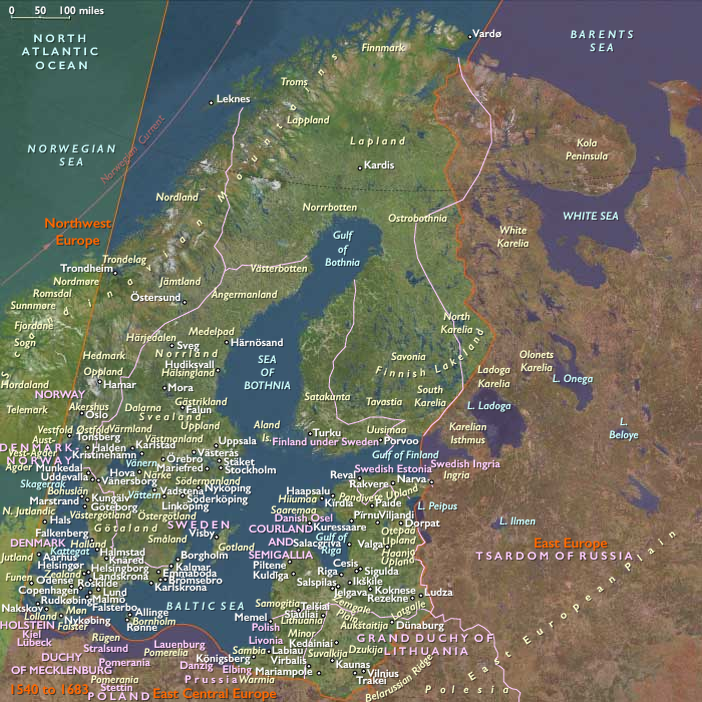
Lithuanian hetman Jan Karol Chodkiewicz and Polish chancellor Jan Zamoyski, recalled from Moldavia, arrive in Lithuania in 1601 to fight the Swedish incursion, which now threatens not only the Estonia promised by Sigismund, but older Polish territories south of it.
Chodkiewicz and Radziwiłł defeat the Swedes in the first major open battle of this war at Kokenhusen (modern Koknese) in June 1601.
Soon afterwards, Zamoyski, fresh from his victory against the Moldavians, comes in to help against the Swedes, with twelve thousand men, and fifty artillery pieces, fifteen of which are classified as heavy.
Charles is unable to deal effectively with such an army and is forced to retreat.
However, during the retreat he leaves sizable numbers of defenders at various captured fortresses in Livonia.
Locations
People
Groups
- Livs
- Sweden, (second) Kingdom of
- Calvinists
- Courland and Semigallia, Duchy of
- Livonia, Duchy of (Polish Estonia and Latvia)
- Estonia, Duchy of (Swedish Estonia)
- Polish-Lithuanian Commonwealth (Commonwealth of the Two Nations)
Topics
- Protestant Reformation
- Counter-Reformation (also Catholic Reformation or Catholic Revival)
- Moldavian Magnate Wars
- Polish-Swedish War for Livonia, First
Commodoties
Subjects
Regions
Subregions
Related Events
Filter results
Showing 4 events out of 4 total
Baruch de Spinoza, a Dutch philosopher of Portuguese Jewish origin, is the most famous of the Jews in Holland at this time.
Spinoza has became known in the Jewish community for positions contrary to prevailing Jewish belief of this period, wherein he harbors critical positions towards the anti-maimonidean dominance of Jewish religious texts that has persisted since the Maimonidean Controversy.
The Jewish community of Amsterdam on July 27, 1656, issues to him the writ of cherem, a kind of excommunication.
Righteous indignation on the part of the synagogue elders at Spinoza's heresies is not the sole cause for the excommunication; there is also the practical concern that his ideas, which disagree equally well with the orthodoxies of other religions as with Judaism, will not sit well with the Christian leaders of Amsterdam and will reflect badly on the whole Jewish community, endangering the limited freedoms that the Jews had achieved in that city.
The terms of his cherem are severe.
He is, in Bertrand Russell's words, "cursed with all the curses in Deuteronomy and with the curse that Elisha pronounced on the children who, in consequence, were torn to pieces by the she-bears."( The cherem, atypically, will never be revoked.)
Following his excommunication, he adopts the first name Benedictus, the Latin equivalent of his given name, Baruch; they both mean "blessed".
Atlantic West Europe (1660–1671): Stabilization, Maritime Expansion, and Cultural Prosperity
Between 1660 and 1671, Atlantic West Europe—including northern France, the Low Countries (modern-day Netherlands, Belgium, Luxembourg), and the regions facing the Atlantic and English Channel coasts—experienced a period of relative peace, increased maritime trade, economic growth, and flourishing cultural life. This era marked a significant recovery from decades of warfare, reinforcing political stability, commercial vitality, and setting foundations for the region's emerging global influence.
Political and Military Developments
French Consolidation under Louis XIV
-
Louis XIV’s personal rule began after the death of Cardinal Mazarin (1661), inaugurating an era of increasingly centralized absolutist monarchy in France.
-
Royal authority strengthened through administrative reforms, centralizing governance, taxation, and military organization. Minister Jean-Baptiste Colbert implemented mercantilist economic policies, enhancing state control over commerce, trade, and colonial endeavors.
Stability and Prosperity in the Dutch Republic
-
Under the Grand Pensionary Johan de Witt (1653–1672), the Dutch Republic enjoyed internal political stability, economic prosperity, and maritime dominance.
-
De Witt’s diplomatic strategies prioritized neutrality and trade expansion, though underlying tensions with England and France remained, foreshadowing later conflicts.
Spanish Netherlands: Continued Vulnerability
-
The Spanish Netherlands (present-day Belgium and Luxembourg) remained politically vulnerable, caught between French ambitions and Dutch economic competition. Habsburg governance struggled to maintain stability amid fiscal constraints and military pressure from France.
Economic Developments: Maritime and Commercial Expansion
Dutch Maritime Supremacy
-
The Dutch Republic consolidated its dominance in global maritime commerce, notably through the expansion of the Dutch East India Company (VOC), which generated immense wealth from Asian trade.
-
Amsterdam solidified its status as Europe’s leading financial center, managing complex trade networks, banking systems, and establishing early financial institutions, including the Amsterdam Exchange Bank.
French Economic Reform and Colonial Expansion
-
Under Colbert’s direction, France pursued aggressive mercantilist policies, promoting industrial growth, infrastructural development, and maritime trade expansion.
-
French Atlantic ports—particularly Bordeaux, Nantes, and Rouen—prospered, driven by increased trade in wine, textiles, sugar, and colonial products from the Americas and the Caribbean.
-
French colonial ventures accelerated, notably in North America (New France) and the Caribbean (Saint-Domingue, Martinique), fueling Atlantic commerce and establishing a robust colonial economy.
Economic Challenges in the Spanish Netherlands
-
Antwerp and Brussels struggled economically compared to Amsterdam and French ports, due to ongoing fiscal burdens, declining trade competitiveness, and disrupted traditional commerce routes resulting from geopolitical tensions.
Religious and Intellectual Developments
Reinforced Catholic Orthodoxy in France and the Spanish Netherlands
-
Under Louis XIV, Catholic orthodoxy intensified in France, laying the groundwork for future religious policies targeting Protestant minorities (Huguenots). Jesuit influence remained strong, particularly in education and cultural institutions.
-
In the Spanish Netherlands, Catholicism remained firmly entrenched through ecclesiastical institutions, supported by Habsburg authority, emphasizing religious uniformity and limiting Protestant influences.
Dutch Religious Pluralism and Intellectual Flourishing
-
The Dutch Republic continued fostering religious toleration, encouraging intellectual openness. Leiden University and other institutions attracted European scholars, nurturing philosophical and scientific advances, exemplified by the enduring influence of Baruch Spinoza.
Cultural and Artistic Developments
French Baroque and Royal Patronage
-
Louis XIV’s court at Versailles (initial developments from 1661 onward) emerged as a preeminent center of European artistic patronage, producing monumental architecture, sculpture, and landscaping that defined French Baroque style.
-
Artists and architects, including Charles Le Brun, André Le Nôtre, and Louis Le Vau, produced masterworks that embodied royal absolutism, classical aesthetics, and centralized power.
Dutch Artistic Prosperity and Golden Age
-
Dutch Golden Age painting continued flourishing, with renowned artists such as Johannes Vermeer creating iconic masterpieces during this period, reflecting the urban, mercantile prosperity and domestic tranquility of Dutch society.
-
Artistic innovation extended beyond painting, influencing printmaking, decorative arts, and publishing, contributing to a vibrant cultural climate and broader European cultural exchange.
Social and Urban Developments
Urban Expansion and Social Dynamism
-
Major urban centers—Amsterdam, Rotterdam, Antwerp, Nantes, Rouen, and Bordeaux—expanded significantly, reflecting growing maritime trade, industrial development, and population growth.
-
Merchant elites and prosperous middle classes wielded substantial influence in urban governance, cultural patronage, and economic policymaking, promoting civic pride, cultural refinement, and infrastructural improvement.
Rural Recovery and Agricultural Productivity
-
Agricultural regions in northern France and parts of the Low Countries experienced gradual recovery, aided by peace, better harvests, and improved agricultural practices. Increased agricultural output contributed to regional economic stabilization and demographic recovery.
Legacy and Historical Significance
The years 1660–1671 represented a pivotal phase for Atlantic West Europe, defined by political stability, maritime commercial dominance, and vibrant cultural achievements:
-
Politically, France’s centralized monarchy solidified under Louis XIV, the Dutch Republic enjoyed internal stability and economic expansion, and the Spanish Netherlands faced persistent geopolitical vulnerability.
-
Economically, the region prospered, driven by Dutch global trade networks and French mercantilist policies that facilitated industrial growth, urban prosperity, and colonial expansion.
-
Culturally and intellectually, artistic patronage, particularly in France and the Dutch Republic, fostered exceptional creativity, leaving enduring legacies in art, architecture, and intellectual discourse.
By 1671, Atlantic West Europe had significantly advanced beyond wartime disruptions, firmly establishing its position as a center of political strength, economic dynamism, and cultural sophistication, shaping the region’s influential trajectory into the early modern period.
Atlantic West Europe (1672–1683): Conflict, Expansion, and Cultural Vitality
Between 1672 and 1683, Atlantic West Europe—including northern France, the Low Countries (modern-day Netherlands, Belgium, Luxembourg), and regions along the Atlantic and English Channel coasts—experienced a turbulent yet transformative period marked by intense warfare, renewed territorial expansion, economic resilience, and sustained cultural and intellectual creativity. Despite challenges, this era solidified the foundations for the region’s future global prominence.
Political and Military Developments
The Franco-Dutch War (1672–1678)
-
Known as the "Disaster Year" (Rampjaar) of 1672 in Dutch history, Louis XIV of France invaded the Dutch Republic, allying with England under Charles II. Initial French advances were dramatic, capturing Utrecht and threatening Amsterdam.
-
The invasion caused internal political upheaval, resulting in the downfall and assassination of Grand Pensionary Johan de Witt (1672). William III of Orange emerged as Stadtholder, rallying Dutch resistance.
-
The Dutch Republic, supported by Spain, the Holy Roman Empire, and Brandenburg-Prussia, successfully repelled French forces, leading to the Peace of Nijmegen (1678–1679). France acquired important territories, including parts of the Spanish Netherlands and the Franche-Comté, solidifying its northeastern borders.
Strengthening of Absolutism in France
-
Louis XIV reinforced absolute monarchy following military gains. Internal administration tightened under Jean-Baptiste Colbert and Louvois, who enhanced military reforms, infrastructure, and centralized governance.
-
French territorial expansion along the eastern frontier (Alsace, Franche-Comté) bolstered France’s geopolitical position, setting the stage for ongoing European conflicts.
Stability and Recovery in the Dutch Republic
-
Following the Franco-Dutch War, the Dutch Republic recovered politically and economically under William III’s leadership, though increasingly burdened by military and financial pressures, particularly maintaining large armies against potential future conflicts.
Economic Developments: Resilience and Expansion
French Economic Strength and Colonial Growth
-
French maritime commerce expanded dramatically. Atlantic ports like Bordeaux, Nantes, and La Rochelle prospered, driven by trade in wine, sugar, slaves, and colonial commodities from the Caribbean (Saint-Domingue, Martinique) and Canada (New France).
-
Colbert’s mercantilist policies supported industrial growth, maritime trade, and colonial settlements, significantly enhancing France’s Atlantic commercial interests.
Dutch Economic Resilience
-
Despite initial setbacks in 1672, the Dutch Republic rapidly recovered its position as a maritime and commercial powerhouse, with Amsterdam maintaining dominance in banking, shipping, and global trade.
-
The Dutch East India Company (VOC) continued its expansive presence in Asia, while the Dutch West India Company (WIC) engaged heavily in the Atlantic slave trade and plantation economies, notably in Suriname and the Caribbean.
Decline of the Spanish Netherlands' Economy
-
The Spanish Netherlands faced prolonged economic stagnation due to warfare, fiscal pressures, and diminished commercial competitiveness. Antwerp and Brussels increasingly fell behind Amsterdam and French Atlantic ports economically, prompting migration of skilled workers and merchants to the Dutch Republic and France.
Religious and Intellectual Developments
Continued Catholic Orthodoxy in France and Spanish Netherlands
-
France intensified Catholic orthodoxy, reflected in Louis XIV’s ongoing suppression of Protestant communities, notably the Huguenots. Although formal revocation of the Edict of Nantes occurred later (1685), repression was already intensifying, leading to Huguenot emigration, particularly toward the Dutch Republic and England.
-
The Spanish Netherlands remained staunchly Catholic, reinforcing ecclesiastical control and limiting Protestant influences.
Dutch Intellectual and Scientific Flourishing
-
The Dutch Republic sustained its intellectual prominence, becoming a hub of scientific inquiry and innovation. Christiaan Huygens, Antoni van Leeuwenhoek, and others made groundbreaking scientific discoveries in optics, biology, and astronomy.
-
Religious tolerance, though challenged, persisted, facilitating intellectual freedom, attracting persecuted intellectuals, and enriching Dutch scholarly traditions.
Cultural and Artistic Developments
French Cultural Patronage: Baroque and Classicism
-
Under Louis XIV, French culture flourished in grand Baroque and Classical forms. Versailles continued to symbolize royal absolutism, magnificently expanded and embellished by architects Jules Hardouin-Mansart and landscape designer André Le Nôtre.
-
Artists, playwrights, and musicians—such as Molière, Jean Racine, Jean-Baptiste Lully—thrived, supported by royal patronage, firmly establishing French cultural dominance across Europe.
Dutch Artistic Vitality and Genre Painting
-
Despite war and financial burdens, the Dutch Golden Age artistic tradition endured, with artists producing richly detailed domestic scenes, landscapes, still lifes, and portraits. Though Rembrandt had died in 1669, his artistic legacy profoundly influenced contemporaries.
-
Painters like Jan Steen and Jacob van Ruisdael contributed significantly during this era, capturing scenes of daily life and natural landscapes, representing a distinctly Dutch cultural identity.
Social and Urban Developments
Urban Growth and Economic Dynamism
-
Major Atlantic urban centers—Amsterdam, Rotterdam, Nantes, Bordeaux—continued growing, driven by maritime trade, commercial activity, and industrial expansion. Merchant classes gained greater social prominence and political influence, underpinning urban prosperity.
-
Bordeaux's wine industry, exporting significant quantities of wine to England and the Netherlands, became an economic cornerstone, bolstering the city’s prosperity and international recognition.
Social Tensions and Rural Challenges
-
Although urban prosperity was notable, rural areas across northern France and parts of the Low Countries faced ongoing economic strain due to warfare, fiscal burdens, and agricultural difficulties. Rural poverty and periodic unrest remained common, contrasting sharply with urban affluence.
Legacy and Historical Significance
The period 1672–1683 was critical in shaping Atlantic West Europe’s historical trajectory, deeply influenced by conflict, economic recovery, cultural vitality, and social transformations:
-
Politically, French territorial expansion significantly reshaped Europe’s geopolitical landscape, while the Dutch Republic preserved its independence and commercial prominence despite military threats.
-
Economically, the era witnessed sustained maritime commerce and colonial expansion, particularly benefiting France’s Atlantic ports and the resilient Dutch trading empire.
-
Culturally and intellectually, French absolutism promoted extraordinary cultural patronage, reinforcing European classical norms, while Dutch scientific inquiry and artistic production continued flourishing, exemplifying a dynamic intellectual climate.
-
Religiously, intensified religious tensions and increasing persecution of Protestant minorities foreshadowed major demographic and cultural shifts in subsequent decades.
By 1683, Atlantic West Europe had firmly established its position as a pivotal center of European power, commerce, and culture, laying foundations for its influential role in global affairs throughout subsequent centuries.
German mathematician and philosopher Gottfried Leibniz had managed to delay his arrival in Hanover until the end of 1676, after making one more short journey to London, where he possibly was shown some of Newton's unpublished work on the calculus.
This fact was deemed evidence supporting the accusation, made decades later, that he had stolen the calculus from Newton.
On the journey from London to Hanover, Leibniz had stopped in The Hague where he had met Leeuwenhoek, the discoverer of microorganisms.
He had also spent several days in intense discussion with Spinoza, who had just completed his masterwork, the Ethics.
Leibniz respects Spinoza's powerful intellect, but is dismayed by his conclusions that contradict both Christian and Jewish orthodoxy.
Promoted in 1677, at his request, to Privy Counselor of Justice, a post he is to hold for the rest of his life, Leibniz is to serve three consecutive rulers of the House of Brunswick as historian, political adviser, and most consequentially, as librarian of the ducal library.
He henceforth employs his pen on all the various political, historical, and theological matters involving the House of Brunswick; the resulting documents form a valuable part of the historical record for the period.
Years: 1601 - 1601
June
Locations
People
Groups
- Livs
- Sweden, (second) Kingdom of
- Calvinists
- Courland and Semigallia, Duchy of
- Livonia, Duchy of (Polish Estonia and Latvia)
- Estonia, Duchy of (Swedish Estonia)
- Polish-Lithuanian Commonwealth (Commonwealth of the Two Nations)
Topics
- Protestant Reformation
- Counter-Reformation (also Catholic Reformation or Catholic Revival)
- Moldavian Magnate Wars
- Polish-Swedish War for Livonia, First
