
Filters:
John Harrison had designed a marine clock …
Years: 1732 - 1743
John Harrison had designed a marine clock to compete for the Longitude Prize and traveled to London in 1730, seeking financial assistance.
He had presented his ideas to Edmond Halley, the Astronomer Royal, who had in turn referred him to George Graham, the country's foremost clockmaker.
Graham must have been impressed by Harrison's ideas, for he has loaned him money to build a model of his "Sea clock".
As the clock was an attempt to make a seagoing version of his wooden pendulum clocks, which perform exceptionally well, he used wooden wheels, roller pinions and a version of the 'grasshopper' escapement.
Instead of a pendulum, he used two dumbbell balances, linked together.
It takes Harrison five years to build his first Sea Clock (or H1).
He demonstrates it to members of the Royal Society who speak on his behalf to the Board of Longitude.
The clock is the first proposal that the Board considers to be worthy of a sea trial.
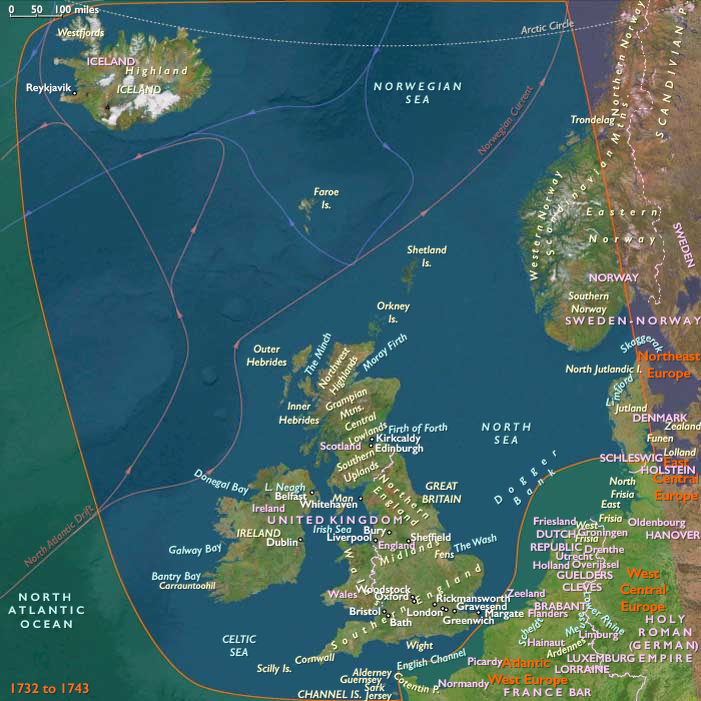
In 1736, Harrison sails to Lisbon on HMS Centurion under the command of Captain George Proctor and returns on HMS Orford after Proctor dies at Lisbon on October 4, 1736.
The clock loses time on the outward voyage.
However, it performs well on the return trip: both the captain and the sailing master of the Orford praise the design.
The master notes that his own calculations had placed the ship sixty miles east of its true landfall which had been correctly predicted by Harrison using H1.
This had not been the transatlantic voyage demanded by the Board of Longitude, but the Board is impressed enough to grant Harrison £500 for further development.
Harrison moves on to develop H2, a more compact and rugged version.
In 1741, after three years of building and two of on-land testing, H2 is ready, but by now Britain is at war with Spain in the War of Austrian Succession and the mechanism is deemed too important to risk falling into Spanish hands.
In any event, Harrison suddenly abandons all work on this second machine when he discovers a serious design flaw in the concept of the bar balances.
He had not recognized that the period of oscillation of the bar balances could be affected by the yawing action of the ship (when the ship turned such as 'coming about' while tacking).
It is this that leads him to adopt circular balances in the Third Sea Clock (H3).
The Board grants him another £500, and while waiting for the war to end, he proceeds to work on H3.
He had presented his ideas to Edmond Halley, the Astronomer Royal, who had in turn referred him to George Graham, the country's foremost clockmaker.
Graham must have been impressed by Harrison's ideas, for he has loaned him money to build a model of his "Sea clock".
As the clock was an attempt to make a seagoing version of his wooden pendulum clocks, which perform exceptionally well, he used wooden wheels, roller pinions and a version of the 'grasshopper' escapement.
Instead of a pendulum, he used two dumbbell balances, linked together.
It takes Harrison five years to build his first Sea Clock (or H1).
He demonstrates it to members of the Royal Society who speak on his behalf to the Board of Longitude.
The clock is the first proposal that the Board considers to be worthy of a sea trial.
In 1736, Harrison sails to Lisbon on HMS Centurion under the command of Captain George Proctor and returns on HMS Orford after Proctor dies at Lisbon on October 4, 1736.
The clock loses time on the outward voyage.
However, it performs well on the return trip: both the captain and the sailing master of the Orford praise the design.
The master notes that his own calculations had placed the ship sixty miles east of its true landfall which had been correctly predicted by Harrison using H1.
This had not been the transatlantic voyage demanded by the Board of Longitude, but the Board is impressed enough to grant Harrison £500 for further development.
Harrison moves on to develop H2, a more compact and rugged version.
In 1741, after three years of building and two of on-land testing, H2 is ready, but by now Britain is at war with Spain in the War of Austrian Succession and the mechanism is deemed too important to risk falling into Spanish hands.
In any event, Harrison suddenly abandons all work on this second machine when he discovers a serious design flaw in the concept of the bar balances.
He had not recognized that the period of oscillation of the bar balances could be affected by the yawing action of the ship (when the ship turned such as 'coming about' while tacking).
It is this that leads him to adopt circular balances in the Third Sea Clock (H3).
The Board grants him another £500, and while waiting for the war to end, he proceeds to work on H3.
Locations
People
Groups
Topics
Subjects
Regions
Subregions
Years: 1732 - 1743
Locations
People
Groups
Topics
Subjects
Regions
Subregions