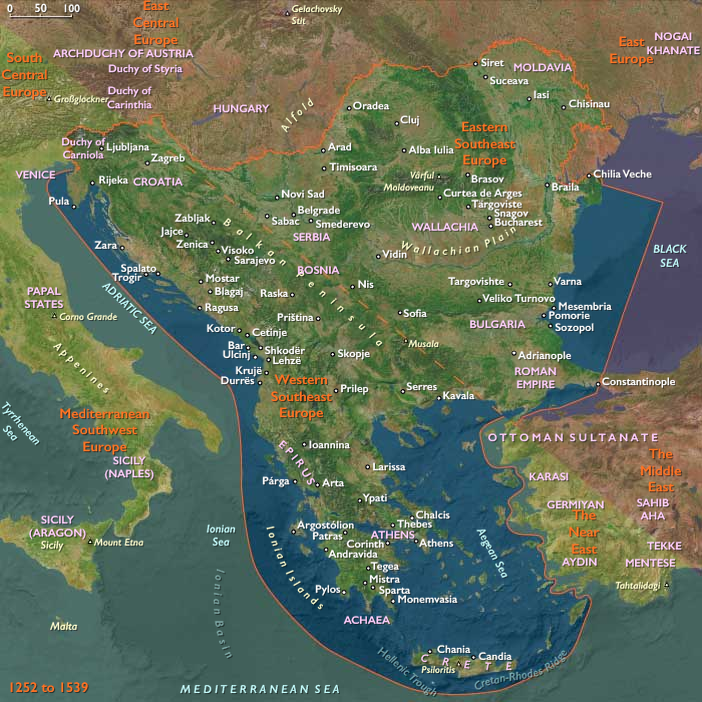
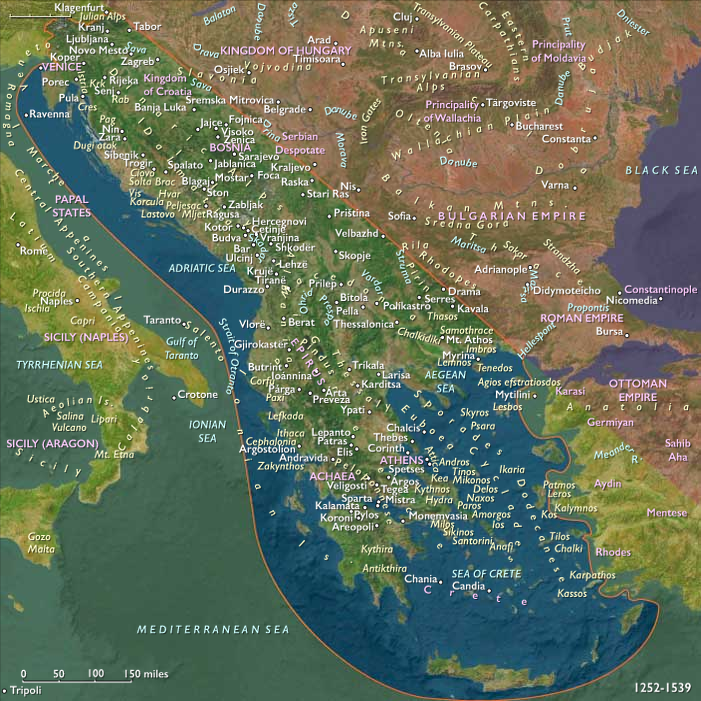
…lose Cephalonia, largest of the Ionian islands.
Years: 1503 - 1503
…lose Cephalonia, largest of the Ionian islands.
Locations
Groups
Topics
Commodoties
Subjects
Regions
Subregions
Related Events
Filter results
Showing 10 events out of 39746 total
The influential Sesshu Toyo, now eighty-three years old, treats a famous Japanese scene in a masterly combination of Japanese lyric mood and Chinese-style brushwork in his Amanohashidate, depicting one of Japan's famous three scenic views.
Svante Nilsson continues the war after Sture’s death in 1503, unsuccessfully besieging Stockholm and ...
…Borgholm.
Alexander, who two years earlier had succeeded his brother John Albert to the Polish throne, allows the Jews to return to Lithuania in 1503 after an eight-year exile.
Viet Stoss, following his return to Nuremberg in 1496 with his wife and eight children, had reacquires his citizenship for three gulden and resumed his work here as a sculptor, producing a great number of extremely moving sculptures, both reliefs and freestanding statues, in stone and in wood.
Between 1500 and 1503 he has carved an altar, now lost, for the parish church of Schwaz, Tyrol, of the "Assumption of Mary".
In 1503, he is arrested for forging the seal and signature of a fraudulent contractor.
Sentenced to be branded on both of his cheeks, he is prohibited from leaving Nuremberg without the explicit permission of the city council.
Dürer also continues to make images in watercolor and bodycolor (usually combined), including a number of still lifes of meadow sections or animals, including his Young Hare and the Great Piece of Turf.
The hand of Adam Kraft has been claimed to be evident as an assistant in works in Ulm Minster, completed in 1471, and the pulpit at Strasbourg Cathedral, completed in 1485.
Ite is not known where was born and raised; he is believed to have married twice, but is not known to have produced any children.
All his known works are in stone, but he may also have carved unidentified pieces in wood.
His masterpiece is considered to be the eighteen point seven meter (sixty-one feet) tall tabernacle in the Saint Lorenz church of Nuremberg.
The tabernacle, which has the shape of a Gothic tower reaching into the church's vault, is made up of tracery interspersed with figural scenes from Christ's Passion and is commissioned in 1493 by Hans Imhoff, a patrician from Nuremberg.
The contract for the commission was preserved and stipulates details about the execution and finish of the work.
The stone tower, which is supported by three figures, will be lightly damaged during the Second World War and restored afterwards.
One of the supporting figures is a self-portrait by Kraft (at right).
Another important work is a huge relief of 1490-92 depicting the Crucifixion, Entombment of Christ, and Resurrection of Christ, on the exterior of St. Sebaldus Church, Nuremberg.
Kraft is believed to have completed all of his sculpting work in Nuremberg and its environs in Bavaria, between the years 1490 and 1509, working with only a small complement of two or three assistants.
In 1503, Adam Kraft sculpts another major monument, the Landauer family tomb in the Egidienkirche.

Lucas Cranach (the Elder) was born at Kronach in upper Franconia, probably in 1472; his exact date of birth is unknown.
His mother, with surname Hübner, died in 1491.
Lucas had learned the art of drawing from his father Hans Maler (his surname meaning "painter" and denoting his profession, not his ancestry, after the manner of the time and class).
The name of his birthplace was later used for his surname, another custom of the times.
How Cranach was trained is not known, but it was probably with local south German masters, as with his contemporary Matthias Grünewald, who works at Bamberg and Aschaffenburg (Bamberg is the capital of the diocese in which Kronach lies).
Apparently painting portraits for academic patrons in Vienna in 1503, Cranach completes the diptych of Dr. Johannes Cuspinian and Anna Cuspinian, the first German portraits containing a landscape background common to both and contributing to the mood of each subject.
Another early masterpiece completed in that year, the Crucifixion (which scholars will, until 1895, mistakenly attribute to Matthias Grünewald) portrays an intensely expressive landscape background and human emotions in compositions more unified than those of the Flemish realists of the previous century.
Cranach’s distinctive style may have initiated the Danube school of romantic landscapes.
The Ottoman fleet emerges for the first time as a major Mediterranean naval power at the conclusion of the Venetian Turkish War of 1499-1503—a triumph amply justifying the program of naval construction that Bayezid had approved in the years before the beginning of the war—and the Ottomans become an integral part of European diplomatic relations.
Bayezid never will be able to use this situation to make new conquests in Europe, because the rise of revolts in eastern Anatolia will occupy much of his attention during the last years of his reign.
In Moldavia, a frustrated Stephen, having failed in his attempts to obtain Polish and Hungarian support against the continuing Turkish threat, eventually agrees to the payment of an annual tribute in exchange for continuing Moldavian independence.