
The fossilized remains of Homo sapiens idaltu …
Years: 173709BCE - 152974BCE
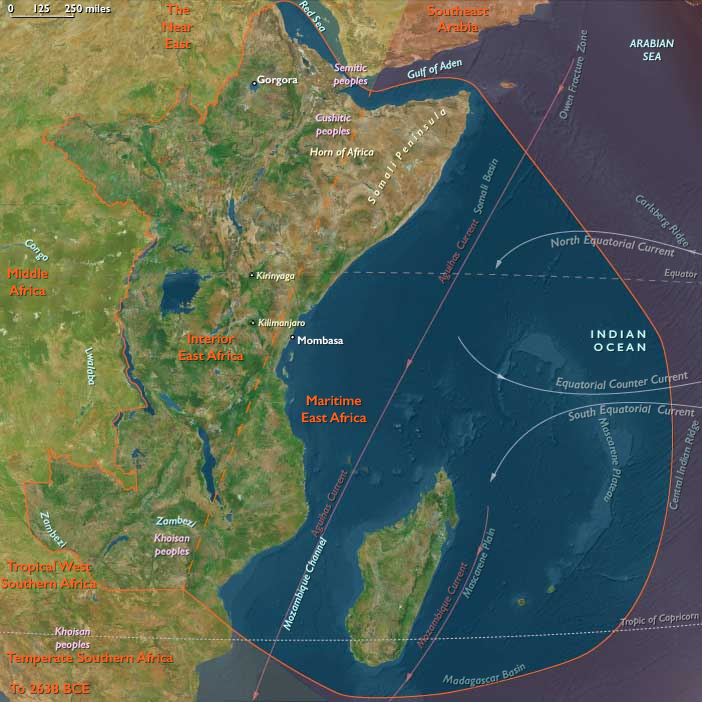
Herto Bouri is a region of Ethiopia under volcanic layers.
By using radioisotope dating, the layers date between one hundred and fifty-four thousand and one hundred and sixty thousand years old.
Idaltu is the Afar word for "elder, first born.”
These fossils differ from those of chronologically later forms of early H. sapiens such as Early European Modern Humans found in Europe and other parts of the world in that their morphology has many archaic features not typical of H. sapiens (although modern human skulls do differ across the globe).
Despite the archaic features, these specimens are postulated to represent the direct ancestors of Homo sapiens sapiens.
"Modern humans" are defined as the Homo sapiens species, of which the only extant subspecies is known as Homo sapiens sapiens.
According to the "Recent African Origin (RAO)" or "Out-Of-Africa" theory, H. sapiens sapiens developed shortly after this period (Khoisan mitochondrial divergence dated not later than 110,000 BP) in Eastern Africa, and as such, to be the oldest representative of the H. sapiens species found so far.
Locations
Topics
Subjects
Regions
Subregions
Related Events
Filter results
Showing 10 events out of 302 total
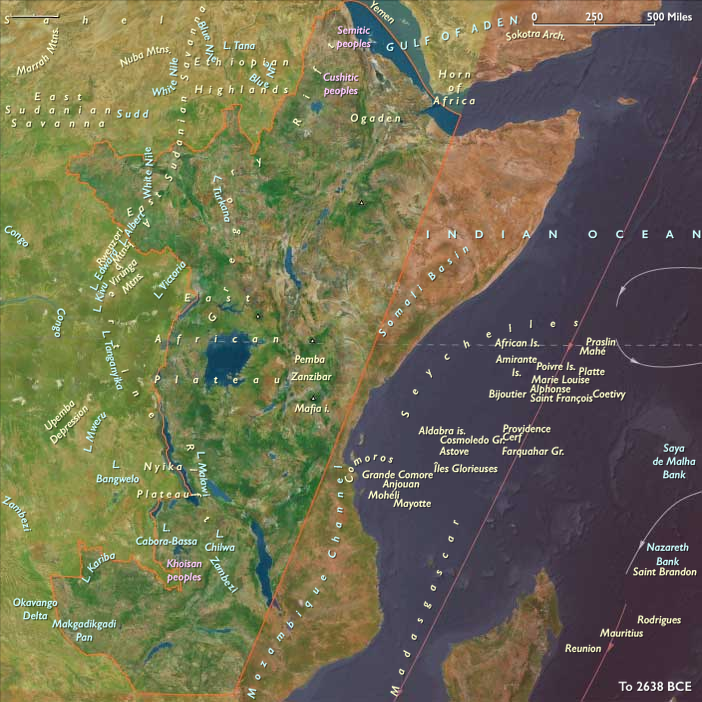
A French expedition from Mauritius reaches the Seychelles in 1742, and during a second expedition in 1756 the French make a formal claim to them.
The name "Seychelles" honors the French minister of finance under King Louis XV.
Settlement begins in 1778 under a French military administration but barely survives its first decade.
Although the settlers are supposed to plant crops only to provision the garrison and passing French ships, they also find it lucrative to exploit the islands' natural resources.
Between 1784 and 1789, an estimated thirteen thousand giant tortoises are shipped from Mahé.
The settlers also quickly devastate the hardwood forests—selling them to passing ships for repairs or to shipyards on Mauritius.
In spite of reforms to control the rapid elimination of trees, exploitation of the forest continues for shipbuilding and house building and later for firing cinnamon kilns, ultimately destroying much of the original ecology.
Possession of the islands alternates between France and Britain several times during the French Revolution and the Napoleonic wars.
France ceded Seychelles—which at this time includes the granitic group and three coral islands—to Britain in 1814 in the Treaty of Paris after rejecting a British offer to take French holdings in India in place of Seychelles.
Because Britain's interest in the islands has centered mainly on halting their use as a base for French privateering, its main concern is to keep the islands from becoming burdens.
Britain administers Seychelles as a dependency of Mauritius, from which they receive little attention and few services.
King Louis XIV of France dies on September 1, 1715, after a reign of seventy-two years, leaving his throne to his five-year-old great-grandson Louis XV, who will reign for fifty-eight years.
Philippe d'Orléans, nephew of Louis XIV, is the Regent for the new monarch.
The private bank set up by John Law in 1716 has developed the use of paper money.
Law in August 1717 conceives a joint stock trading company, the Compagnie d'Occident (Company of the West,) a grandiose project meant to generate private prosperity and state income in France through colonial and commercial exploitation of French Louisiana.
Law is named the Chief Director of this new company, which is granted a trade monopoly of the West Indies and North America by the French government.
Shares in what will become known as the Mississippi Scheme initially sell for five hundred livres.
Atlantic West Europe (1720–1731): Financial Crisis, Economic Resilience, and Enlightenment Expansion
From 1720 to 1731, Atlantic West Europe—including northern France, the Low Countries (modern Belgium, Netherlands, Luxembourg), and the Atlantic and Channel coasts—faced significant economic turbulence exemplified by financial crises, yet continued its broader trajectory toward intellectual, cultural, and social development shaped by Enlightenment thought and stabilized political structures. The period underscored the resilience of regional economies and fostered deepening intellectual exchanges across Europe.
Political and Military Developments
Stability under Bourbon and Habsburg Rule
-
Under the regency (1715–1723) and then reign of Louis XV (r. 1715–1774), France enjoyed relative internal peace, allowing a focus on domestic economic and administrative reforms despite ongoing fiscal challenges.
-
The Austrian Netherlands (Belgium and Luxembourg), governed under Habsburg rule, enjoyed stable yet conservative administration, maintaining internal order while gradually integrating into wider European economic networks.
Diplomatic Stability and Limited Warfare
-
European diplomatic conditions were generally peaceful, guided by balance-of-power diplomacy, especially after the significant territorial realignments resulting from the Treaty of Utrecht (1713). Atlantic West Europe benefited from a respite from widespread conflict, despite occasional diplomatic friction.
Economic Developments: Crisis and Recovery
The Financial Bubble Crisis (1720)
-
The early 1720s were dominated by financial instability exemplified by the infamous Mississippi Bubble in France and the contemporaneous South Sea Bubble in Britain.
-
In France, John Law’s Mississippi Company, heavily tied to colonial speculation in North America, collapsed spectacularly in 1720, devastating public finances, eroding trust in government-backed financial schemes, and causing widespread economic disruption across France, particularly affecting Paris and the northern trading cities.
-
Amsterdam and other Dutch cities faced ripple effects from these speculative crashes, temporarily disrupting financial markets, though the robust Dutch banking system proved resilient, recovering more swiftly than France.
Regional Economic Resilience and Recovery
-
Despite initial disruption, northern French cities (Bordeaux, Nantes, and Rouen) and the Low Countries (Amsterdam, Antwerp, Brussels) demonstrated resilience, recovering through diverse trade networks, maritime commerce, and robust agricultural productivity.
-
Dutch commerce, particularly trade in luxury goods, textiles, and colonial commodities, rapidly resumed strength, maintaining Amsterdam’s position as a pivotal commercial hub and financial capital.
Industrial and Agricultural Expansion
-
The Low Countries saw continued growth in industries such as textiles (Flanders) and ceramics (Delft and Brussels), while French Atlantic ports expanded commerce with the Americas, notably in wine, sugar, tobacco, and manufactured goods.
-
Agricultural improvements continued steadily across northern France, increasing productivity and facilitating demographic growth.
Intellectual and Religious Developments
Continued Enlightenment Expansion
-
Enlightenment ideas increasingly permeated intellectual and cultural life across Atlantic West Europe, prominently through French philosophes like Montesquieu, whose seminal work Persian Letters (1721) offered critical yet engaging commentary on French society, politics, and culture, profoundly influencing political thought.
-
Universities and academies in the Low Countries, especially Leiden University and the University of Louvain, continued intellectual dynamism, attracting scholars and disseminating Enlightenment ideals broadly.
Religious Moderation and Debates
-
Religious toleration advanced modestly, notably in the Dutch Republic, where Calvinist orthodoxy gradually softened, facilitating greater intellectual openness and more liberal religious discourse, exemplified by theologians like Jean Leclerc in Amsterdam.
Cultural and Artistic Flourishing
Continued Rococo Expansion
-
Rococo style flourished, particularly in France and the Austrian Netherlands. The aesthetic reached new heights in decorative arts, architecture, and painting, emphasizing ornate elegance, pastel colors, and playful themes. Paris, Brussels, and Antwerp became vibrant centers of artistic innovation.
-
The French court under Louis XV patronized artists such as François Boucher, who began his influential career during this period, becoming emblematic of Rococo aesthetics.
Literary and Philosophical Innovations
-
Literary life thrived, reflected in the growing popularity of satirical works, social critiques, and emerging novelistic forms. Writers and satirists addressed societal issues such as corruption, wealth disparities, and moral decadence, echoing Enlightenment ideals.
-
Salons and literary circles, especially in Paris, flourished as platforms for intellectual exchange, significantly shaping public discourse and cultural production.
Social and Urban Developments
Urban Growth and Commercial Expansion
-
Atlantic port cities—Bordeaux, Nantes, La Rochelle, Amsterdam, Rotterdam—experienced notable population and commercial growth, fueled by transatlantic trade and expanding colonial markets.
-
Brussels and Antwerp stabilized economically, benefiting from peaceful governance, strengthened trade networks, and improved urban infrastructure.
Societal Shifts and Social Mobility
-
Increased commercial prosperity in port cities boosted the social status and influence of merchant and bourgeois classes, reshaping social structures and fostering greater urban civic engagement and cultural patronage.
-
Economic turbulence temporarily heightened social tensions, particularly after the financial bubble crises, fueling criticism of aristocratic privileges and governmental corruption—foreshadowing later Enlightenment and revolutionary critiques.
Legacy and Significance
The period 1720–1731 represented both vulnerability and resilience in Atlantic West Europe’s trajectory:
-
The financial crises of 1720 exposed the fragility of speculative economic schemes, reshaping European financial practices and spurring more prudent economic governance.
-
The subsequent economic recovery underscored regional resilience, emphasizing the importance of diverse trade networks, agricultural productivity, and manufacturing capabilities as foundations for lasting prosperity.
-
Enlightenment intellectuals deepened their critiques of political and social structures, laying crucial ideological groundwork for future revolutionary movements.
-
Cultural and artistic achievements during this period solidified Rococo aesthetics and literary innovations as enduring components of European cultural heritage.
Overall, this era reinforced Atlantic West Europe's enduring capacity for economic recovery and intellectual vitality, positioning it firmly on the path toward modernity and global influence.
France had begun construction on a fortified town located along the sheltered southwestern shore of Havre Louisbourg on Cape Breton in 1719, naming the settlement Louisbourg.
The sheer volume of the French investment in construction and a growing economy based almost entirely on the Grand Banks fishery, coupled with some out-migration of Acadians living in the British colony now named Nova Scotia, soon see the town of Louisbourg become a thriving community.
The mounting costs for construction also lead to King Louis XV's famous musing to his ministers (to whom he had authorized the fortress's construction) if he should one day be able to see Louisbourg rising over the western horizon from his palace at Versailles.
As construction progresses and the settlement and its economy grow, Louisbourg soon becomes an important hub for commerce between France, New France, and French colonies in the West Indies.
As experienced warriors, the Osage ally with the French, with whom they trade, against the Illiniwek during the early eighteenth century.
The first half of the 1720s is a time of more interaction between the Osage and French.
Étienne de Veniard, Sieur de Bourgmont, founds Fort Orleans in their territory; it is the first European fort on the Missouri River.
Jesuit missionaries are assigned to French forts and establish missions to the Osage, learning their language.
In 1724, the Osage ally with the French rather than the Spanish in their fight for control of the Mississippi region.
In 1725, Bourgmont leads a delegation of Osage and other tribal chiefs to Paris.
The Native Americans are shown the wonders and power of France, including a visit to Versailles, Château de Marly and Fontainebleau.
They hunt with Louis XV in the royal forest and see an opera.
Louis XV had been betrothed in 1721 to his first cousin, Marianne Victoria of Bourbon, daughter of Philip V of Spain and his second wife Elizabeth Farnese.
The eleven-year-old king had found no interest in the arrival in Paris of his future wife, the three-year-old Spanish infanta, who only bored him.
The young king and the court had in June 1722 returned to Versailles, where they will stay until the end of the reign.
Louis XV had in October of the same year been officially crowned in Reims Cathedral.
The king, as he turns thirteen on February 15, 1723, is declared of majority by the Parlement of Paris, thus ending the Régence.
The king leaves the Duke of Orléans in charge of state affairs.
Cardinal Dubois, close confident of the regent, had made prime minister in 1722, but on the the death of Dubois in August 1723, Orléans becomes first minister; however, he himself dies in December of the same year.
Following the advice of his aged tutor, André-Hercule de Fleury, Louis appoints his cousin Louis Henri, Duke of Bourbon, Prince of Condé, to replace the late Orléans.
Louis grants fresh privileges to the Mississippi Company, which had reorganized and opened for business in 1722.
Among these are the monopoly of sale of tobacco and coffee, and the right to organize national lotteries.
It can again tap the capital markets and raise capital by issue of shares and bonds.
Fleury has been present at all interviews between Louis XV and his titular first minister, and on Bourbon's attempt to break through this rule, Fleury retires from court.
The king takes no part in the decisions of Bourbon’s government, which is secretly under the influence of a group of speculators and wheeler-dealers such as Étienne Berthelot de Pléneuf and banker J. Pâris-Duverney.
Berthelot’s daughter, Jeanne Agnès, had at the age of fifteen been married to Louis, marquis de Prie, and had gone with him to the court of Savoy at Turin, where he was ambassador.
Twenty-one when she returned to France, she had soon become Bourbon’s declared mistress.
During his ministry, she has in several respects been the real ruler of France.
The king is quite frail, and several alerts have led to concern for his life.
Bourbon is concerned for Louis’s health, less from concern for the monarch or the future of the dynasty and more from a desire to prevent the late regent’s House of Orléans, which Bourbon sees as an enemy camp, from ascending the throne should the king die.
As the Spanish infanta is far too young to produce an heir, Bourbon, hostile also to Spain, sends the infanta home and sets about choosing a European princess old enough to produce an heir.
Eventually, the choice falls on twenty-one-year-old Marie Leszczyńska, daughter of Poland’s deposed King Stanislaus, who is currently residing at Wissembourg in Alsace.
A poor princess who had followed her father's misfortunes, she is nonetheless said to be virtuous, and quite charming.
She is also from a royal family that had never interbred with the French royals, and it is hoped that she will infuse it with vigorous blood.
Her father’s relatively low status will also ensure that the marriage will not cause diplomatic embarrassment to France by having to choose one royal court over another.
The marriage is celebrated in September 1725 and Louis immediately falls in love with Marie, who is seven years his senior.
This union is Madame de Prie’s most notable triumph but most of Europe considers the marriage of its most powerful king with such a low-ranking princess to be improper and lacking in grandeur.
Stanislaus moves to Chateau Chambord, in the Loire valley.
The ministry of the Duke of Bourbon has been marked by several monetary manipulations, the creation of new taxes such as the fiftieth (cinquantième) in 1725, the persecution of Protestants in 1726, and the high price of grain, all of which have created troubles and economic depression.
The king, who is now sixteen, has since his marriage shown a new health and authority noticed by everyone at court.
The extremely unpopular Duke is preparing a war against Spain and Austria, but Louis makes him recall Fleury, who on July 11, 1726, takes affairs into his own hands and secures the exile from court of Bourbon and of his mistress Madame de Prie, who had earlier sought the exile of Fleury.
He continues to refuse the formal title of first minister, but his elevation to cardinal, in 1726, confirms his precedence over any others.
Fleury is the right man for the moment; naturally cool and imperturbable in his demeanor, frugal and prudent, he carries these qualities into the administration.
With the help of the controller-general of finances Michel Robert Le Peletier des Forte, Fleury almost immediately stabilizes the currency and secures French credit by initiating regular payment of interest on the national debt.
Fleury, abroad, seeks peace, averse as he is to wars, basing his policy on an English alliance and the reconciliation with Spain.
Queen Marie, at the end of her third pregnancy, in September 1729 finally gives birth to a male child, Louis, dauphin de France, who immediately becomes heir to the throne.
The birth of a long awaited heir, which ensures the survival of the dynasty for the first time since 1712, is welcomed with tremendous joy and celebrations in all spheres of French society, and indeed in most European courts.
The royal couple is at the time very united and in love with each other, and the young king is extremely popular.
The birth of a male heir also dispels the risks of a succession crisis and the likely war with Spain that would have resulted.
