
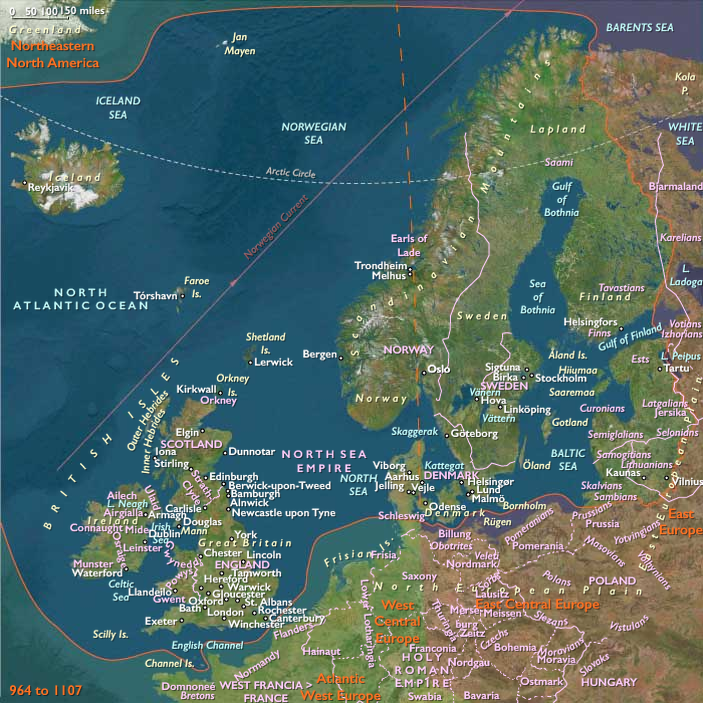
…Lund is the oldest city in present-day …
Years: 990 - 990
…Lund is the oldest city in present-day Sweden.
Lund's origins are unclear.
The town was thought until the 1980s to have been founded around 1020 by either Sweyn I Forkbeard or his son Canute the Great of Denmark.
The area was then part of the kingdom of Denmark.
Recent archaeological discoveries suggest, however, that the first settlement dates to circa 990, possibly the relocation of settlers at Uppåkra.
The Uppåkra settlement dates to the first century BCE, and its remains are at the present site of the village of Uppåkra.
King Sweyn I Forkbeard moves Lund to its present location, a distance of some five kilometers (three point one miles).
The new location of Lund, on a hill and across a ford, gives the new site considerable defensive advantages in comparison with Uppåkra, situated on the highest point of a large plain.
Locations
People
Groups
- Polytheism (“paganism”)
- Christianity, Chalcedonian
- Svealand, (Scandinavian) Kingdom of
- Götaland, (Scandinavian) Kingdom of
- Danes (Scandinavians)
- Swedes (North Germanic tribe)
- Sweden, Kingdom of
Subjects
Regions
Subregions
Related Events
Filter results
Showing 10 events out of 52221 total
The Tanguts, a group of partly nomadic Qiangic-Tibetan people living to the northwest of the Great Wall, had moved from place to place and eventually settled in northwestern China (Ningxia, Gansu, and Shaanxi).
From the moment they entered this region they had undergone a process of sinicization, a term meaning the adoption of Chinese cultural characteristics.
Renouncing their allegiance in 982 to China’s new Song ruler—currently preoccupied with fighting the Tanguts’ Khitan neighbors to the east—the Tangut, under Li Deming, had proclaimed themselves an independent kingdom .
Known in the Chinese language as "Xi-Xia", the Tangut people call their state "The Great State of White and Lofty."
The Khitans had immediately recognized the new state (after 1038 called the Hsi Hsia or Western Hsia).
Following a weak attempt by the Chinese to reestablish dominion, beginning in 990, the Tanguts will soon be left to their own devices.
Eric I the Victorious is the first Swedish king about whom anything definite is known.
His original territory lay in Uppland and neighboring provinces.
He had been victorious over an invasion from the south in the Battle of the Fýrisvellir close to Uppsala.
The extent of his kingdom is unknown.
In addition to the Swedish heartland around Lake Mälaren, it may have extended down the Baltic Sea coast as far south as Blekinge.
According to the Flateyjarbok, his success was due to the fact that he allied with the peasants against the nobility, and it is obvious from archaeological findings that the influence of the latter diminished during the last part of the tenth century.
He was also, probably, the introducer of the famous medieval Scandinavian system of universal conscription known as the ledung in the provinces around Mälaren.
According to Adam of Bremen, Eric allied himself with the Polish prince Boleslav to conquer Denmark and chase away its king Sweyn Forkbeard.
He proclaimed himself the king of Sweden and Denmark which he ruled until his death, which would have taken place in the mid-990s.
Adam says that Eric was baptized in Denmark, but later returned to the Norse gods.
Adam of Bremen gives Emund Eriksson as Eric's predecessor.
In all probability he founded the town of Sigtuna, which still exists and where the first Swedish coins will be stamped for his son and successor Olof Skötkonung.
Along with Sigtuna, …
The 'Uqailids, descended from the Banu Uqayl Bedouins, had first come to power in the city of Diyarbakr when they had been granted land there by the Buyids of Baghdad, who had hoped that they would serve as a buffer against the Kurdish rebel Badh.
Soon afterwards, the 'Uqailids, drawn into the struggle between the Hamdanids and Marwanids, a Kurdish dynasty in Northern Mesopotamia and Armenia, centered around Diyarbakır, for possession of Mosul, had forged an alliance with the Hamdanids, who had been expelled from Mosul by the Buyids in 979.
Together, the two dynasties had moved against the Buyids and Mosul had been occupied in 989.
The 'Uqailid leader, Muhammad b. Musayyib, then fights against the Kurdish rebel Badh, which eventually results in the death of the latter.
Following this, Muhammad turns against the Hamdanids and defeats them as well.
He also forces the Buyid governor of Mosul to grant him half of his dependencies.
Abu adh-Dhawwud Muhammad, the first 'Uqaylid, succeeds the Hamdanids as emir of Mosul, though remaining nominally subject to the Buyids.
Conan I and the Reunification of Brittany (990)
In the spring of 990, Conan I, Count of Rennes, assumed the title of Duke of Brittany, following his successful attack on Nantes and the subsequent death of Count Alan. His rise to power marked the end of a period of fragmentation in Brittany, as he sought to unify the duchy under his rule.
The End of Fractured Rule
Brittany had endured a prolonged period of instability following the death of Drogo of Brittany, whose regency had governed the duchy. After his passing, Brittany fractured under the divided rule of his brothers:
- Hoël and Guerech controlled different regions, resulting in a brief vacancy in the ducal title.
- This political disunity weakened the duchy and left it vulnerable to external pressures.
Conan I emerged as the dominant Breton leader, but before he could secure the title of Duke, he had to ally himself with Odo I, Count of Blois, a powerful regional figure who helped consolidate his claim.
Marriage Alliance with Anjou
Long before assuming the title of Duke, Conan had reinforced his position through a dynastic marriage:
- In 973, he wed Ermengarde-Gerberga of Anjou, daughter of Geoffrey I, Count of Anjou, and Adele of Vermandois.
- This alliance with the House of Anjou bolstered Conan’s standing among the great feudal lords of northwestern France.
Religious Patronage and Land Grants
As Duke, Conan I extended land grants to religious institutions, strengthening ties with the powerful monastic orders. In a charter dated July 28, 990, he granted Villamée, Lillele, and Passille to Mont Saint-Michel—territories that would later become part of the seigneury of Fougères.
A More Unified Brittany
With his consolidation of power in 990, Conan I helped end the fractured rule that had plagued Brittany, asserting ducal authority over Rennes and Nantes. Though tensions among Breton nobles persisted, his reign marked the beginning of a more centralized rule in the duchy, setting the stage for future Bretons to assert their independence within the feudal order of medieval France.
Charles of Lorraine Captures Reims; Hugh Capet Seeks Arnulf’s Deposition (989–991)
Following his invasion of Reims in 989, Charles of Lorraine successfully captured the city and took Archbishop Arnulf—his own nephew—prisoner. This bold move marked a serious challenge to Hugh Capet’s authority, as Reims was the traditional coronation site of West Frankish kings and a center of royal legitimacy.
Hugh Capet’s Response: The Deposition of Arnulf
Despite being a Carolingian prince, Arnulf had initially been accepted as Archbishop of Reims by Hugh Capet. However, his betrayal and support for Charles led Hugh to consider him a traitor. In retaliation, Hugh:
- Refused to recognize Arnulf as archbishop, declaring him a turncoat for aiding the Carolingian claimant.
- Sought Papal intervention, demanding that Pope John XV depose Arnulf from his position.
The Struggle for Control of Reims
With Charles of Lorraine controlling Reims, the city briefly became a Carolingian stronghold, reinforcing his claim to the West Frankish throne. However, his failure to secure widespread support meant that his resurgence remained short-lived.
Hugh Capet’s diplomatic and political maneuvering against Arnulf and Charles would soon culminate in Charles' downfall and the final end of Carolingian ambitions in France.
One group of nomadic Ghuzz, or Oguz, Turkmen tribes, led by a chief named Seljuq, had during the tenth-century migrations of the Turkish peoples from Central Asia and southeast Russia split off from the bulk of the Tokuz-Oghuz, a confederacy of nine clans long settled between the Aral and Caspian Sea, and in 985 set up camp on the right bank of the lower Syr Darya (Jaxartes), in the direction of Jend, near Kzyl Orda in present day south-central Kazakhstan.
Here, in 985, Seljuq had converted to Islam.
The biblical names of his four sons—Mikâîl (Michael), Isrâîl (Israel), Mûsâ (Moses), and Yûnus (Jonah)—suggest previous acquaintance with either Khazar Judaism or Nestorian Christianity.
According to some sources, Seljuq had begun his career as an officer in the Khazar army.
The Seljuq clan has played a part in the frontier defense forces of the Iranian Samanid dynasty, which is now on the verge of collapse.
The Lutici federation of West Slavic Polabian tribes had remained quiet during the early years of Otto III's reign, even during Henry II's failed rebellion.
In 983, following Otto II's defeat at the battle of Stilo, the Slavs had revolted against Imperial control, forcing the Empire to abandon its territories east of the Elbe Rivier in the Northern March and the Billung March.
With the process of Christianization halted, the Slavs had left the Empire in peace, and with Henry II's rebellion put down, Theophanu had launched multiple campaigns to reconquer the lost eastern territories, beginning in 985.
Even though he was only six at the time, Otto III had personally participated in these campaigns.
During the expedition of 986 against the Slavs, Otto III had received the homage of Duke Meiszko I of Poland, who had provided the Imperial army with military assistance and had given Otto III a camel.
Although the Lutici were subdued for a time in 987, they have continued to occupy the young king’s attention.
When Otto III is eleven, Slavic raiders capture the city of Brandenburg in September 991.
The three-year-old son of Otto II, the third ruler of the Saxon or Ottonian dynasty of the Holy Roman Empire, had been acclaimed King of Germany in Verona in June 983, and crowned, as Otto III, in Aachen on December 25 the same year.
His father had died four days before the ceremony, but the news did not reach Germany until after the coronation.
Henry the Quarrelsome, who had been deposed as Duke of Bavaria by Otto II, had seized Otto in early 984 and claimed the regency as a member of the reigning house.
To further his object he had made an alliance with Lothair of France.
Willigis, Archbishop of Mainz, the leader of Otto's party, had induced Henry to release the imprisoned king, for which his Duchy of Bavaria was restored.
Otto had thus been returned to his mother, the Imperial Greek princess Theophanu, who then began serving as regent.
Abandoning her husband's imperialistic policy, she had devoted herself entirely to furthering an alliance between Church and Empire.
She had been unable, however, to prevent France from speedily freeing herself from German influence.
The regent has endeavored to watch over the national questions of the Eastern Empire.
One of the greatest achievements of this empress has been her success in maintaining feudal supremacy over Bohemia.
When her husband Otto I died in 973, Adelaide of Italy, also called Adelaide of Burgundy, perhaps the most prominent European woman of the tenth century, had been succeeded by their son Otto II, and Adelaide for some years had exercised a powerful influence at court.
Later, however, her daughter-in-law, Theophanu, had turned her husband Otto II against his mother, and she had been driven from court in 978; she had lived partly in Italy, and partly with her brother Conrad, king of Burgundy, by whose mediation she had ultimately been reconciled to her son; in 983, Otto had appointed her his viceroy in Italy.
However, Otto had died the same year, and although both mother and grandmother had been appointed as co-regents for the child-king, Otto III, Theophanu had forced Adelaide to abdicate and exiled her.
When Theophanu dies in 991, Adelaide is restored to the regency of her grandson.
She is assisted by Willigis, bishop of Mainz.
The Slavic invasion, as well as an incursion of Viking raiders, forces Otto III to lead his army against the invaders in 992; he suffers a crushing defeat in this campaign.
Phokas had been killed in 989 and his followers had surrendered, and Basil II had reached an agreement with Skleros the following year.
The Greeks focus their attention on Bulgaria, counterattacking in 991.
Although Roman is acknowledged as the official Bulgarian ruler, most of the military matters are left in the hands of Samuil, who is the youngest brother of the Comitopuli dynasty, and Roman devotes to the church deeds similar to his father Peter in his end of life.
During one of his invasions of Bulgaria, the Emperor Basil II succeeds in capturing Roman in 991.
The Bulgarian army is defeated; Samuel manages to escape.
Years: 990 - 990
Locations
People
Groups
- Polytheism (“paganism”)
- Christianity, Chalcedonian
- Svealand, (Scandinavian) Kingdom of
- Götaland, (Scandinavian) Kingdom of
- Danes (Scandinavians)
- Swedes (North Germanic tribe)
- Sweden, Kingdom of
