
Luxembourg City boasts some of the most …
Years: 1867 - 1867
March
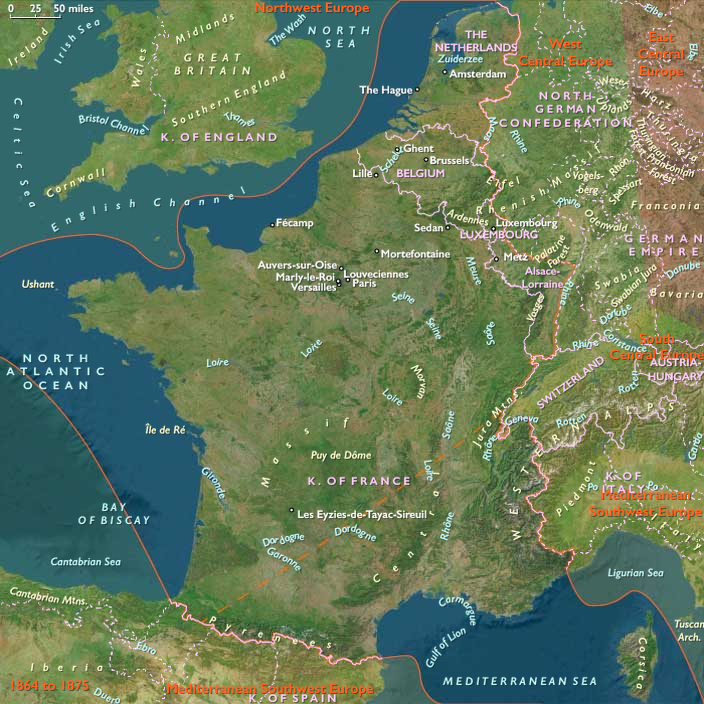
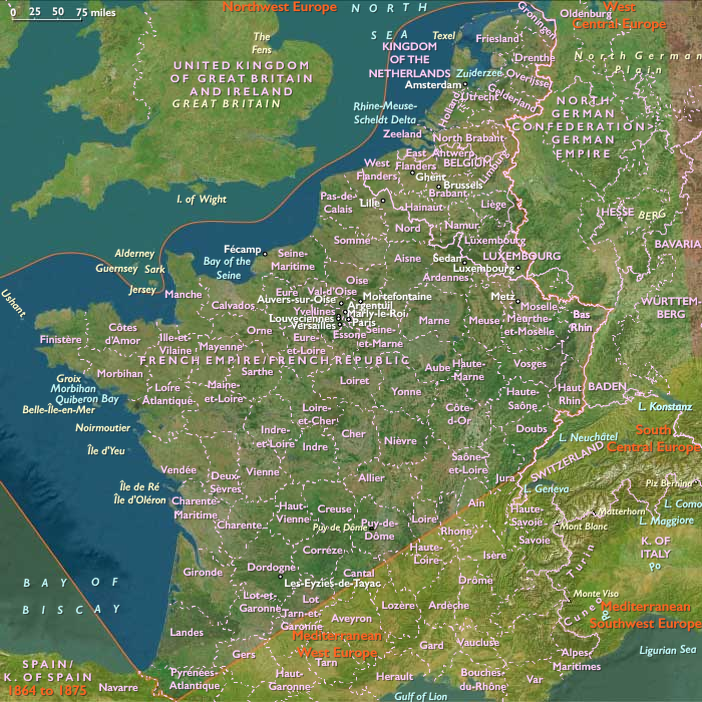
Luxembourg City boasts some of the most impressive fortifications in the world; designed by Marshal Vauban, it is referred to as the Gibraltar of the North.
Since the 1815 Congress of Vienna, the Grand Duchy of Luxembourg had been in personal union with the Kingdom of the Netherlands.
In a concession to Prussia, Luxembourg is to be a member of the German Confederation, with several thousand Prussian soldiers stationed here.
The Belgian Revolution of 1830 had divided Luxembourg into two, and had threatened Dutch control of the remaining territory.
As a result, William I of the Netherlands had entered Luxembourg into the German customs union, the Zollverein, to dilute the French and Belgian cultural and economic influence in Luxembourg.
The Second Schleswig War had further advanced nationalist tensions in Germany, and, throughout 1865, it was clear that Prussia intended to challenge the position of Austria within the German Confederation.
Despite potentially holding the balance of power between the two, Napoleon III had kept France neutral; the French Emperor (like most of Europe) had expected an Austrian victory, but could not intervene on Austria's side, as that would jeopardize France's relationship with Italy post-Risorgimento.
As a result, at Biarritz on October 4, 1865, Napoleon III had promised Bismarck France's neutrality, hoping that such an open statement of intent would strengthen France's negotiating position on the western bank of the Rhine.
The Prussian Prime Minister had refused to offer any land from the Rhineland, which is Napoleon's preferred region.
However, he had made offers of French hegemony in Belgium and Luxembourg, although not committing anything to writing.
When Austria and Prussia did go to war in 1866, the result had been a shock to Europe.
After Prussia defeated Austria's allies in Bavaria and crushed the Austrian army under Benedek at Königgrätz, forcing Austria to the negotiating table, Napoleon III had offered to mediate, and the result, the Treaty of Prague, had dissolved the German Confederation in favor of a Prussian-dominated organization, the North German Confederation.
Assuming that Bismarck will honor his part of the agreement, the French government offers William III of the Netherlands five million guilders for his personal possession of Luxembourg.
Being in deep financial trouble, William accepts the offer on March 23, 1867, but the French are shocked to learn that Bismarck will not agree.
Not only has Bismarck united much of northern Germany under the Prussian crown, but he had secretly concluded agreements with the southern states on October 10, 1866.
His hand forced by nationalistic newspapers in North Germany, Bismarck seeks to renege on the pledge that he had made to Napoleon at Biarritz, and threatens war.
Locations
People
Groups
- Luxemburg, Duchy of
- Prussia, Kingdom of
- Austrian Empire
- Belgium, Kingdom of
- Zollverein (German Customs Union)
- Netherlands, Kingdom of The
- France, Second Empire of
- Italy, Kingdom of
- German Confederation, North
- Austria-Hungary
- Luxembourg, Grand Duchy of
Topics
Subjects
Regions
Subregions
Years: 1867 - 1867
March
Locations
People
Groups
- Luxemburg, Duchy of
- Prussia, Kingdom of
- Austrian Empire
- Belgium, Kingdom of
- Zollverein (German Customs Union)
- Netherlands, Kingdom of The
- France, Second Empire of
- Italy, Kingdom of
- German Confederation, North
- Austria-Hungary
- Luxembourg, Grand Duchy of
Topics
Subjects
Regions
Subregions