
Marwan's death signals the end of Umayyad …
Years: 750 - 750
Marwan's death signals the end of Umayyad fortunes in the East, and is followed by the mass-killing of Umayyads by the Abbasids.
Almost the entire Umayyad dynasty is killed, except for the talented prince Abd ar-Rahman, who escapes to Spain, where he will eventually found an Umayyad dynasty.
Locations
People
Groups
- Iranian peoples
- Arab people
- Persian people
- Islam
- Muslims, Sunni
- Muslims, Kharijite
- Umayyad Caliphate (Damascus)
- Muslims, Shi'a
- Syrian people
- al-Andalus (Andalusia), Muslim-ruled
- Abbasid Caliphate (Kufa)
Topics
Commodoties
Subjects
Regions
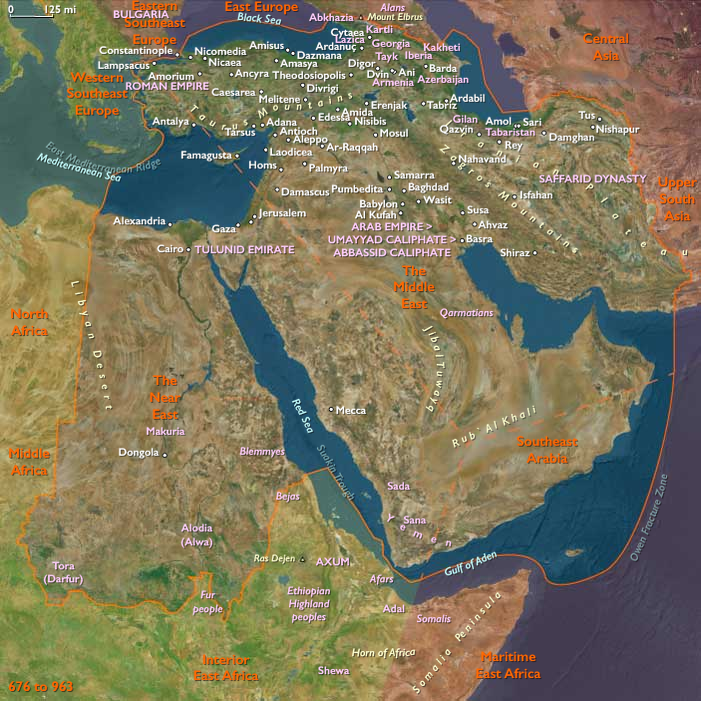
Subregions
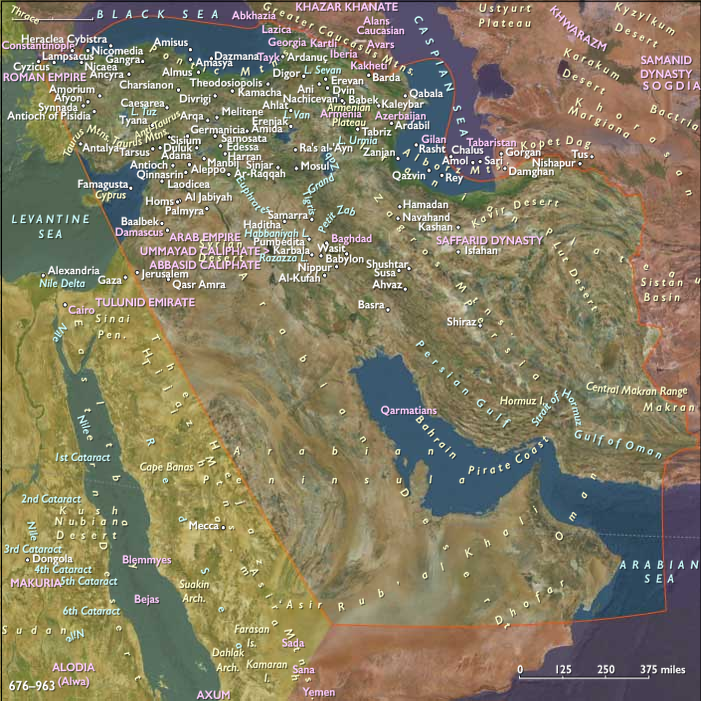
Related Events
Filter results
Showing 10 events out of 55280 total
The army of Marwan II fights a combined force of Abbasid, Shia, and Persian soldiers at the Zab on January 25, 750.
Marwan's army is far larger and seemingly more formidable than that of his opponents, as it contains many veterans of earlier Umayyad campaigns against the Empire; its support for the caliph, however, is only lukewarm.
The morale of the Umayyads has been damaged by the series of defeats inflicted earlier in the rebellion, while the morale of the Abbasid armies has increased.
The Abbasid army forms a spear wall, a tactic they had adopted from their Syrian opponents, presumably from witnessing it in earlier battles.
This entails standing in a battle line with their lances pointed at the enemy (similar to the stakes used by English longbowmen at Agincourt and Crécy many centuries later).
The Umayyad cavalry charges, possibly believing that with their experience they could break the spear wall.
This is a mistake on their part, however, and they are all but butchered.
The Umayyad army falls into retreat, its morale finally shattered.
Many are cut down by the zealous Abbasids or are drowned in the wintertime River Zab.
Over three hundred members of the Umayyad family die at this battle alone.
Marwan himself escapes the battlefield and flees down the Levant, pursued relentlessly by the Abbasids, who meet no serious resistance from the Syrians because the land has recently been laid waste by an earthquake and pestilence.
His heirs Ubaydallah and Abdallah escape to Ethiopia, where Ubaydallah will die in fighting there.
Bengal had become shrouded in obscurity after the reign of Shashanka, King of Gauda, ended in 626, and has been shattered by repeated invasions.
During the reign of Manava, Bengal had been invaded and divided between Harsha Vardhana and Bhaskaravarman.
Jayavardhana of the Shaila Dynasty from Central India had invaded Bengal in 730 and killed the king of the Pundra Kingdom.
Yasovarman (725–752) of Kannauj had killed the king of Magadha and Gauda.
Later Lalitaditya Muktapida of Kashmir, who defeated Yasovarmana, had invaded Bengal.
Sri Harsha of Kamarupa had conquered Anga, Vanga, Kalinga and Odra.
The social and political structure of Bengal has been devastated.
The various independent chieftains of Bengal, disgusted at the situation and tired of the ceaseless political chaos and anarchy (known as matsyanyaya), have selected a person named Gopala to put an end to this sorry state of affairs.
Gopala, already a leading military general, had made a mark as an effective ruler.
In the Khalimpur copper plate inscription (dated to the thirty-second regnal year of Dharmapala), Gopala's father Vapyata is described as a noted military chief of his time and his grandfather Dayita Vishnu is described as a learned man of no military distinctions.
This election of Gopala is probably the only democratic election to have taken place in medieval India.
Marwan flees at last to Abusir/Busir, which is a small town on the Egyptian Nile delta.
It is here on August 6, 750, a few months after the Battle of the Zab, that he is at last killed in a short battle and replaced as caliph by Abu al-Abbas as-Saffah, bringing to an end Umayyad rule in the Middle East.
Arabic-speaking people have spread Islam into the northern Sahara by 750.
The earliest author to mention Ghana is the Persian astronomer Ibrahim al-Fazari who, writing at the end of the eighth century, refers to "the territory of Ghana, the land of gold".
The Ghana Empire lies in the Sahel region to the north of the West African gold fields and is able to profit from controlling the trans-Saharan gold trade.
The early history of Ghana is unknown but there is evidence that North Africa had began importing gold from West African before the Arab conquest in the middle of the seventh century.
Most of our information about the economy of Ghana comes from merchants, and therefore we know more about the commercial aspects of its economy, and less about the way in which the rulers and nobles may have obtained agricultural products through tribute or taxation.
The empire becomes wealthy because of their trading.
They have an abundant amount of gold and salt.
Al-Bakri noted that merchants had to pay a one gold dinar tax on imports of salt, and two on exports of salt.
Other products paid fixed dues, al-Bakri mentioned both copper and "other goods."
Imports probably include products such as textiles, ornaments and other materials.
Many of the hand-crafted leather goods found in old Morocco may also have their origins in the empire.
The main center of trade is Koumbi Saleh.
The king claims as his own all nuggets of gold, and allows other people to have only gold dust.
In addition to the exerted influence of the king onto local regions, tribute is also received from various tributary states and chiefdoms to the empire's periphery.
The introduction of the camel had played a key role in Soninke success as well, allowing products and goods to be transported much more efficiently across the Sahara.
These contributing factors will all help the empire remain powerful for some time, providing a rich and stable economy that is to last over several centuries.
The empire is also known to be a major education hub.
The collapse of the authority of the Damascus Caliphate over the western provinces is another consequence of the Berber revolt.
With the Umayyad Caliphs distracted by the challenge of the Abbasids in the east, the western provinces of the Maghreb and al-Andalus had spun out of their control.
From around 745, the Fihrids, an illustrious local Arab clan descended from Oqba ibn Nafi al-Fihri, have seized power in the western provinces and rule them almost as a private family empire of their own—Abd al-Rahman ibn Habib al-Fihri in Ifriqiya and Yūsuf al-Fihri in al-Andalus.
The Fihrids welcome the fall of the Umayyads in the east, in 750, and seek to reach an understanding with the Abbasids, hoping they might be allowed to continue their autonomous existence.
But when the Abbasids reject the offer and demanded submission, the Fihrids declare independence and, probably out of spite, invite the deposed remnants of the Umayyad clan to take refuge in their dominions.
It is a fateful decision that they will soon regret, for the Umayyads, the sons and grandsons of caliphs, have a more legitimate claim to rule than the Fihrids themselves.
Rebellious-minded local lords, disenchanted with the autocratic rule of the Fihrids, intrigue with the arriving Umayyad exiles.
The Pueblo I Era, from CE 750 to 900, is the first period in which Ancient Pueblo People begin living in pueblo structures and realize an evolution in architecture, artistic expression, and water conservation.
Pueblo I, a Pecos Classification, is similar to the early "Developmental Pueblo Period" of CE 750 to 1100.
People construct and live in pueblos, which are surface level, flat-roofed homes.
At the beginning of the period pueblos are made with jacal construction.
Wooden posts are used to create a frame to supported woven material and a covering of mud.
Later in the period, stone slabs will sometimes used around the dwelling foundation.
The pueblos are made of several rooms that form a straight row or in a crescent shape.
Sometimes they build the dwellings two rows thick with a combination of living rooms with fire pits and storage rooms.
The Pueblo I villages are larger than the settlements of the preceding Basket Maker period; In the Four Corners region the average of five to ten pit-house per settlement rises to twenty to thirty pit-houses per community.
In some cases, the Pueblo I communities are quite large.
Southeastern Utah's Alkali Ridge has about one hundred and thirty rooms built on the surface, with sixteen pit-houses and two kivas.
The Tang Dynasty has fought successfully against the Turks and Tibetans but suffers a major military defeat by the Arabs in 751.
The storm of this year at the southern Chinese seaport of Yangzhou, lLike the storm of 721, reportedly destroys over a thousand ships engaged in canal and river traffic.
The son of the first king of the Bai state of Nanzhao had succeeded his father to the throne and in 750 had refused any longer to recognize Chinese suzerainty.
In retaliation, the Tang send an army against Nanzhao in 751, but this army is soundly defeated at Xiaguan. (It is in the same year that the Tang suffer another serious defeat at the hands of the Arabs at the Battle of Talas in Central Asia; these defeats weaken the dynasty both internally and externally.)
Today the General's Cave (two kilometers west of Xiaguan), and the Tomb of Ten Thousand Soldiers (in Tianbao Park) bear witness to this great massacre.
The Kaifūsō (Fond Recollections of Poetry), the oldest collection of Chinese poetry (kanshi) written by Japanese poets, is created by an unknown compiler in 751.
In the brief introductions of the poets, the unknown writer seems sympathetic to Emperor Kōbun and his regents who had been overthrown in 672 by Emperor Temmu after only eight months of the rule.
Thus, it has been traditionally credited to Awami Mifune, a great grandson of Emperor Kōbun.
It is a collection of one hundred and twenty works by sixty-four poets written in the elegant style of poetry popular in China in the eighth century.
Most of the poets are princes and high ranking regents, such as Prince Ōtsu.
Eighteen of the Kaifūsō poets, including Prince Ōtsu, also have poems in the later anthology of Japanese poetry, the Man'yōshū.
At the time Kaifūsō is written, Chinese poetry has a higher place in the Japanese literary world than waka, and Chinese characters are used for official documents.
Most of the works collected are read on a public occasion.
Years: 750 - 750
Locations
People
Groups
- Iranian peoples
- Arab people
- Persian people
- Islam
- Muslims, Sunni
- Muslims, Kharijite
- Umayyad Caliphate (Damascus)
- Muslims, Shi'a
- Syrian people
- al-Andalus (Andalusia), Muslim-ruled
- Abbasid Caliphate (Kufa)
