
Muhammad had made Medina his first capital, …
Years: 532 - 675
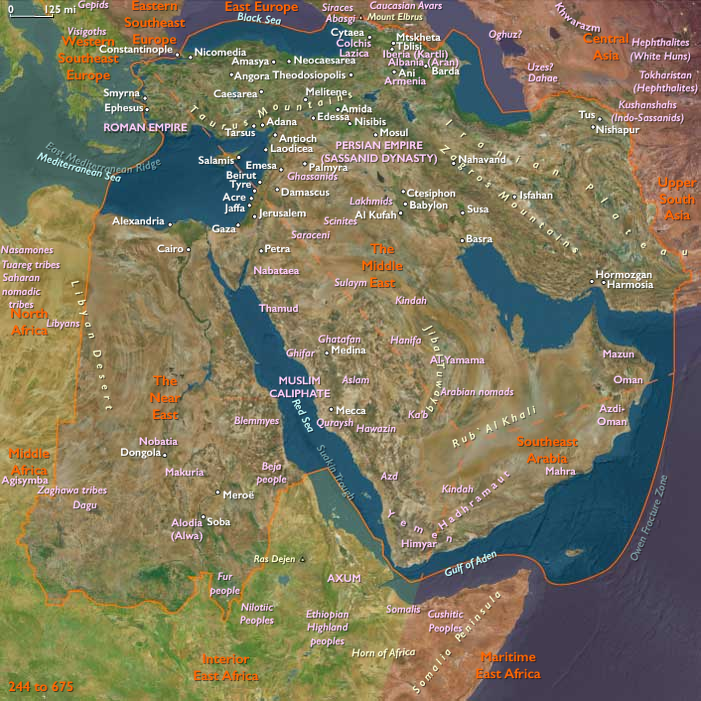
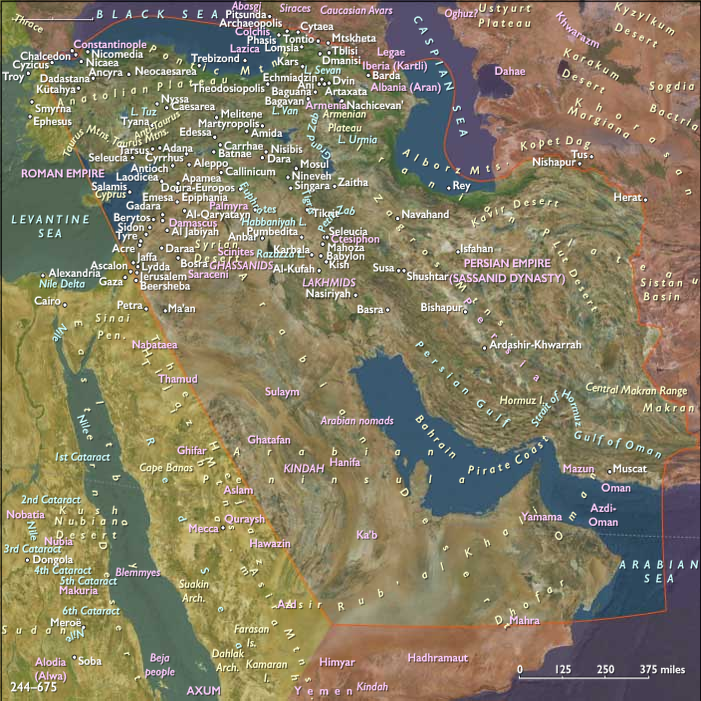
Muhammad had made Medina his first capital, and it was there that he dies.
Leadership of the faithful falls to Abu Bakr (632-34), Muhammad's father-in-law and the first of the four orthodox caliphs, or temporal leaders of the Muslims.
Umar follows him (634-44) and organizes the government of captured provinces.
The third caliph is Uthman (644-56), under whose administration the compilation of the Quran is accomplished.
Among the aspirants to the caliphate is Ali, Muhammad's cousin and son-in-law, whose supporters feel he should be the Prophet's successor.
Upon the murder of Uthman, Ali becomes caliph (656-61).
After a civil war with other aspirants to the caliphate, Ali moves his capital to Mesopotamia and is later assassinated at Al Kufah.
Ali's early followers establish the first of Islam's dissident sects, the Shias (from Shiat Ali, party of Ali).
Those who had accepted the successions before and after Ali remain the orthodox of Islam; they are called Sunnis—from the word sunna, meaning orthodox.
After Ali's murder in 661, Muawiyah—the governor of Syria during the early Arab conquests, a kinsman of Uthman, and a member of the Quraysh tribe of the Prophet—proclaims himself caliph and establishes the Umayyad caliphate with its capital at Damascus.
From here he conquers Muslim enemies to the east, south, and west and fights the imperial forces to the north.
Locations
People
Groups
- Semites
- Aramaeans
- Arab people
- Persian Empire, Sassanid, or Sasanid
- Christians, Miaphysite (Oriental Orthodox)
- Christianity, Chalcedonian
- Ghassan, Kingdom of
- Roman Empire, Eastern: Heraclian dynasty
- Islam
- Rashidun Caliphate
- Muslims, Sunni
- Umayyad Caliphate (Damascus)
- Muslims, Shi'a
Topics
- Muslim Conquest of the Levant
- Byzantine-Muslim War of 645-56
- Fitna, First, or First Islamic Civil War
Subjects
Regions
Subregions
Years: 532 - 675
Locations
People
Groups
- Semites
- Aramaeans
- Arab people
- Persian Empire, Sassanid, or Sasanid
- Christians, Miaphysite (Oriental Orthodox)
- Christianity, Chalcedonian
- Ghassan, Kingdom of
- Roman Empire, Eastern: Heraclian dynasty
- Islam
- Rashidun Caliphate
- Muslims, Sunni
- Umayyad Caliphate (Damascus)
- Muslims, Shi'a
Topics
- Muslim Conquest of the Levant
- Byzantine-Muslim War of 645-56
- Fitna, First, or First Islamic Civil War
Subjects
Regions
Subregions