
Muhammad and Khadijah have produced two sons, …
Years: 622 - 622
Muhammad and Khadijah have produced two sons, both of whom had died young, and four daughters.
The house of 'Abd al-Muttalib of the Banu Hashim clan of the Quraish tribe comprises a form of nobility in Mecca, based upon their hereditary duty to act as stewards and caretakers of the pilgrims coming to the city to worship at the Kaabah.
Muhammad’s criticism of the polytheism of the Meccan religion angers the merchants of Mecca, who reap large profits from pilgrims visiting such ancient pagan sanctuaries as the Black Stone, probably of meteoric origin, and a shrine for the pagan deities of the Arabs, which have come to be occupied by some hundreds of idols.
The idols represent many different tribes and as a result Mecca has became a center of pilgrimage, and the Kaabah's environs are an inviolable sanctuary.
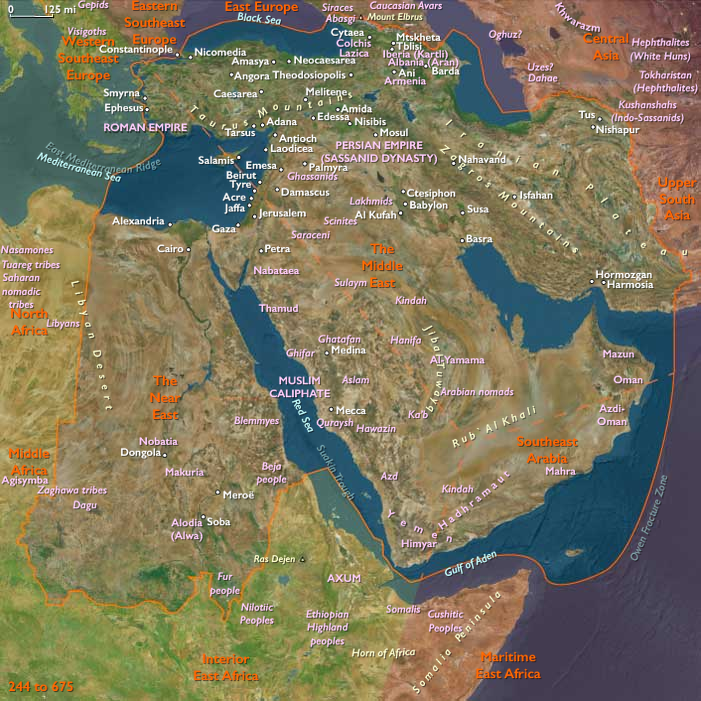
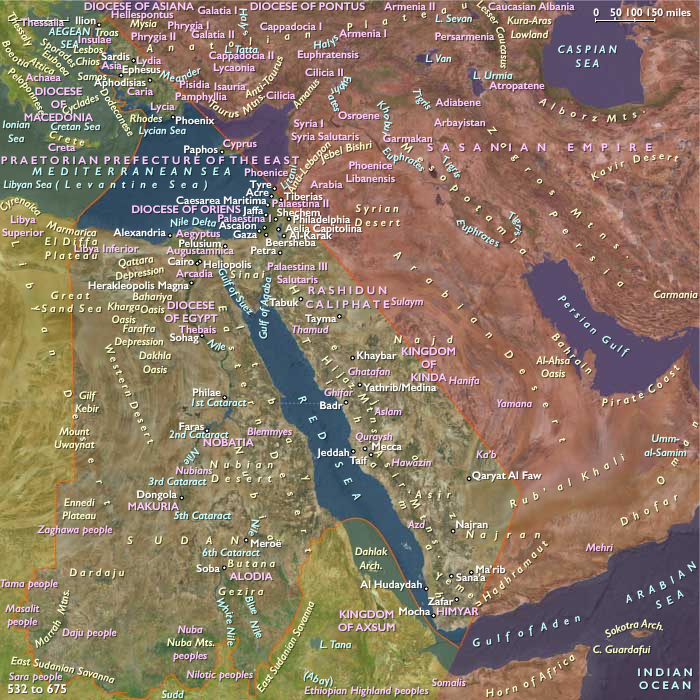
This pilgrimage traffic adds considerably to the wealth of the merchants of Mecca, which also benefits from its position astride the caravan routes from Yemen (Arabia Felix) up to the Mediterranean markets.
The Hashim clan to which Muhammad belongs becomes the target of a boycott by other Quraish, but the unpopular preacher is still protected by Abu Talib.
After Abu Talib’s death in 619, however, the new clan leader is unwilling to extend his protection to Muhammad, whose wife Khadijah dies around this time.
The Meccan elite now openly oppose him, harass his small group of dedicated followers, and plot to kill him.
Faced with this persecution and curtailed freedom to preach, Muhammad and about seventy followers decide to sever their ties of blood kinship in Mecca.
Locations
People
Groups
Topics
Commodoties
Subjects
Regions
Subregions
Years: 622 - 622
Locations
People
Groups
Topics
Commodoties
Subjects
Regions
Subregions