
Filters:
Charles leaves forty thousand troops under Rosenburg …
Years: 1809 - 1809
April
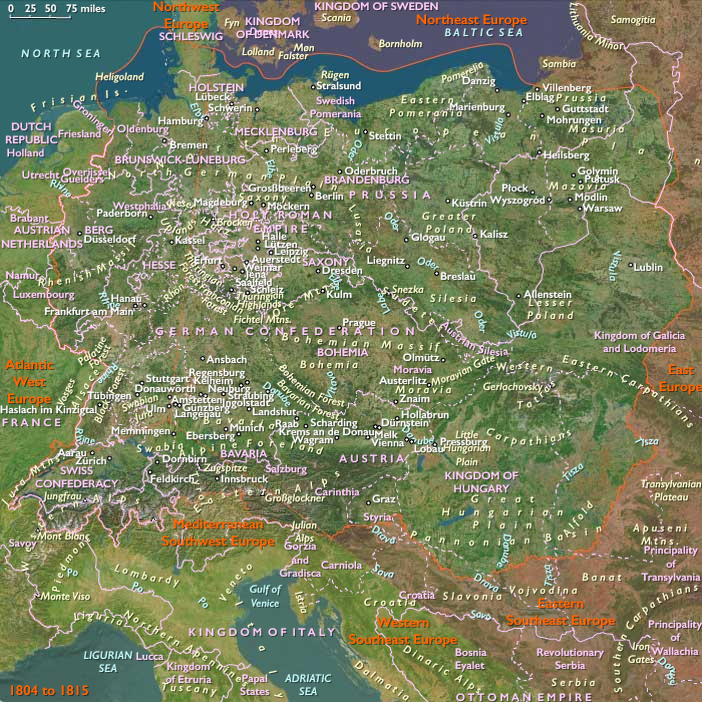
Charles leaves forty thousand troops under Rosenburg and Hohenzollern to attack Davout and Lefebvre
on April 22, while detaching two corps under Kollowrat and Lichtenstein to march for Abbach and gain undisputed control of the river bank.
At 1:30 pm, however, the sound of gunfire from the south can be heard—Napoleon has arrived.
Davout immediately orders an attack along the entire line despite numerical inferiority; the 10th Light Infantry Regiment successfully storms the village of Leuchling and goes on to capture the woods of Unter-Leuchling with horrific casualties.
Napoleon's reinforcements are soon crippling the Austrian left.
The Battle of Eckmühl ends in a convincing French victory, and Charles decides to withdraw over the Danube towards Regensburg.
on April 22, while detaching two corps under Kollowrat and Lichtenstein to march for Abbach and gain undisputed control of the river bank.
At 1:30 pm, however, the sound of gunfire from the south can be heard—Napoleon has arrived.
Davout immediately orders an attack along the entire line despite numerical inferiority; the 10th Light Infantry Regiment successfully storms the village of Leuchling and goes on to capture the woods of Unter-Leuchling with horrific casualties.
Napoleon's reinforcements are soon crippling the Austrian left.
The Battle of Eckmühl ends in a convincing French victory, and Charles decides to withdraw over the Danube towards Regensburg.
Locations
People
- André Masséna
- Archduke Charles of Austria, Duke of Teschen
- Francis II, Holy Roman Emperor
- François Joseph Lefebvre
- Frederick William III of Prussia
- Heinrich Friedrich Karl vom und zum Stein
- Jean Lannes
- Louis-Alexandre Berthier
- Louis-Nicolas Davout
- Napoleon
Groups
- Britain (United Kingdom of Great Britain and Ireland)
- France, (first) Empire of
- Austrian Empire
- Bavaria, Kingdom of
Topics
Subjects
Regions
Subregions
Years: 1809 - 1809
April
Locations
People
- André Masséna
- Archduke Charles of Austria, Duke of Teschen
- Francis II, Holy Roman Emperor
- François Joseph Lefebvre
- Frederick William III of Prussia
- Heinrich Friedrich Karl vom und zum Stein
- Jean Lannes
- Louis-Alexandre Berthier
- Louis-Nicolas Davout
- Napoleon
Groups
- Britain (United Kingdom of Great Britain and Ireland)
- France, (first) Empire of
- Austrian Empire
- Bavaria, Kingdom of
Topics
Subjects
Regions
Subregions