Nara’s Golden Hall of the Horyu-ji is …
Years: 607 - 607
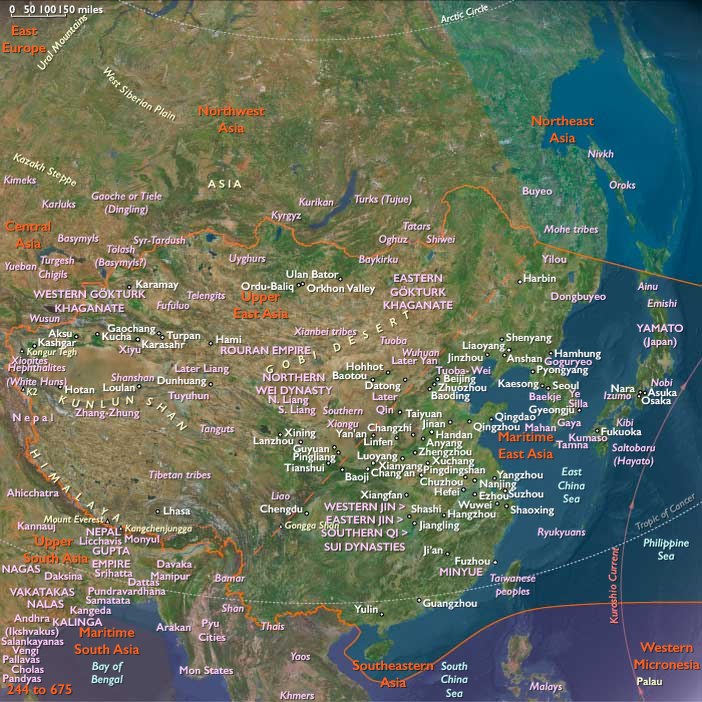
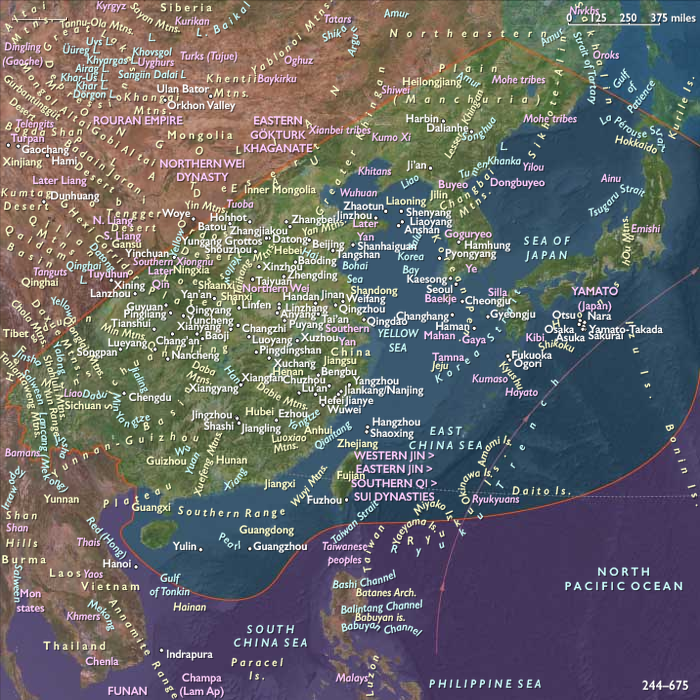
Nara’s Golden Hall of the Horyu-ji is completed in 607 as the shrine for two important images associated with Prince Shotoku (the oldest Buddhist temple in Japan, the Horyuji is also believed to be the world’s oldest surviving wooden structure).
Locations
People
Groups
Topics
Commodoties
Subjects
Regions
Subregions
Related Events
Filter results
Showing 10 events out of 57038 total
Ashina Rangan visits Emperor Yang at Luoyang in spring 607.
At the instigation of Yuwen Shu Emperor Yang has Yang Yong's eight sons put to death around the same time.
Emperor Yang abolishes provinces in summer 607 and changes them to prefectures.
At the same time, he reorganizes his father's governmental system of having five main bureaus, keeping four of the main bureaus—the executive bureau (Shangshu Sheng), the examination bureau (Menxia Sheng), the legislative bureau (Neishi Sheng), the archival bureau (Mishu Sheng)—while abolishing the eunuch bureau and replacing it with the palace bureau (Diannei Sheng).
He establishes three additional independent agencies and five independent departments.
He also organized the imperial army into sixteen corps.
He abolishes three levels of noble titles—the counts, the viscounts, and the barons—keeping only the princes, the dukes, and the marquesses.
Also in summer 607, Emperor Yang embarks on a tour of the northern provinces, building an imperial highway from Chang'an to …
…Jinyang (the capital of Bing Province).
He then personally visits the imperial tent of Ashina Rangan, whose display of submission and loyalty causes Emperor Yang to bestow much honor and wealth on him.
When the senior officials Gao Jiong, Yuwen Bi, and Heruo Bi privately express disapproval, Emperor Yang discovers their criticism and puts all of them to death, while removing Su Wei, who had also discouraged him from giving excessive rewards to Ashina Rangan, from his post. (Traditional historians attribute Gao's death to Gao's refusal to keep Chen Shubao's Consort Zhang alive in 589.)
As Xiao Cong has a deep friendship with Heruo Bi, and there have been rumors that the Xiaos will rise again, the superstitious Emperor Yang also removes Xiao Cong from his post.
Also in 607, at the instigation of Pei Ju, Emperor Yang reopens relations with the Western Regions, or Xiyu states.
Smbat is first mentioned some time in the 580s, when the emperor Maurice requested the Armenian nobles to raise cavalry for service in his wars against the Avars.
Smbat and Sahak Mamikonian led a thousand-strong unit each to Constantinople, where they were richly rewarded and sent home.
Sebeos also adds that Maurice supposedly adopted Smbat at this occasion.
In 589, however, Smbat led a rebellion against the Empire, was captured and sent to Constantinople, where he was condemned to death and was thrown to be devoured by the beasts in the Hippodrome of Constantinople.
He was pardoned at the last minute by Maurice, who then banished him to some "distant islands" and later to Africa.
Smbat returned from exile some time after, and entered the service of the Sasanian shah Khosrow II, who in 595 had appointed him marzban (military governor) of Hyrcania (the southern coastlands of the Caspian Sea).
Smbat had served in this post until 602, but was initially employed in suppressing the rebellion of Vistahm in Khorasan, before being recalled to reside at the royal court in Ctesiphon.
There he had received further honors, and been appointed Lesser Minister of Finance.
In about 607 ("the eighteenth year of Khosrow's reign") he is sent back to Armenia with extensive powers as "Commander of the army of the lords of houses".
His tenure in Armenia is short but productive.
Smbat receives the honorific title Khosrow Shun ("the Joy or Satisfaction of Khosrow") in the next year, and leads a campaign around this time on behalf of Khosrow against the Hephthalites.

Emperor Yang conscripts over a million men in spring 608 to construct the Yongji Canal, from the Yellow River to Zhuo Prefecture (roughly modern Beijing).
It is said that there were not enough men, and that he started conscripting women as well.
The Western Tujue khan (Ashina Rangan's western rival), the Heshana Khan Ashina Daman, whose mother was Han, submits to Sui as a vassal in 608 after persuasion by the Sui official Cui Junsu However, in the same year Emperor Yang receives a letter claiming to be from the King of Japan, Duolisibigu (now commonly believed to be Prince Shōtoku), stating, "The Son of Heaven where the sun rises, to the Son of Heaven where the son sets, may good health be with you."
Displeased by what he sees as insolence, he orders that in the future, "insolent" letters from other states not be submitted to him.
Also in 608, Emperor Yang's relationship with Yang Jian begins to deteriorate, initially over disputes over women (Yang Jian's having taken a concubine that Emperor Yang himself wanted) and hunting (Yang Jian's guards having been much more successful than Emperor Yang's guards at hunting).
He ordered investigations into Yang Jian's violation of laws, and discovers that Yang Jian had used witchcraft to curse Yang Zhao's three sons.
In anger, Emperor Yang executes and exiles a number of Yang Jian's associates, but he does not depose Yang Jian, although from this point on Yang Jian does not exert much influence on the political scene.
In 608 also, Pei Ju persuades the Tiele tribes to attack Tuyuhun, forcing Tuyuhun's Busabuo Khan Murong Fuyun to flee.
Murong Fuyun initially considers submitting to Sui, and Emperor Yang sends Yuwen with an army to welcome him.
However, when Murong Fuyun changes his mind, Yuwen attacks him and seizes much of Tuyuhun's populace.
When Murong Fuyun flees further, Emperor Yang has his forces seize Tuyuhun's territory, establishing four prefectures, to be populated with exiles.
The Jews of Antioch, upon receiving word of the imminent approach of the Persians, riot, killing the Christian patriarch in revenge for severe repression, thus facilitating the entrance of Persian troops into the city.
As a result, anti-Jewish pogroms break out in the Roman Empire from Syria to Asia Minor.
The Persians reach the Bosporus by 608, laying siege to Chalcedon.
The Western Turks, having lost the first war against Persia thirty years earlier, seek to change their fortunes while Persia is engaged fighting the Eastern Roman (Byzantine) Empire.
They invade eastern Persia with a large number of men, but are defeated in the first battle near the fort of Tus in Khorasan by a force of two thousand Savaran (elite heavy cavalry).
Having lost this battle, the Turks and Hephthalites request reinforcements from the Khagan.
Sebeos exaggerates that three hundred thousand troops were sent to reinforce the invading army.
This force soon overruns Khorasan, as well as the fort of Tus, with its three hundred defenders under prince Datoyan.
However, the Turks withdraw after their raids, which go as far as Isfahan.
Smbat IV Bagratuni quickly reorganizes the eastern Persian forces and finally crushes the Turks and Hephthalites, reportedly killing their leader in hand-to-hand combat.
After the death of their leader, which shatters troop morale, the Turks and Hephthalites retreat in a disorderly manner.
The Savaran pursue them, killing many.